
Spain Made With Love
Special | 55m 18sVideo has Closed Captions
Explore the wonders of classic Spanish craftsmanship in food, fashion, ceramics, jewelry and more.
Meet some of the country’s most gifted artisans and explore the wonders of classic Spanish craftsmanship in food, fashion, ceramics, jewelry and more. From the bustling streets of Madrid to the rugged countryside, discover many forms of creative expression — from embroidering flamenco dresses to crafting traditional Basque walking sticks to fine leather bags that last a lifetime.
Problems playing video? | Closed Captioning Feedback
Problems playing video? | Closed Captioning Feedback
Support provided by:

Spain Made With Love
Special | 55m 18sVideo has Closed Captions
Meet some of the country’s most gifted artisans and explore the wonders of classic Spanish craftsmanship in food, fashion, ceramics, jewelry and more. From the bustling streets of Madrid to the rugged countryside, discover many forms of creative expression — from embroidering flamenco dresses to crafting traditional Basque walking sticks to fine leather bags that last a lifetime.
Problems playing video? | Closed Captioning Feedback
Where to Watch Made With Love
Made With Love is available to stream on pbs.org and the PBS app.
Buy Now
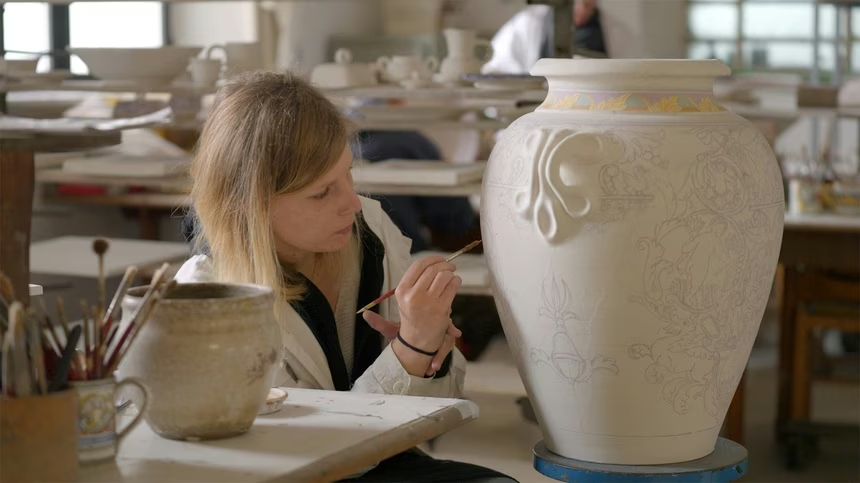
Made With Love
Made with Love celebrates the artisans keeping age-old traditions alive — an intimate journey into their workshops, kitchens, and the passionate hands behind extraordinary craft. Without them, a piece of our shared heritage would be lost.Providing Support for PBS.org
Learn Moreabout PBS online sponsorship[Waves crashing] ♪ Narrator: Spain... a place that's been shaped for centuries by diverse cultures... ♪ intense pride, and a deep well of creativity.
♪ Tengo mucha pasión por eso que hago, que defiendo algo que es nuestro, de nuestras raíces.
For us is... it's not only a job, yes?
It's more than a job.
Es parte nuestra.
Y es algo que es nuestro, que debemos defender, de cuidar y promocionar.
Narrator: Artisans here make music, food, and art that honors their epic history and puts a modern spin on ancient traditions.
Siempre tengo algo nuevo por... por crear o alguna idea nueva.
Nunca deja de sorprenderme.
Me gusta el proceso creativo.
Narrator: They are the leaders of a cultural revolution, unleashing their imagination, honor, and ambition to showcase the many faces of this nation.
♪ [Bells tolling] Seville.
This southern Spanish city is the capital of Andalusia.
♪ It's an area once controlled by the Moors, a group largely made up of Muslims who came here from North Africa.
Seville is known for its amazing architecture... ♪ spectacular festivals... ♪ and a very special kind of performance.
♪ Flamenco.
It's a mix of music and dance fueled by passion and creativity.
This uniquely Spanish artform produces a dazzling harmony of sound, style, and spectacle.
[Heavy footsteps] El flamenco es una pasión.
El flamenco es un verso, es una primavera.
Es cortejar a una mujer.
Es un sufrimiento, es cantar a una madre.
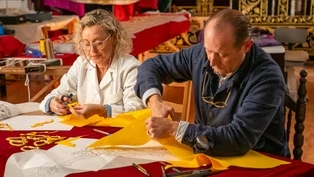
Soy Jesús Rosado, bordador de profesión, maestro artesano de Écija, Sevilla, por España y por la gracia de Dios.
Narrator: Jesús Rosado runs one of the most respected traditional embroidery workshops in Spain, and he's put his own spin on this symbol of Spanish style, the flamenco dress.
Es un legado histórico que ayudas a mantener y a engrandecer algo que tiene sus raíces aquí.
Narrator: Jesús first became interested in fashion and design as a teenager, but he wasn't sure how to learn the trade.
He got his start as an apprentice working in a clothing workshop at a convent.
Since then, his designs have been commissioned across Spain and beyond, including by legendary designers like Christian Dior.
Trabajar para ellos creo que es el máximo reconocimiento como artesano que uno puede tener.
Narrator: Whoever the client is, he's known for his classic styles, especially his flamenco dresses, a personal passion.
El flamenco es la forma de vida y parte cultural de gente que nos precedió.
Y es algo que es nuestro, que debemos defender, de cuidar y promocionar.
Narrator: The flamenco dress was inspired by loose robes worn by women working in the Andalusian countryside.
By the late 19th century, wealthier Spanish women had adopted the dresses.
As this colorful costume became more popular, flamenco dancers made it their signature attire, starting a tradition that continues to this day.
A single dress can take Jesús and his team about two months to finish.
It starts with a spark of imagination.
Cuando yo empiezo una... una obra, un diseño, ya lo he dibujado muchísimas veces antes en mi mente.
De esas varias ideas, voy plasmando.
Sobre la marcha, voy mezclando esas ideas que he tenido mentalmente hasta hacer la definitiva.
Narrator: When the drawing is done, he copies the design onto a piece of felt.
That's where his wife Pepa joins the process.
Él es el que hace todo el diseño de plantilla y dibujo, y luego pasa por mí.
Recorto lo que es la plantilla.
Y empezamos a preparar ya para pasarla al bastidor de la muselina.
Ahora mismo, córtala así y luego lo pegas.
Pero que el grosor... Son para las laterales, eso es.
En mediano, ¿no?
Sí.
Vale, perfecto.
Narrator: A team of expert stitchers handles the embroidery work, creating intricate patterns with gold thread.
Ahora tienes que ponerla en el... en el otro bastidor.
Y eso, las puntaditas así chiquitas, chiquitas, chiquitas, como tú... tú creas conveniente.
¿Te parece?
Perfecto.
Narrator: Small pieces of embroidery are then sewn into place on the dress.
Estoy muy contento con el resultado de este diseño.
Y creo que hemos acertado completamente.
Narrator: Finally, the ruffles are fixed, and the dress is tailored to fit the performer.
¿Vale?
Perfecto.
♪ Qué bien que saca el cuerpo, hija.
♪ Narrator: But a dress is never truly finished until it's tested on the dance floor.
♪ Bueno, yo creo que el trabajo es muy bueno y que la percha aun lo hace mejor.
♪ La verdad, que es una... que es una pieza que es una maravilla.
Parece un guante.
Y seguramente que me sentiré supercómoda con ella.
♪ ♪ [Cheering and applause] Narrator: In northern Spain lies San Sebastian... ♪ the cultural heart of what's known as Basque country... ♪ a region with a storied history, a strong culture, and a long tradition of hand weaving.
♪ It's an ancient craft, weaving thin pieces of materials like rattan to make chair seats.
The final product is rustic yet refined, but today, there are only a handful of chair makers in Spain still using these methods, which have been passed down for centuries.
I am Daniel Lizarralde.
I am chair weaver from San Sebastian.
Narrator: Daniel has been weaving seats for wooden chairs for more than 20 years.
He was first exposed to the craft thanks to his aunt, who was a nun at a school for the blind.
Girls and women there learned various crafts, including how to weave chair seats.
Well, it's something tricky because you think that they cannot make something without your eyes and they did it much, much better.
Narrator: One of those weavers, a student named Maria Jesús, became Daniel's mentor.
She is one of the few remaining experts in the classic 7-step method of weaving.
¿Y qué tal van las manos, María Jesús?
Bien.
¿Sí?
O sea que, si coges algunas sillas, se podría seguir haciendo algo, ¿no?
Sí.
¿Puedes más o menos explicar qué es lo que estás haciendo ahora?
La preparación.
Es la preparación.
Sí.
Narrator: Although Maria Jesús is blind, she's made thousands of chairs, using her sense of touch to help guide her.
Yo te he visto antes que te has puesto así el junco en los labios para saber... Para saber si es derecho o al revés.
Vale.
O sea que ese movimiento lo haces para saber cuál es la parte... Derecho.
Vale.
She was feeling it and, when she needs to feel it, she puts the material in the... in the lips.
I have always heard that, when one of your senses is lost, the others get better.
Narrator: Using the traditional 7-step method, pieces of cane are woven vertically and horizontallyf to create a square.
Then strips are crossed diagonally to make an octagon, a process that's repeated again and again.
Right now she is concentrated, she's just now fixing one line to the other.
Qué bien hablas inglés.
Daniel: Ha ha ha!
Daniel.
Bueno, no sé si hablo mejor inglés o tejo rejilla.
¿Cuál de las dos hago mejor?
Ah, no lo sé.
Yo, como no entiendo... No se hace difícil, ¿no, María Jesús?
No.
Esto ya lo has hecho... lo has hecho ya tantas veces.
Yo ya me acuerdo que hay trabajera más fino que esto.
Ah, más fino.
Sí.
Narrator: Daniel watches closely as Maria Jesús weaves.
Director: How about you, Daniel?
What's it like being next to María here and...?
Well, actually... You shouldn't... you shouldn't ask those questions.
[Sniffles] Um... Narrator: For Maria Jesús, this is not just another chair seat to weave.
This is her final project.
So it is really special when... when you have been... working in something for so long.
And probably this is the last chair she's going to weave, because I don't think she will be doing it again.
And then it becomes a really special moment.
And it's so, so nice that we can share this moment with all of you, because it's a way of giving thanks.
A pleasure to share with you and with her, her last chair probably.
Because she has given the... the tools, so, you know, she's not planning to weave it again.
Narrator: As one weaving career comes to an end, another begins.
Heh heh heh.
Está bien.
Entonces, mantienes ahí la curva.
Entonces, es... Un anforito.
Exacto.
Narrator: Daniel hopes to share everything Maria Jesús has taught him with Elena, an apprentice of his own.
María Jesús just gave me this little plastic bag.
It is the remaining tools that she was keeping to do her last jobs.
It feels like a responsibility.
You are given like the key of the craft.
So, this means that this has to be given to someone else.
Parece que la... lo que es el ratán está un poco seco, ¿no?
Ojo a este.
Este sí.
Obviously, Elena is going to be the one that will be receiving something like this from me.
Maybe she's ready in a couple of years to fly herself, and then we can give her all the tools to keep going.
♪ Narrator: Basque country is an integral part of Spain but also a world apart, a region with its own language, history, and customs.
♪ This is the makila, a unique kind of walking stick with a rich tradition here in Basque country.
Made from a special type of tree, crafted by hand, it's long been seen as a sign of nobility and power.
I am Beñat.
I am Saioa.
We are makila makers.
In the Basque country.
♪ [Snip] Narrator: Beñat and Saioa Alberdi are third-generation makila artisans.
They run one of the only workshops in Spain that still make these sturdy, handmade walking sticks in a place built by their grandfather.
He was a good wood carver.
And, at the beginning, he was doing, like... Beñat: Furniture, carver.. Saioa: Furniture.
And a Basque symbol, always connected with the Basque culture.
Always connected, yes, even to the furnitures.
Narrator: The origins of the makila are a mystery, but this carved walking stick has been made here for at least 300 years.
It was a status symbol, conveying justice and authority.
It was also practical-- used to cross open fields and hiding a secret.
If it doesn't have this, it's not the traditional one, yes?
That is that we have a hidden tip, yes?
It was as... as a defense, just in case.
Narrator: During the Spanish Civil War, Basque culture was under attack, and the art of making these walking sticks was almost lost.
Not only the makila, but also just... All Basque symbols.
Just speak the Basque, it was forbidden.
It was forbidden.
Narrator: Years later, their father Iñaki dedicated himself to learning about the makila and helped bring this symbol of Basque culture back to Spain.
Although they grew up watching him closely, these siblings soon headed off to pursue their own ambitions.
We realized when we went out and we work in another jobs and travel around the world that our fathers and our family was doing something really special.
Narrator: When his father finally retired, Beñat knew what he had to do-- take over the workshop.
My dad did it, so why not keep going?
So already 11 years, I took the decision and we are doing very well.
Narrator: Two years ago, Saioa also came back, and they've been working together ever since.
I love it, I love it.
It's, a ver, you have your good and your bad.
I mean, we know each other really well.
When he have a bad day, I can see him and I know that it's not the day to go and tell him a lot of things, you know.
I take my space.
I have to say the same.
The same.
Yes, I look at him.
I say, "No, today I'm going to leave it.
I'm going to say that tomorrow."
Yes?
Narrator: To make a makila, they use wood from the medlar tree, the only kind with the right mix of hardness and flexibility.
Before being cut, branches are marked, or tattooed, to get patterns like this.
Today, Beñat and Saioa's father comes out of retirement to help them straighten these branches.
It's a process that can take years.
[Iñaki speaking Basque] Narrator: Each walking stick also gets a metal tip covered in intricate patterns.
All the designs are hand engraved with Basque symbols.
All of them are Basque symbols.
We cannot decorate it in a different way.
The traditional makila must be doing this way.
Narrator: Before the makila is done, wax is applied to the wood to protect it.
My work here is like the last part of the manufacturing.
And I take my time to see if all is like it need to be, yes?
And I love it because it's after it's going to the client that it need to be perfect.
Narrator: Their finished makilas go out into the world, where they're given as gifts of love, friendship, and respect, traits reflected here in the Alberdi workshop.
For us is... it's not only a job, yes?
It's more than a job.
We trust each other and the business is easier.
And, also, it's a family business.
Yeah, it's not just a business.
It's more than that.
It's a family.
So, I think that we enjoy it.
We enjoy it.
Yeah.
[Seabirds crying] ♪ Narrator: Here in San Sebastian, seafood dishes are a staple like this modern take on hake in parsley sauce.
Ahora marcamos la merluza.
Esta merluza, le hemos quitado la piel nosotros y luego la hemos deshidratado.
Narrator: After the hake is seared, the plate is prepped with a touch of parsley, a bit of shellfish, and some parsley sauce.
♪ At last, the dish is ready to serve.
♪ ¿Qué tal está?
Muy bueno.
Narrator: The beret.
It's much more than just a round felt hat.
It can be a must-have accessory-- dashing, elegant, timeless.
Although the modern beret was born in the Basque region, for centuries, it's been worn across the globe by peasants, artists, and revolutionaries alike, and it never goes out of style.
Soy Ander Astigarraga.
Soy fabricante de boinas.
Llevo 33 años haciéndolas con mucho orgullo y porque encima... soy vasco.
♪ Narrator: Here at Boinas Elósegui, they've been making berets, or chapelas, for more than 160 years.
Sin duda nosotros hacemos las mejores boinas del mundo.
Las mejores chapelas del mundo.
Narrator: Incredibly, this company has been in the same family for 5 generations.
It's one of the only hatmakers in Europe that still makes berets under one roof from start to finish.
Somos una empresa con la ilusión y con el objetivo de que dure otras cinco generaciones más.
Entonces, debemos de aprovechar las tecnologías que hoy nos brinda toda la evolución industrial pero tenemos que mantener esa parte de la artesanía.
Narrator: In the 15th century, the modern beret took shape along the border of France and Spain.
It soon found a spiritual home here in Basque, where locals adopted this unique look and brought it around the world.
Y van a Estados Unidos, por ejemplo, a Sudamérica, a Argentina, a Uruguay.
Un vasco siempre llevaba una boina.
Y, cuando un nativo veía, decía: "Un vasco".
Un vasco.
Porque llevaba la boina.
La boina se quedó con el nombre de un vasco.
Y esto lo ha llevado la región del país vasco a todo el mundo y lo ha extendido.
Ha extendido el uso de la boina.
Narrator: So what does it take to make a beret?
Qué fácil, qué sencilla, ¿no?
Es una boina.
Pero una boina tiene una construcción muy difícil.
Tiene mucho trabajo de artesanía.
La boina es una única pieza.
No tiene costuras.
Es toda ella de una pieza.
Y hace que la fabricación de ellas tenga mucha dificultad.
Narrator: At Boinas Elósegui, the process starts with 100% pure wool, the highest quality they can find.
Una vez que tenemos la lana, hacemos un tricotado.
Hacemos un similar a un jersey.
Narrator: These baggy-looking wool hats are put into a machine to be felted.
El proceso del fieltrado es lo más crítico.
Ese momento es clave.
El pasar de un tricotado al fieltro.
La apariencia del fieltro, la finura, la suavidad, ese tacto.
Y el fieltro lo que hace es proteger del frío y de la lluvia.
Es una prenda muy antigua.
Narrator: Like the beret itself, the machinery here has been around a while.
They still use some of the same equipment from the company's early days.
Es una máquina que le tengo mucho cariño.
Yo y todos los demás, porque creo que es la más vieja de toda la fábrica.
Esta habrá hecho millones de boinas en los ciento y pico años que tiene, con lo cual, pues todos le tenemos muchísimo cariño.
La cuidamos.
Es una anciana, pero de buena calidad.
Narrator: After felting, the beret is dyed... placed into a mold... and put into an oven.
♪ When it comes out, it gets brushed... excess material is cut away... the lining and trim are added... and the label gets sewn in.
Y al final, pues presentamos una boina desde el comienzo de la compra de la lana hasta el producto final a lo largo de todo el mundo.
Narrator: Now all you have to do is put the beret on.
So what's the right way to wear it?
No hay una forma de llevar una boina.
Es muy curioso.
Tú te pones una visera y es fácil ponerte, ¿no?
La boina tiene más complejidad.
Hay que buscar la forma que cada uno pueda llevar, hacia un lado, hacia el frente, cubriéndose del sol o del frío.
Tiene muchas diferencias de ponérsela.
Nosotros, en el país vasco, la boina normalmente siempre la ponemos encajada atrás y echada para adelante.
Normalmente, siempre buscando un poco el cubrir un poco la visera, y muchos dicen que es porque también, pues, tapa un poco, camufla.
Narrator: The beret has lasted for many years, and this beret maker hopes it's still got a long life ahead.
Animo a todo el mundo que se ponga una boina.
Una chapela auténtica vasca.
Y verá cómo va feliz por el mundo.
♪ ♪ Narrator: Using natural dyes to make art.
It's an ancient technique for adding color with a very modern twist.
Flowers and plants are the raw materials, and the results are as vibrant as they are unpredictable.
Soy Flor, hago estampación botánica aquí en Euskadi.
♪ Narrator: Flor specializes in making bags and other accessories by printing on fabrics with all-natural materials.
Un poco es como pintar, seleccionar los colores que queremos que se plasmen en la tela.
Narrator: Natural plant dyes were used 4,000 years ago in Mesopotamia and ancient Egypt.
This coloring process was also popular across Europe during the Middle Ages.
Today, artists like Flor use colors from plants to put their own spin on this with eco-printing.
Creo que ese es un saber que está bien transmitir.
Una técnica que tiene muchísimo para ofrecer.
Y que no quiero que se pierda.
Narrator: The key ingredients for this coloring technique are collected in the wild.
No todas las plantas nos otorgan el mismo color.
Vengo con una idea y me encuentro con hojas de una forma que sé cómo funcionan y que igual ahí cambio la idea inicial y se transforma en otra pieza.
A veces son las mismas plantas las que te van diciendo qué hacer con ellas.
Y eternizarlas es como mi manera de agradecerla a la naturaleza.
♪ Narrator: She always starts with natural fibers like cotton or felt, and here's the fun part-- adding a pattern of her own design.
Es como pintar, pero pintar con plantas.
Ahora mismo todo esto lo estoy viendo en color.
Sé lo que me van a dar o intento saber lo que... lo que me van a dar.
La magia se... se revela después al final.
Narrator: She covers her creation with a cloth... ♪ then flattens and rolls it tightly.
♪ The fabric is cooked, helping the colors soak in.
Nature can be unpredictable, and she never really knows what the final product will look like until it's revealed.
Siempre, siempre, siempre me sorprendo.
♪ ♪ ♪ Narrator: With the eco-printing done, Flor knows exactly what she's going to do with this.
♪ Va a ser un bolso y va a ir con asas de cuero.
El diseño será como este que, dentro del estilo, es parecido, pero le cambié el fondo de color.
Narrator: Even after almost 20 years, she's still excited by her collaboration with Mother Nature.
Es un mundo tan infinito, tan... de tantas posibilidades que te otorga que al final siempre tienes algo para... para descubrir.
Y es esa libertad la que... la que me gusta.
♪ Narrator: In southern Spain lies Granada, the nation's last outpost of Moorish rule, and that influence can be felt all over this city and in its art.
♪ It's a craft known for its elegance and splendor.
You might even call it a kind of alchemy, turning ordinary ceramic objects into stunning works of art.
Soy Miguel Ruiz Jiménez, ceramista, alquimista, nacido en Granada.
Narrator: Miguel is an expert in Nasrid lustreware, a technique sometimes known as golden pottery.
Metal compounds are painted on enameled clay, then fired in the oven to make them shine.
Como cualquier otra artesanía o arte, tiene su particular proceso de realización, que eso le da un carácter y una dificultad añadida, y los resultados son, pues, realmente distintos.
His re-created pieces are treated like artifacts, carefully catalogued and internationally celebrated.
This one is modeled on an ancient relic from Granada's Alhambra museum.
Y, bueno, tiene una... una elegancia y una forma y un equilibrio fascinante, ¿no?
Narrator: This art form goes back centuries to the Muslims who once ruled southern Spain.
They helped Spain become a hub for golden pottery and inspired ceramic techniques across Europe.
In today's Spain, the art of making Nasrid ceramics was nearly lost until Miguel helped bring it back.
Restituyo piezas que están en los museos, pero también amplío la colección con piezas originales mías, ¿no?
Siguiendo las mismas pautas técnicas y decorativas, ¿no?
Narrator: After about 70 years of working with various kinds of ceramics, Miguel remains a student of his craft.
Cada hornada es una experiencia nueva.
Aprendo algo.
Me voy compenetrando con los materiales, con el proceso, con el fuego, ¿no?
Entonces, no termina nunca.
♪ ♪ Narrator: It's a type of woodworking that's been practiced here in Granada for centuries.
It takes an artistic eye, a high level of precision, and a deep knowledge of history.
Soy Jesús Molero, soy maestro artesano de la taracea en Granada.
Narrator: Marquetry is the art of assembling veneers from different materials to form intricate designs.
Jesús is a fourth-generation master of marquetry, specializing in custom-made furniture.
Una vez que me eligen el diseño que sea, tienes que hacer, dijéramos, el mueble en blanco, dijéramos en madera, ¿no?
Y después, una vez que lo tienes en madera, ya empezar a revestir, a enchapar, a hacer incrustaciones.
Narrator: The business was founded by Jesús' great-grandfather in 1888.
Since then, the Moleros have made pieces for palaces around the world and for several popes, too.
Now Jesús continues the family tradition with skills passed on by his father.
[Speaking Spanish] Narrator: For more than 40 years, his wife and business partner Maria Angeles has watched closely as he's perfected his craft.
Entonces, para mí es como una fuente de inspiración propia viendo a Jesús trabajar a diario.
Narrator: Today, Jesús is designing a new table.
Choosing the right wood is critical, using both lighter and darker pieces to provide contrast.
The design is sketched out on the wood, in this case the image of a leaf.
Se pinta a mano alzada y después ya, con bolígrafo, ¿eh?, ya se va perfilando hasta conseguir ya la perfección.
Narrator: Jesús fills in the outline of his design with an inlay, gluing on pieces of mother-of-pearl.
Then he cuts out the marquetry veneers.
♪ For him, it's like putting together an intricate puzzle with each piece designed to fit perfectly.
A form of wood inlay was brought to Spain by the Moors more than 1,000 years ago.
While marquetry has been popular here for centuries, Jesús is one of only a handful of artisans who still practice this ancient craft.
Jesús: Se puede decir que este tipo de trabajo que yo hago, de moviliario, ¿no?
Soy, quizá, único en el mundo.
Narrator: The process can take several days of painstaking work.
After the tabletop is done, a border is added, and everything gets a polish.
♪ María: Está bonita, está bonita.
¿Te parece?
Me gusta.
Perfecto.
♪ Narrator: About 200 miles north of Granada is Toledo, one of the oldest and most majestic cities in Spain.
It's full of grand structures that evoke its past as a power center during the Middle Ages.
One of the city's most iconic buildings is the Cathedral of Toledo.
In many ways, this medieval marvel looks just as it did almost 800 years ago due in large part to some of its devoted caretakers, its blacksmiths.
Juan Antonio: Soy Juan Antonio Sánchez, soy un herrero de Toledo, España.
♪ Narrator: Juan is a third-generation blacksmith, continuing a tradition started by his grandfather and carried on by his father.
He uses the skills they've passed on to him to help keep up this stunning cathedral.
Juan Antonio: En el caso de la Catedral de Toledo, nuestro principal trabajo es de conservación y de mantenimiento, y es muy atractivo el que su encargo más recurrente sea el conservar una rejería en su forma primitiva, como si estuviese recién hecha.
Narrator: This site has been a place of worship since the 6th century.
The cathedral that stands here today was built in the 13th century.
Various additions and repairs have been underway ever since.
♪ Juan Antonio: Estas puertas están hechas todas entre el siglo XII y el siglo XVIII, la mayor parte de ellas, y lo que tratamos es de conservarlas manteniendo, digamos, su singularidad primitiva.
Narrator: Sometimes, maintenance means being a locksmith, making new keys for these old doors.
Juan Antonio: Las llaves siguen haciéndose como en su primera vez en hierro, entonces conservamos todas las guardias que la cerradura original tiene para que esta llave sea capaz de abrir esa cerradura original y conservar todo el valor original de esta puerta, que no se vea alterado o que se altere lo más mínimo posible.
♪ Narrator: Today, Juan is making a candle holder for the cathedral, a new piece designed to blend right in with the old.
First, Juan chooses a piece of metal.
It gets heated in a red-hot forge so that he can begin to shape it.
♪ Juan Antonio: Lo que hemos hecho es poner sobre 1200 grados toda esta parte del metal para conseguir hacerlo girar sobre el mismo.
Narrator: He relies on classic tools to work the iron... ♪ but the most important tools of all are his own hands.
Juan Antonio: Esta mano es la fuerza y esta mano es el corazón y la cabeza.
♪ Narrator: After leaving the heat, the metal has to stay above 900 degrees Celsius, or it won't be pliable.
Working fast is key.
Juan Antonio: Va perdiendo temperatura muy rápido, 10, 15 segundos.
Narrator: Juan gradually hammers the metal into shape... but if he finds even a single mistake, he has to start over.
Juan Antonio: Digamos que problemas no tiene ninguno.
Lo único que cada golpe, pues tiene que ser certero porque volver a poner el hierro o dar marcha atrás prácticamente es imposible.
Entonces... Narrator: The finished candle holder is a modern antique, a perfect fit for the cathedral.
Siento la satisfacción de piezas que sé que van a durar mucho tiempo expuestas, que se las van a dar un valor y que en el sitio en el que están, pues mucha gente va a poder disfrutar de ellas.
♪ Narrator: Toledo is also the home of a more delicate form of metalwork, one that takes a bold imagination and a surgical touch.
It's known as damascening.
Soy Raquel de la Torre, soy amaquinadora y vivo en Toledo, España.
♪ Narrator: Making damascene jewelry is an ancient tradition with a softer metal like gold or silver inlaid in a harder one like steel.
Raquel practices this craft in a workshop she founded, working beside her brother Jesús.
Jesús: Cada artesano elige lo que quiere hacer.
Yo soy más tradicional.
Hago el trabajo más tradicionalmente.
Narrator: For Raquel, inspiration comes from the natural world.
A mí me gusta muchísimo la naturaleza.
También creo que todos los oficios artesanos surgen de ahí, de materiales nobles, de procesos orgánicos.
♪ Narrator: The name damascening comes from the city of Damascus, which was celebrated for its use of this technique.
Over time, the Egyptians, Greeks, and Romans all embraced this artform.
In the Middle Ages, the Moors brought it to Spain, where it was used to adorn everything from swords to dishes.
The intricate process involves preparing the steel... darkening it with a torch... ♪ then laying in a piece of gold or silver wire.
♪ Once the thread is hammered into place, Raquel hopes for just one thing.
Que me quede bien.
[Laughs] Que quede perfecto o lo más perfecto posible.
Narrator: Today, only a small number of artisans still practice this historic trade, and like Raquel and Jesús, they do it with love.
Queremos mantener el legado y bueno, y sobre todo aumentar la difusión del conocimiento hacia el oficio, que la gente lo conozca, que sepa lo que es, y en ese camino estamos.
[Laughs] ♪ ♪ Narrator: Just north of Toledo is Spain's capital city, Madrid.
It's the hub of all Spanish roads, as well as a mecca for some of this nation's most famous flavors.
Paella--it's more than just an iconic Spanish dish.
It's a cultural touchstone.
Pues hoy vamos a preparar una paella de marisco.
Narrator: Whatever the type of paella, it starts with the broth.
For this one, they use red pepper, garlic, parsley, and monkfish.
As the broth simmers, it's time to make the sofrito, a classic Spanish sauce that includes tomato and salt.
It adds flavor and texture.
♪ The broth gets strained... ♪ mixed with the sofrito... then heated in a paella pan... where rice is added.
Esto es mucha potencia, esto es mucho calor.
Narrator: At last, the paella is ready to serve.
♪ Mmm!
Riquísimo.
♪ Narrator: Weaving--it's one of the oldest and most celebrated traditions in the world, an act of creative transformation... but it can also be a form of personal expression, making elegant designs from the heart.
♪ I am Alicia Valle, an artisanal weaver from Madrid.
♪ Narrator: For years, Alicia was a scientist, who made textiles at night to help her relax.
Alicia: I started to learn something that implied using my hands.
And I discovered that helped me to stop thinking or to be stressed or something like that.
Narrator: After taking classes, Alicia became a dedicated amateur weaver.
Then she finally started selling what she made.
Alicia: I decided that I will try to live from my creations, my own creations.
Narrator: Her scarves, shawls, and more are all woven by hand on a traditional loom.
♪ A friend found it and we went for it.
Yeah, it's, it's great, and it's still working and very little fixing.
Narrator: Evidence of textile weaving can be traced back tens of thousands of years.
In Spain, this craft-- known as tejido-- was heavily impacted by the Moors, who brought new materials, techniques, and designs.
Alicia draws on both tradition and imagination, making products on demand for clients and for her catalogue.
Lately, I'm very much inspired by land, by rurality, and quiet life lived in villages, and the colors, natural colors.
I am weaving a piece that will be part of a series of different panels, and I am trying to draw with my loom kind of paths, kind of windows, kind of mountains.
Narrator: Her love for the outdoors is reflected in her use of all-natural fibers.
♪ And my favorite one is linen, and the second favorite is silk.
It's a marvelous material, very soft, very shiny.
Narrator: Whatever material she chooses, she weaves it with skill, dedication, and of course with love.
♪ Alicia: Cuando llegas y consigues lo que ese cliente o esa clienta quiere, eso es magnífico y dices: "Bien, aquí tengo que estar", "I have to be here."
Something like this.
♪ Narrator: From urban Madrid, it's about 300 miles back to the more rustic terrain of Andalusia, a region anchored by the city of Seville.
Leather has been used in this area by artisans for more than 1,000 years.
It's a cornerstone of design and fashion and an inspiration for one man's modern take on an ancient art.
Soy Javier Menacho, artesano del cuero, desde Sevilla.
Narrator: Today, Javier makes leather bags, but his journey started with a love of horses.
Yo en realidad quería ser jinete profesor de la Real Escuela Andaluza de Arte Ecuestre de Jerez.
No salió la cosa bien.
Narrator: He soon shifted his focus to making saddles, and that led him to explore what else he might create with leather.
Javier: Y bueno, pues empecé a investigar, a probar técnicas de trabajo, a fijarme mucho de los ateliers parisinos, en cómo hacían sus bolsos, técnicas de costuras y demás.
Narrator: Here in Spain, advanced leathermaking skills were brought by the Moors as early as the 8th century.
The heart of Spanish leatherworking was here in Andalusia.
Local craftspeople perfected a style known for its elegant, intricate patterns, which are still popular today.
♪ Javier designs leather bags with traditional Andalusian craftsmanship and a modern feel.
He starts by choosing a pattern and sketching out the design.
Javier: Una vez que lo tenemos ya correctamente trazado en el papel, lo pasamos al cartón.
Narrator: Then he selects a piece of high-quality, locally-sourced leather, which he tans with organic materials.
Javier: Estos cueros ofrecen una elasticidad magnífica y es un cuero para toda la vida.
Narrator: He cuts out the leather... ♪ and begins to stitch in the design.
Each stitch is individually sewn so that if one breaks the rest hold together.
Javier: Esta costura tradicionalmente se ha empleado en las sillas de montar de trabajo del campo de Andalucía.
Era una costura que amarraba todas las piezas de la silla.
Me di cuenta de que era una costura que podía dar mucho de qué hablar en un bolso.
Narrator: He applies glue and lights it up to help it dry faster, then secures the bag's edges.
♪ Pues este es el resultado, es el producto final.
Es una cartera de mano, más que nada para lucir en fiestas o eventos de noche.
Narrator: The finished bag is something that's unique to this place and the passion that fuels its artisans.
Javier: Igual que amamos nuestra forma de vivir, amamos nuestra forma de trabajar.
Y como yo digo, todo lo que se hace con amor, como eso no hay nada.
♪ ♪ Narrator: Sangria--this beloved cocktail is a staple of summertime fiestas both in Spain and around the world.
Las sangría es típica en Sevilla porque en España los días calurosos, con el vino, que es muy típico de aquí, es afrutado, pues es muy refrescante y la verdad que acompaña mucho en el verano.
Narrator: There are many ways to make sangria.
Here, they use a mix of liquor and fruit juice... and a splash of local Spanish wine, then finish it off with a garnish of pineapple, mint, and a cinnamon stick.
Aquí tenemos la sangría del Doña María.
♪ Narrator: Here in Seville, it's one of the biggest events of the year--Holy Week.
This annual countdown to Easter is a centuries-old festival, where religion comes to the streets.
Over the course of this 7-day ritual, people wearing traditional outfits and carrying handmade floats honor religion, tradition, and these amazing works of art.
The floats start out as wood, which get covered in gold to add a touch of splendor and majesty.
♪ Francisco: Entonces nosotros lo que nos dedicamos es a embellecer esa madera para que no vaya en madera, vaya ustero, queremos que luzca.
Soy Francisco Javier González, soy dorador de Sevilla, España.
Narrator: They use 23 3/4-carat gold.
It ranges in color from orange-- the most common shade-- to lemon yellow.
♪ Gilding these gold pasos is a unique trade, one practiced by talented artisans across southern Spain.
For Javier, it's a family business, one he learned from his father and is passing onto his son.
¿Qué pasa, mi niño?
¿Cómo lo llevas?
Narrator: After layers of plaster are applied, Francisco Javier Jr.
sands them down so gold can be put on.
For the younger gilder, this is more than a job.
It's a calling.
Francisco Jr.
:Pues yo soy la tercera generación ya, y yo pues lo he amado también desde chiquitito y aquí sigo.
Me encanta, es una pasión.
Narrator: Javier's wife Barbara handles a key part of the process.
She brushes off any excess particles... then uses a mix of water and alcohol to apply gold leaf.
♪ Y se pegaría, por ejemplo, aquí.
Con mucha paciencia.
Narrator: The Holy Week procession in Spain goes back to at least the 16th century.
It's celebrated in the week between Palm Sunday and Easter as people carry pasos through the street to remember the last week of Jesus' life.
Francisco: Son nuestros abuelos, bisabuelos, nuestros padres, nos han llevado desde chiquititos a ver esas procesiones.
Pues eso es lo que te emociona, y ahí es donde viene la explosión de emocionante.
Es mi vida, mi vida es esta y ya está.
Y yo me gusta el oficio, con el tiempo lo he amado más.
♪ Narrator: Spain is a cultural mosaic influenced by people from around the globe and shaped by the vision of artisans across generations.
Their spirit can be seen in works old and new, these Spanish creations that are made with love.
♪ ♪
Video has Closed Captions
Explore the wonders of classic Spanish craftsmanship in food, fashion, ceramics, jewelry and more. (30s)
Providing Support for PBS.org
Learn Moreabout PBS online sponsorship New Season
- Drama

Hugh Bonneville stars in a crime drama inspired by one of the largest robberies in British history.
 New Episode
- News and Public Affairs

Top journalists deliver compelling original analysis of the hour's headlines.
 New Episode
 New Season
 New Episode
 New Episode

 New Episode


Support for PBS provided by: