
Grant's Farm, Hour 3
Season 30 Episode 15 | 52m 26sVideo has Closed Captions
Catch a crop of ROADSHOW discoveries at scenic Grant’s Farm in St. Louis, Missouri. One thrift store
Catch a crop of ROADSHOW discoveries at Grant’s Farm, including a Cartier Art Deco Tutti Frutti clutch, ca. 1925, a Carl Kauba cowboy bronze, ca. 1900, and a Sumerian cuneiform tablet, ca. 2150 BCE. One find has a value of $30K -$100K!
Problems playing video? | Closed Captioning Feedback
Problems playing video? | Closed Captioning Feedback
Funding for ANTIQUES ROADSHOW is provided by American Cruise Lines and Ancestry. Additional funding is provided by public television viewers.
Support provided by:


Grant's Farm, Hour 3
Season 30 Episode 15 | 52m 26sVideo has Closed Captions
Catch a crop of ROADSHOW discoveries at Grant’s Farm, including a Cartier Art Deco Tutti Frutti clutch, ca. 1925, a Carl Kauba cowboy bronze, ca. 1900, and a Sumerian cuneiform tablet, ca. 2150 BCE. One find has a value of $30K -$100K!
Problems playing video? | Closed Captioning Feedback
Where to Watch Antiques Roadshow
Antiques Roadshow is available to stream on pbs.org and the PBS app.
Buy Now

ANTIQUES ROADSHOW's 2026 Production Tour
Enter now for a chance to win a pair of free tickets to one of the three stops on ANTIQUES ROADSHOW's 2026 Tour. Sweepstakes entry deadline is April 6.Providing Support for PBS.org
Learn Moreabout PBS online sponsorship♪ ♪ CORAL PEÑA: "Antiques Roadshow" has turned Grant's Farm into a vetting zoo for America's treasures.
These are all lost films.
We don't have any complete footage.
Ooh, I didn't realize that.
Thank you.
(chuckles) ♪ ♪ PEÑA: If you're wild about animals and antiques, "Roadshow's" stop at Grant's Farm in St.
Louis has just what you're looking for.
The 280-acre wildlife park has more than 900 animals on site from all over six continents.
And today, "Roadshow" is giving our thousands of curious human visitors something to squawk about.
Check it out.
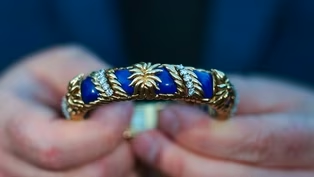
GUEST: So it's a bracelet that was my mother-in-law's.
She got it about 20 years ago, and gave it to me about eight years ago.
And where did she get it?
She got it at a yard sale.
My mother-in-law loved her yard sales and her flea markets and all things junk.
She saw this bracelet, and it spoke to her and she thought she needed it, even though she said it was too ugly for her to wear.
(chuckles) And what did she pay for it?
Uh, she paid a dollar for it.
My mother-in-law, we found out she was terminally ill, uh, in 2018, and so I was looking at the bracelet and I saw a marking on the back and so I just put the name in and I saw a "contact us."
And so it's a company I'm probably going to butcher-- Laykin et Cie.
And so I sent them an email, and they confirmed it.
Okay.
My husband says it could be like gold and some-- maybe some diamonds and lapis, maybe?
It is 18 karat gold.
It is lapis and diamonds... Oh, wow.
And it is by Laykin et Cie.
Okay.
And the company was founded in 1932 in Hollywood, California and they became very popular among the film elite in Hollywood.
And the name actually comes from a complaint from Gloria Swanson, that the Laykin Diamond Company just didn't have the right ring to it.
So they changed the name to Laykin et Cie.
This dates to the 1960s.
The bracelet is signed Laykin et Cie... And we can see the signature right back here.
And it's also marked "Made in France."
Nice.
And then, on the tongue here... We can also see... French hallmarks.
Oh, wow.
And the French hallmarks are for 18 karat gold and the diamonds are mounted in platinum.
It's a great thing for one dollar.
Yeah, one dollar.
So, the company is still in business.
I think if you went to go sell this at auction, I think someone would pay in the $15,000 to $20,000 range for it.
Oh, wow.
(laughs) It's, it's a really beautiful thing.
That's amazing.
Any other questions?
(chuckling): No, none.
I'm just surprised.
Good dollar.
(laughs) GUEST: She is my husband's great-grandma's doll.
And she sat around in a bedroom, scaring the kids for years.
And I took her home with me to use for Halloween.
And everybody's like, loved to hate her since.
She's happy to be here today.
(chuckles) If she is haunted, she's a pleasant spirit.
Well, it's a non-functional model replica of a traction engine.
If you don't know what that is, it's basically a steam-powered tractor that was used in like, the olden days, before gasoline powers and stuff.
PRODUCER: How much did you guys have to pay for it?
GUEST: $500.
(chuckling): Maybe too much.
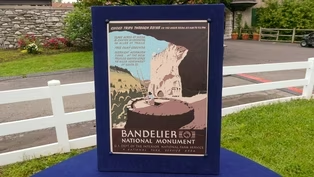
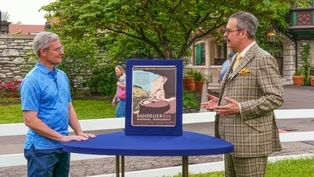
Well, I believe I brought you a placard or a poster on heavy card stock advertising, uh, Bandelier National Monument in the National Park System.
And it's a WPA poster.
My wife and I have visited, uh, northern New Mexico for years, 36 years.
Proposed to her there, uh, honeymoon there.
This piece happened to be in kind of a dirty corner of an antique mall.
It was covered with dust, New Mexico dust, just kind of struck a chord in my heart.
We paid $22 in 2024.
What you have here is a silk-screened poster.
You say placard, I would say poster.
It is printed on card.
As an archaeological site, it was the home to the, the Ancestral Puebloan people.
Just an incredible monument to the early peoples of America.
It dates from 1941.
The national parks were created in 1916.
In 1934, the WPA-- the Works Progress Administration-- designed the first series of posters promoting the national parks by, by an artist named Dorothy Waugh.
And then, in 1938, they began a second series promoting the parks, which ran from 1938 until 1941, at which point the Second World War broke out, and basically most of the artisan artisans were taken from the WPA workshops and put to work for the war effort.
At the very bottom here, it says "WPA CCC"-- the Civilian Conservation Corps.
And they were responsible for building the infrastructure in the national parks.
These were done in Berkeley, California, in the WPA workshop there.
They made 100.
When they were made, they cost $12 for every hundred.
So that's 12 cents each, was the price of these posters.
Because this is printed on card, a lot of times these were taken, they were cut into quarters and used as file dividers in national park offices.
(chuckling): I've heard that.
There are about six intact copies of this poster, all in public institutions.
This may be the last one privately held.
It's not one of the famous national parks.
And you know, they always say "location, location, location."
So, a Yosemite poster... Oh yeah.
...might fetch more money, but they're all so rare and they're all so collected.
My estimate on this, at auction, would be between $8,000 and $12,000.
That's surprising.
That's surprising.
I thought maybe $1,000.
Two of them were the Wind Cave and the Smoky Mountains.
There are no original copies that have yet to be found.
Well, it's a cuneiform tablet from Mesopotamia, came through the family.
So, all I know is family lore on it.
A great-uncle was a British officer in Iraq around the late 1800s, early 1900s... Oh, wow.
...and there was some insurrection that was going on, and family lore has it that he was stabbed to death, and then his stuff was sent back to England, and presumably this came with that.
Ah, okay.
I've lived and worked all over the Middle East, so I was quite aware of what it was.
I might know a little Arabic, but I don't know how to read cuneiform.
(chuckles) Cuneiform is one of the earliest, if not the earliest, writing systems.
What they did was they took clay and they pressed it with reeds to create these pictographs, and the language was born.
And because of cuneiform, small villages were able to advance in complexity into urban city states.
Probably it's around 2100 BC, 2200 BC, so making it over 4,000 years old.
It's written on all sides.
It's completely intact.
Y-you sometimes have these referred to as biscuits, because of their shape.
I actually did email a photograph of it to a colleague of mine... Yes?
...who's a scholar.
Yeah?
...and I do have an exact translation of it.
(laughs) It's an Ur III administrative tablet, dating to year nine of King Amar-Suen of Ur in the third month, and it accounts for barley rations to be ground into the goats and taken to the granary by the officials in Igi-Shara.
The transaction was conducted through Lugina.
Oh.
Which would've been the center.
Yeah, so, it's... (chuckles) ...it was in a beautiful little protective box.
Yeah.
And in the little box, I saw a card.
It helps us today, because that card had a date on it of 1916.
And today was the first time I've seen that.
It's a documentation that, that puts the collection history of this pre-UNESCO, which was where they protected all the cultural artifacts.
Yeah.
And also with all of the recent... turmoil in the Middle East, you know, there's been looting.
So, provenance for these items, it's-- it gets tricky.
But this is absolutely 100% safe in the marketplace because the little card is dated to the early part of the 20th century.
And I believe that little card was written by a Assyriologist at Yale University, Albert Clay.
Is that right?
He was a very early language expert.
Because of the great provenance, if I were to insure it, I would say $3,000.
Wow.
Wow, that's very interesting.
It's not for sale.
And now it'll be in the world cuneiform database.
STEVE BYRD: One unique thing about Grant's Farm is we also are the home of Grant's cabin.
So, this property was originally Frederick Dent's property, Grant's father-in-law.
So when Grant met Julia and they got married, Frederick Dent gave 80 acres of what is now Grant's Farm to them as a wedding gift.
It was built on the grounds, but not where it sits today.
It has moved a few times.
It served at one point as a coffee house at the 1904 World's Fair, which is actually where August Busch Sr.
found it.
August A. Busch Sr.
purchased the cabin and had it rebuilt here on its now home since 1907, Grant's Farm.
PEÑA: After it was built, President Grant's wife, Julia Dent Grant, called the cabin Hardscrabble, for its rough and simple appearance.
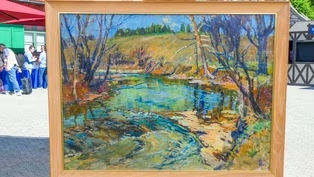
GUEST: So, about two years ago, my uncle passed away and this painting was in his house that he grew up in.
It was given to his mother, Rose Corrubia, for her wedding.
Her dad was Angelo B.M.
Corrubia, and he was a well-known architect in St.
Louis.
And he was friends with Tom Barnett, who's the artist of this painting.
And so now it's your painting.
Now it's my painting.
Tom Barnett was an architect and a painter.
First and foremost, he was an architect.
His father, George, was an architect of some renown.
Tom was born in 1870, and he started his own architecture firm-- Barnett, Haynes, Barnett-- with his brother and brother-in-law.
The firm did a lot of noteworthy buildings around town, including the Cathedral Basilica.
Later on in his career, he started painting.
He studied under Paul Cornoyer, who was a very well-respected artist.
The painting is oil on canvas and it's done in an American impressionist style, using very bold strokes of bright color.
And this painting, "The Rapids," was done in 1926.
Okay.
So, three years before he died.
So, it was at the height of his career.
Because he was so already established in architecture, there was a demand for his paintings, and he was quite talented as an artist.
He painted a mural for the State Capitol in Jefferson City.
His work is in permanent collections at the St.
Louis Art Museum, the Missouri History Museum, and also right here at Grant's Farm, in the collection of the Busch family.
Wow.
(laughs) So, it's, uh, kind of notable.
It's been hanging on a wall for 50 years.
It's really impressive due to its size.
And being in the auction business myself, and also from St.
Louis, I always get excited when I see a work by Tom Barnett.
It's not that often that you find his work.
This is a case where I think the value in St.
Louis would be greater than the value if you were to ship it to New York or California.
Easily, an auction estimate for this painting would be $5,000 to $7,000.
Wow.
(chuckles) That's awesome.
Yeah.
If you were to send it somewhere else, it might be around $2,500 to $3,500.
I'm gonna keep it at home.
GUEST: It's a Hassenforder safe.
It was handed down to my mother from her mother.
It was locked for many years and I had to have, um... an expert pick it.
PRODUCER: Was there anything inside?
Some antique opera glasses and some notes from the late 1800s.
You were rooting for diamonds.
Yeah, I was.
(laughing) No diamonds.
GUEST: My dad worked at McDonnell Douglas and he worked in aviation, and... he has a lot of the space memorabilia from when they first started.
And this was the sign that hung in McDonnell Douglas when they were creating all the space... uh, shuttle and everything.
They made airplanes, rocket ships, every type of aviation within St.
Louis.
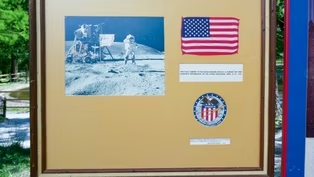
GUEST: I brought in a few of the many heirlooms that have been handed down from my grandmother and grandfather, who were parent to John Young, who is one of the astronauts in the program, well-known astronaut.
And he joined, uh, NASA in the second wave of the astronaut recruitment.
John Young, a well-known astronaut.
Gemini 3, which he was on, was the first crewed mission of the Gemini program.
Mm-hmm, mm-hmm.
And then Gemini 10... Mm-hmm.
...and then Apollo 10.
Mm.
He was commander of the command module, which made him the first person to orbit the moon by his lonesome.
(chuckling): So, pretty cool.
I didn't know that, yeah.
Yeah.
And then, Apollo 16, he became the ninth person to walk on the moon.
Right?
Yeah, that's very cool.
And here we have a picture of John Young jumping on the-- on the lunar surface... With the salute.
Right.
And then with a flown flag, a mission patch, and beta cloth-- a fireproof material.
And then, the crew were allowed to bring stuff.
Mm-hmm.
And they brought flags and insignias and things like that.
Sandwiches.
Sandwiches.
Space food.
(chuckles) And they were allowed to take those and have... as personal items that they could give out to friends and family, et cetera.
Mm, mm-hmm.
So, you have a flown flag with the emblem.
And in the world of space collecting, it kind of breaks down between those two camps: flown and not flown... Mm-hmm.
...because only a handful of things ever got it into space.
Yes.
So it's great.
You have a wonderful flown flag, and the beta cloth patch, which-- it doesn't designate it was flown.
Mm-hmm.
It might have been, but we're going to assume for sure at least the flag was flown, right.
Okay.
Okay, great.
Then he becomes the first, uh, pilot for STS-1.
Yeah.
STS stands for Space Transport System.
Yeah.
And STS-1 was really just kind of the "working out the bugs" flight.
It was only a two-man crew making sure that all the systems were working... Mm-hmm.
...and everything was going to go just fine.
Mm-hmm.
And there, you have a flown flag as well as mission patch and signed by John Young and his crew member, Bob or Robert Crippen.
Yeah.
Pretty cool.
John Young was actually the only astronaut to have been on the moon as well as a space shuttle pilot.
Yes.
So that's a pretty cool... Wow, yeah.
Whatever adhesive they were using... Yeah.
...for the flag is starting to turn a brown a little bit.
That needs to be looked at by a conservator at some point, but presumably it probably could be at least halted.
I like the STS-1 patch and flag.
And the condition issues hold me back from being a little bit aggressive, but I would say, at auction, we'd have something like a $1,500 to $2,500 auction estimate.
Oh.
If you had to insure it, easily in the $5,000 to $7,000 range.
Mm, okay.
The Apollo 16, you've got the flag and a wonderful beta cloth, uh, emblem.
I would say an auction estimate would be $3,000 to $5,000.
Oh, okay, okay, wonderful.
For insurance you could do as much as $10,000.
Okay.
Perfect, thank you.
Oh my gosh.
Well, they've always been-- he was such an inspiration to all of us.
And just to have these, this makes me feel... good about being able to display this kind of thing.
GUEST: They're... two chairs that my husband bought at a thrift store on the south side of St.
Louis in 1990.
And we are here to see if they're legitimately Harry Bertoia for Knoll-- that's what we're hoping.
Harry Bertoia was a great designer and even better artist, but he did make some iconic furniture designs, and he worked with the great manufacturers of the day, like Knoll.
I'm certain, without inspecting these too much, that these are Harry Bertoia chairs.
(gasping): Oh.
He made them... (laughs) ...in various sizes.
You know, there's child size, there's dining chairs.
The design is 1952, but they've been in production ever since.
They look relatively early.
They might be '60s or '70s.
At auction, a pair would probably sell for $300 to $500.
Nice.
Oh, perfect.
Thanks.
Thank you.
My-my dad spent $20 on 'em.
(laughing): Yeah.
So a good deal.
GUEST: It's painted by a Moroccan painter named Ahmed Yacoubi.
In, uh, 1965, uh, my parents, uh, met Ahmed and his fiancée, and they all got along.
My parents were invited in to New York, to his studio, and, uh, my parents saw this piece of work, and they fell in love with it and asked Ahmed if they would hold it for them.
He said $200.
(chuckles) $200.
$200 in 1965.
I think my parents were lucky if they made $2,000 that year... Wow.
So they must have really loved this piece of work.
Absolutely.
Yeah.
Uh, Ahmed called it a "Spell Against Evil."
And there is a human figure in there, and you can see the hands, casting spells.
But he didn't paint overt human figure at this time, because he was a practicing Muslim.
Ahmed was discovered, actually, by the writer Paul Bowles in Morocco.
And Paul Bowles's wife got him his first show... Oh.
...in Tangier.
He also met Francis Bacon, the great British realist painter.
And Bacon was a huge proponent of Ahmed's work.
The painting is oil on canvas, and he used layers and layers of glazes.
And then he used this richly surfaced dark, um, black paint, and kind of worked through the paint, scraping away, and in some areas, adding a little bit of lighter color, the orange and the yellow.
It is signed in a very distinctive way... (chuckling): Yeah.
With little polka dots on it.
His work comes on the market mostly in British sales.
Works of this size, um, sell very consistently in the auction market between $20,000 and $30,000.
Oh, my.
Wow.
Not bad for a $200 investment in 1965.
Wow.
I would insure it for closer to $40,000.
It's never going to be for sale.
I've known this painting my whole life.
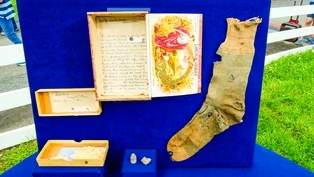
GUEST: This is my husband's grandfather's collection from the Civil War.
He wrote, in here, a, a letter.
It-- well, he was at the second battle of Memphis.
And these are the things that he had there.
His sock got soiled, so he washed it and hung it up.
The next day at like, 3:00 in the morning or something, they attacked.
The... rebels attacked and shot the tent up, and shot up the sock.
And this is hardtack that he had at the same time, and those were some of the bullets.
I wasn't expecting a sock to come in today... (laughs) ...that would catch my eye so much.
Right.
But this is a super special sock.
Yes.
So it happened in August of 1864.
Confederate General Nathan Bedford Forrest brought... Union soldiers, which were really Confederate soldiers dressed in Union blue, bringing in prisoners to the camp.
They were looking to get two Union generals captured and take their Confederate prisoners home with them.
They opened fire and surprised the Union with this attack at about 4:00 A.M.
The sock says it was hung at 3:00 A.M., because it was soiled and dirty, to dry on his tent.
Really basic, you know, two guys, one little tent as coverage, drying out his wet socks.
Well, I noticed on there, he said the boys called it a dog tent.
(laughs) They called it a pup tent or dog tent.
When the battle came in at 4:00 A.M., not long after he hung up the sock, they shot through the camps.
And that tent sustained 72 musket or bullet strikes.
It had 72 holes pierced in it.
Yeah.
And the letter attests that, and that's what we're looking at here, is the holes that the bullets caused to that sock.
Right, right.
So, the tent itself is provenance by that document as being taken and being sent by a captain to the governor of Illinois.
Yes.
He also picked up a piece of hardtack.
So, it wasn't necessarily his ration, but he was souvenir hunting, and he brought a piece of hardtack, which was the ration of the Civil War soldier.
Mm-hmm.
So, it was what they had to sustain them.
Not the most delicious food.
These are neat in the fact that it's a before and after.
So, they're Civil War lead bullets.
And this is an unfired or we call a drop bullet.
This is a fired example, that obviously hit something harder than itself.
You can see the striations from whatever it struck, some rifling within the grooves.
And you can see they're both what we call three-ring Union Minie balls.
So they were standard issue, and undoubtedly picked up on the same field, as the 137th Illinois was only in one engagement.
And this is a fired bullet, so that would attest to it belonged to the same battlefield as the other two objects.
Mm-hmm.
These passing through, you've got to imagine the scene of these soldiers leaving the camp and nearly losing their lives.
Um, 72 rounds.
72 of those is quite a few.
They left with a lot of arms, a lot of supplies, and about 500 Union prisoners.
Do you have any guesses as to their value?
No, I just know that probably most people didn't save their socks.
Sure.
Sure.
So it's probably rare.
Would you say you've ever heard of a sock being worth on the retail market $5,000 before?
No.
(laughs) Well, you have now.
Oh, my gosh.
Wow.
That's exciting.
(chuckles) Always wondered what happened to the other sock.
(both laugh) On insurance estimate, I would go a little higher to about the $6,000, $6,500 range.
Conservation efforts have always been a part of Grant's Farm, and mainly, the way we focus on conservation is through education.
PEÑA: Check out these large bovines with insulating and thick shaggy coats.
THOMAS: We have a population of yaks, a breeding group of, of yaks.
Right now, I think we have five or six.
They're found in the Himalayas.
They are capable of, of enduring very cold temperatures.
All these different species of bovine found from all over the world can cohabitate here and get along very well.
GUEST: This is a bronze that an aunt who lived in Arizona sent me.
Everyone got oil paintings, and she sent me the bronze.
I've always liked westerns, and I've seen beautiful bronzes that I liked.
The bronze is signed.
And then I certainly didn't see that... (chuckles) ...on the back.
It's very hard to see on the back here.
Right.
But it appears to say "Geschützt."
Geschützt?
(laughs) Geschützt.
Okay.
Which refers to a patent.
This name.
"C...
K-A-U-B-A."
And that is... Carl Kauba.
Kauba, okay.
So, Carl Kauba was an Austrian artist, lived from 1865 to 1922.
And this probably was cast right around the turn of the century, let's say, circa 1900.
What's interesting about Carl Kauba-- imagine somebody who may or may not have ever actually gone to the old West.
Right.
That's what's been said about Carl Kauba, because he is from Vienna.
Carl Kauba was fascinated by the American West.
Cowboys, Native Americans, Rough Riders... Right.
...and did a number of great naturalistic bronzes.
Very realistically rendered, like the one we have here.
The textures are particularly great.
The details in the back of the boots.
I noticed those, yes.
Really well done.
The fringe, yes.
And then we've got... the holster with a pistol.
And then we've got the rifle here.
He studied at the Academy of Fine Arts in Vienna, but his background is a little bit of a debate.
What's not debated is that sometimes you now hear his name in the same circles as artists like Frederic Remington... Uh-huh, right.
...an artist that we know spent a lot of time in the West.
It's on a marble base and naturalistically rendered with a variety of textures, great detail.
By an artist who today has become an Austrian artist, but synonymous with the American West.
We believe this is a lifetime casting by Kauba, as opposed to a bronze that would've been created posthumously.
And in its present condition, And given the strength of the market for Kauba and Western subjects, I would probably insure this for about $6,000.
Wow.
Wow, that is great.
(chuckles) But I don't want him to go anywhere.
(laughs) I don't want him to go anywhere either.
I think that's great.
It is a little porcelain hippo.
I got it at an antique mall a couple years ago and I've just loved it.
I burn incense out of it.
It says "1968 NS" on the bottom.
It was, like, five bucks.
I, like, kind of orphan things.
And this thing struck a nerve with me, so I bought it.
GUEST: It struck a nerve with me, too.
My wife, my wife is not a fan.
We call it the creepy kid.
I don't need another set of eyes following me around.
The eyes follow you when you walk past it.
GUEST: It was 1979, the American embassy in Tehran, Iran.
52 Americans were stripped of their freedom, their dignity and their pride, known as the Iran Hostage Crisis.
That lasted 444 days.
The Shah had fled in January of 1979.
The government of, uh, Islamic Republic of Iran was formed.
I arrived October 7.
When we were taken hostage.
I was a young 22-year-old kid.
My part at the American Embassy was a Marine security guard.
And I'm happy to say that for four hours that morning of November 4, seven Marines held that American Embassy, waiting for the host government, the Islamic Republic of Iran, to come to free us.
But that never happened.
They basically broke through the basement window and attacked the embassy.
President Carter at that point in time said, uh, to give ourself up, that, uh, they were going to work on diplomacy to basically free us.
Well, that lasted 444 days.
What was it like being a hostage?
The first 30-plus days, we sat tied to a chair and not allowed to speak.
It wasn't Until January of 1980 I was put into the room with Billy Gallegos, another Marine, and Jerry Plotkin, the only American civilian.
And in that room, we came up with something to do.
And that consisted of those, uh, playing cards that we created.
We were locked in that room-- we went outside seven times out of 444 days.
We were put into offices of the American Embassy.
And in the offices, there was a table with a typewriter.
The Islamic Republic of Iran, they wanted us to write derogatory statements to our government asking for the Shah to return.
Uh, instead, I took the paper, started typing my diary, which really helped me pass the time.
Within weeks, they took the typewriter away.
Then I just got the paper and I started writing the diary.
There was about 600 pages.
Every time I would move, I would put it in a plastic bag and tie it around my thigh.
January, uh, 20, 1981.
When we were let go, uh, that night, I had it in a plastic bag.
I took two socks, again, tied it around my thigh, and I didn't take it off my body until we got to Germany.
That's the first page when you had the typewriter?
Yes, sir.
That's the last page just before you put it around your leg.
Yes sir.
And you brought it out of the country.
Yes.
So we get to Germany and President Carter, he jumped on Air Force One and came over immediately to meet with us.
When did you get the signed picture and the note?
It was that year of November 1981.
Uh, he had presented each one of the hostages.
The note that Jimmy Carter sent?
Now, he was not president at the time, Reagan was president.
Yes, sir.
But can you read a little of that?
It "is a photograph of us together in Wiesbaden "the day after you were released from imprisonment.
"This was one of the happiest days of my life, and I wanted to share this memory with you in this way."
The two items of Jimmy Carter, usually, the more valuable items would be when they were president.
But the sentiment that he expresses by sending you that picture and saying, this is one of the happiest days of his life, I think easily an insurance value would be $5,000 on the pair of them.
(chuckling) You have four cards of the deck.
People collect cards, people collect P.O.W.
items.
So the cards, an insurance value, I would say would be $2,000.
Wow.
When people are looking for diaries, the reason they buy it, one, is because... ...the information in it is unknown.
In other words, it's something that can be studied.
It's bringing forth new information.
The other reason you buy it is it's a, a great item in and of itself.
It's a display piece-- you published a book.
From what I understand, the book is almost covering word-for-word.
Yes, sir.
So in a way that cuts what somebody might pay for it.
Right.
An insurance value, I think, is more on the $20,000 value.
Got it.
It's a priceless piece because it was really a way for me to survive each day and think of home.
GUEST: It's been passed down through the family since my grandmother and I've had possession of it since 1986.
You know the name.
Zark.
I think it's one of the nicer pieces of Zark I've ever seen.
Really?
The piece is marked "Zark," which is short for Ozark Pottery, which operated in St.
Louis here from 1906 to about 1910.
Locust Street-- I'm not sure where Locust Street is.
Yes.
Downtown, yes.
Downtown.
What's unusual about it is the naturalistic treatment of the dragonflies.
There's one, two, three dragonflies on here.
Right.
And you will note, also, besides saying "Zark" on the bottom, there are other initials.
That would be the artist who... Okay, the potter.
Yes-- or the person who did the decoration.
Okay.
This is a combination of incising and slip decoration.
I don't know who the artist is.
This brilliant blue may be more prevalent up here than you think.
I think you can use mild soap and warm water.
This might clean up quite a bit.
Okay.
Do you have a sense of value?
No, uh, pieces that I was looking at on the internet, I mean, on auction sale, anywhere from a couple of hundred up to a thousand.
I thought, no way would that be in that range.
Well, I think this is a better example.
Whoo!
And truthfully, talked to my colleagues.
We think a conservative auction estimate would easily be in the $1,500 to $2,500.
No, no, no, no, no.
Maybe $2,000 to $3,000.
Are you serious?
I am.
Oh, thank you, Irish gods.
I told you, I'm not Irish.
But I am!
(chuckling) Continue to take care, 'cause it's a... Oh, I will.
...it's a sweetie.
I love it.
I love it's squat, little body.
GUEST: I brought a picture that was done by Roy that worked for Walt Disney.
I was at Disneyland in 1958.
We were walking down the street.
I got the picture, and then we went for ice cream.
And we went inside the ice cream store, and the mother that I was with pointed and said, "There's Walt Disney."
So we walked over.
Introduced ourselves.
He was very nice, and he said, would you like me to autograph your pictures?
And that's what he did.
Okay.
And you were about how old then?
I was probably ten.
So you're 100% right, um, it's a drawing by Roy Williams, who was an early Disney illustrator, who is also a co-host of "The Mickey Mouse Club" in the '50s when it first went on air.
He's also credited with inventing the Mickey Mouse hat.
Signatures from Walt Disney are extremely prized.
We've looked at it, we think it's 100% right.
We've got a combination piece here.
So we've got the value of the drawing by Roy, who-- they are fairly common.
They do come up.
And then we've got the value of Disney.
So the value on the Roy drawing, if it was just this by itself, you're looking at $200 to $300.
You add the Disney on top, you're looking at $3,000 to $5,000 for this piece.
(laughs) Wow, that's something.
That is really something.
Thank you.
Uh, my aunt passed it to me when she passed away.
Right.
But it's been in my family for a very long time.
My grandparents were antique dealers back in Massachusetts.
The story goes that they... ...got this out of an estate sale that had certain items, uh, that belonged to John Quincy Adams.
And, uh, supposedly this desk was one of them.
That was probably in the '30s.
My understanding from what you've just said is that the Adams Family association is more family lore than f-firmly documented provenance.
Correct-- I just have the stories that we, uh, grew up with.
Okay.
Okay-- there are some characteristics of the desk that make it certainly plausible... Mm-hmm.
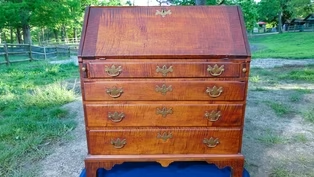
...in the sense that it is an American Chippendale desk in tiger maple or figured maple.
And it's from Massachusetts, mid-century, probably 1760-ish.
Okay.
One of the things I really love about this desk is the fact that it appears to be in virtually untouched condition.
But one of the things that really stands out from the-- for me-- for this desk is, is the fact that it has extraordinarily tall feet and highly-figured feet.
Hm... Lots of times they didn't use this super desirable wood on the feet, but in this case they did, and they are intact.
And the reason that feet break so frequently is that people grab this loper and pull it across the floor by themselves.
Then they have a repair on their hands.
I didn't even know that's what this was called.
A loper?
Loper.
L-O-P-E-R.
So why don't you pull that one out?
Okay.
And we'll take a look at the inside of the desk.
Okay.
And... again, classic Massachusetts slant-front desk-- some wear would be the ink stains, the patch here where the knot is.
Sure.
Patches here where the... Yeah.
...hinges broke out, because somebody... Okay.
...probably didn't pull the lopers out and the lid crashed down toward the floor.
And then it has this other very cool, very quintessentially Massachusetts treatment.
And that is what is normally a prospect door and, and hinge to, to swing as the door does.
This is a prospect panel.
And the only thing that holds it in place is the lock.
So it has two pins here at the bottom.
Yeah, or you can kind of... That go in-- exactly.
Mm-hmm.
Mm-hmm.
You can see where they've been dragged back and forth.
But if you just set it in place, it tends to fall forward on its own.
So you would use the key here to lock it and keep it in place.
Oh!
And it's easily lost and often replaced because it's not attached to the desk.
Oh... It was always in one of the drawers.
Taking the provenance aside and just looking at it as a... Mm-hmm.
...as a beautiful Massachusetts desk.
Okay.
And I would say that if it were to go to auction, I would put an estimate on it of $5,000 to $8,000.
I had no idea.
GUEST: This is Cora.
Her 40-inch bronze is at the Missouri Botanical Garden.
It was my grandmother's.
Then we learned that her name was Cora after I had my daughter, Cora.
So it's a special piece that's very close to our family and we enjoy hanging out with her.
My mom bought it at antique store.
They told her it was really old and it came from India.
Found out today it was manufactured probably in India, but within the last 50 years.
And it was made to look old.
I don't know if it was worth lugging it all the way in here, so.
Yeah.
Now we have to lug it all the way back out.
(laughing) (laughing): But it's okay.
GUEST: I know that it's, um, from a person named A. Paul Brooks.
I think he ended up in Shreveport, Louisiana, which is where I purchased these at an estate sale about three years ago.
I know that they're movie cards.
Uh, and he worked at an old movie house, he was on the art director there.
And how much did you pay for it?
A dollar.
Where do you keep these at the house?
Mm, so, currently, they stay between the wall and a piece of furniture.
Mm-hmm.
(laughter) Well... 'Cause I don't know what to do with them just yet.
So how do you know who the artist is and how'd you find out so much about him?
The front of the portfolio has his name, A. Paul Brooks.
And so I contacted someone that knew things about silent films... Mm-hmm.
...and gave him name and information.
And he sent me an obituary for the man.
Mm-hmm.
You brought in this great portfolio.
But I only chose a couple of pieces.
There are three up here, but there are five more in the portfolio.
I love silent era films.
And the interesting part about these is these are all hand-painted artwork, probably used in the lobby or in the, uh, front window to sell tickets to silent films.
And these date from about 1927 or so.
These are all lost films.
These are all silent films where we don't have any complete footage of the film.
Wow.
But these two aren't based off movie posters.
They're based off of the cover of a movie fan magazine from about 1919 to 1924 called "Shadowland" by a German fellow, A.M.
Hopfmuller.
And it was kind of an art and design and movie fanzine all-in-one ar-arts and culture magazine.
And these were the color covers.
This is a cover from, I believe, 1921.
"Wild Geese" is from 1919.
And this artist, A. Paul Brooks, copied the cover, but he did a better job.
There's more detail, a little more color, a little more life.
And he added this amazing text design.
Mm-hmm.
"The Land Where You Are Not."
It says "that dainty little star, Louise Brooks"... Mm-hmm.
...who was a fairly famous actress.
I can find the novel "The Land Where You Are Not," but we can't find the film.
Oh.
I don't know if the film was ever made.
There are records of the rights being sold for the book for a movie to be made.
But was this ever actually made into a film or was it ever released?
More research needs to be done-- these are by a really skilled hand and a unknown artist.
These are gouache on cardboard and the cardboard is, frankly, trash.
It is very thin.
Because these weren't supposed to last.
They were going to be up on the display for just a couple weeks.
Most of these in here, they're beautiful, they're all great.
And they would average at auction around $500 each.
Wow.
That's around $2,500 for the, for the portfolio.
Do you have any idea what the better pieces might be worth?
No, I would not have said $500 apiece for those.
(laughter) For each one of these, at auction, I'd be looking at around... ...$1,500 to $2,000 each.
Wow... Wow.
Well, they are gorgeous.
I-I've really enjoyed 'em and now I'm probably gonna have to take them out (laughing): from between the wall and the piece of furniture.
(laughing) For that one dollar investment in your portfolio, you're looking at $7,000 to $8,500.
Wow.
PEÑA: Of the hundreds of interesting animals at Grant's Farm, there are some feathered friends that refuse to be ignored.
Peafowl, the term used for both male and female birds, are originally from the Indian subcontinent.
These beautiful show-offs really do seem to be as proud as, well, peacocks.
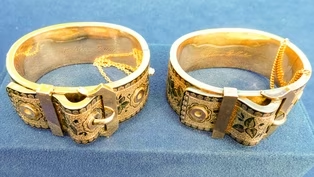
GUEST: These are my husband's grandfather's wife.
After three girls, she had her first boy.
And so the grandfather gave her those two bracelets.
And it goes back to 1890 is when she-- he had this first boy.
Who do we see in this photograph?
This is my husband's grandmother and grandfather.
So in the picture, my husband's grandmother is wearing the one bracelet on her arm.
The other one is probably behind his back, 'cause they wore two, one on each arm at the time.
I wear one now at a time.
Okay.
Just one.
Just... you know.
But, uh, I love them.
They are Victorian, they're big, they're beautiful.
This is black enamel that you have here.
Yeah, that's nice, isn't it?
It's beautiful.
And what I love, it's this kind of garter style, almost that belt style.
Yes.
And it makes them a bit modern.
Like, you could still wear these today, right?
Right, right.
Yes, I love 'em.
Yeah, they're, they're very, very chic.
And the fact that you have two, not one is... Right.
...al-also makes them a little bit more rare and even more desirable.
Right.
So I did weigh them and you have 50 grams of gold.
They're 14 karat yellow gold.
No hallmarks, though.
But they are 14 karat gold.
Also, this is-- I love this part of it, is that when you open them up, what's inside?
That's her name, that's his grandmother's name, Madelena Bollato.
Engraved inside.
If you had to walk into a retail store to purchase those today... Mm-hmm.
...it would be $10,000 for the pair.
(soft chuckle) Whoo!
I didn't realize that.
Thank you.
(laughs) Tell us what you brought in today to share with our viewers.
Two pieces of Golden Venture prison art.
Golden Venture was a ship that was bringing immigrants in and it ran aground in New York.
I think a few drowned and the rest were taken to different detention centers to be held until it was decided if they would be deported or if they would be granted entry into the country.
You bought these when?
We were thinking about ten years ago at an auction in York, Pennsylvania, which is where many of them were held.
Well, this was a very, very well-known and controversial news story.
Uh, the Golden Venture was a ship that started out in China and was holding 286 Chinese dissidents.
Mm-hmm.
In 1993, the ship ran aground 300 yards from shore, right off of Fort Tilburg.
There was panic.
It was 2:00 in the morning, it was pitch dark, and a lot of them jumped overboard.
Ten of them drowned and a few of them actually got away, never to be seen again.
What we're talking about today revolves around the dissidents that were sent to York, Pennsylvania prison.
And they were held there for various amounts of time while their cases were determined and what they're going to do with these prisoners.
Around 50 remained in prison, and finally in 1997, were ordered to be released by President Clinton.
These pieces of the Golden Venture were done at the prison, and they were done for two reasons.
Number one, these people were very proud and they were done to raise some money to pay for their legal expenses.
They were also done to prevent boredom.
There was no glue.
It was strictly folded paper.
Reports are that they made upward of about 10,000 pieces.
Oh, my gosh, I had no idea.
Yeah, very, very interesting.
Bowls, baskets-- later on, they did much larger pieces.
Mm-hmm.
And I'll share something with you.
I still have eight pieces.
Do you?
I do.
And they're very meaningful to me.
Mm-hmm.
We keep one of them on our mantle as a reminder of this, this journey, this plight... Mm-hmm.
...of these dissidents.
Some of them had violated the one-child law and, uh, they were scheduled to be sterilized.
Okay.
So they were seeking asylum, uh, for those reasons.
And it became a real political football.
Mm-hmm.
This hard surface, what they did is they used soap and water and they made almost like a mâché out of toilet paper.
Okay.
(laughing): Okay, good to know.
And soap and water, and they allowed it to dry out and harden.
And you can see, printing on there... Mm-hmm.
...because they cut up magazines and newspapers to do this.
Mm-hmm.
And you also see the ghost image of what used to be on there.
A label-- all of mine have labels on it.
They had the names of the prisoners who made them.
Yes.
My husband removed it.
Yes, they all were named.
The other one was underneath.
So what did you pay for them?
No more than $20 each.
We don't see them come up that often.
I do see them trade from time to time, and typically, they're in the $300 to $400 range.
Okay.
So they're, they're innocent numbers, but the story... But they're interesting.
...is so profound.
And are you going to keep these?
Oh, yes, we have them displayed.
This one's in our bedroom all the time and this one's in our living room.
GUEST: So this was my, uh, grandparents' clock.
It sat on their mantle for years, and then when they passed, they handed it down to me.
According to them, it was their grandparents' clock.
PRODUCER: And you want to see if that adds up?
I want to do the math, yeah, yeah.
We'll see if the math makes sense.
I've been trying to get tickets for years and I finally got drawn, so we're about from Iowa, so we just drove on down here.
GUEST: I've got a, uh, 1969 Gibson Hummingbird.
My dad acquired it in the early to mid-90s.
He was in country bands in Northern Virginia.
He had given it to my grandfather and then my grandfather gave it to me.
GUEST: I just picked it up in a thrift store, and liked it, and thought it was pretty.
APPRAISER: Can you tell me when you got this?
Probably 2018 or '19.
It's an absolutely exquisite Art Deco purse.
This is a lovely little giardinetto decoration on the front.
"Giardinetto" actually means "little garden" in Italian and it's constructed in platinum, gorgeous carved rock crystal, rubies, emeralds, sapphires and old European cut diamonds.
This style in the Art Deco period would be known as Tutti Frutti.
And it was made really popular by a specific maker, Cartier.
So right when you brought this to the table, I immediately thought to myself, is that Cartier?
Fortunately, because the piece is sewn on to the front and we can't see the back of it to see how it's marked.
When I opened up the bag, I saw here that it's signed Cartier.
While we can't say for certain without flipping it over and seeing the reverse, I believe it's probably Cartier France.
Do you remember what you paid for this?
$1.50.
And do you have any idea of what you think it's worth?
I was, I was hoping maybe $2,000 or $3,000.
Conservatively in an auction situation today, it's worth about $35,000.
And that's fair market value.
Wow.
That's something.
Sorry.
No, it's wonderful.
You're an expert looker, and a wonderful picker, and you have an incredible eye to be able to spot this.
Thank you.
Um, insurance would easily be over $100,000.
Ooh whee.
Wow.
Wow, it was worth the trip.
It's been so much fun, I've had, we've just been treated like royalty and I just feel so welcomed.
Oh, I'm so glad.
I'm so happy for you.
It's been so hard not telling you for the last three hours.
(chuckles) (sniffles) Wow.
Phew!
PEÑA: And now it's time for the "Roadshow" Feedback Booth.
So we, uh, brought in a meteorite, but it turns out it's not actually a meteorite, darn it.
I'm still happy, though, even though it's just a rock, because I got to miss a day of school.
She was the doll that was placed on the stairway so that the toddlers wouldn't crawl on the stairs when I was growing up, so we were all terrified of her.
But, uh, the appraiser today just fell in love with Hannah.
So happy to be here at the "Antiques Roadshow."
Got a bag of Big Little comics and they're worth $20 each.
And I paid $25 for the whole bag, so I think I scored.
Found out that my grandparents' uh, beer stein and clock were both from the 1890s.
Beer stein's more for function than fashion.
(chuckle) Worth $100 and this clock was worth about $700.
Had a great time.
Love "Antiques Roadshow."
(chuckle) I brought my grandfather's hand-painted chess set from the 1970s.
Um, they're not beautiful, um, and they're worth nothing.
So, but it was a lot of fun.
And I brought this, uh, memorabilia from the Chicago World's Fair and it is also not worth anything.
But we've been watching "Antiques Roadshow" since we were kids and so it was really great to be here.
We had a lot of fun.
Yep, we love "Antiques Roadshow."
(laughs) PEÑA: Thanks for watching.
See you next time on "Antiques Roadshow."
Appraisal: 1864 Civil War Collection
Video has Closed Captions
Clip: S30 Ep15 | 3m 15s | Appraisal: 1864 Civil War Collection (3m 15s)
Appraisal: 1926 Tom Barnett "The Rapids" Oil
Video has Closed Captions
Clip: S30 Ep15 | 2m 36s | Appraisal: 1926 Tom Barnett "The Rapids" Oil (2m 36s)
Appraisal: 1941 Bandelier National Monument Poster
Video has Closed Captions
Clip: S30 Ep15 | 2m 48s | Appraisal: 1941 Bandelier National Monument Poster (2m 48s)
Appraisal: 1943 Hamilton Model 22 Chronometer
Video has Closed Captions
Clip: S30 Ep15 | 1m 4s | Appraisal: 1943 Hamilton Model 22 Chronometer (1m 4s)
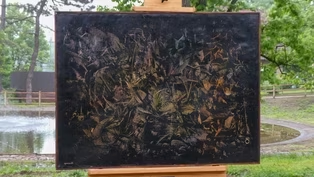
Appraisal: 1962 Ahmed Yacoubi "A Spell Against Evil" Oil
Video has Closed Captions
Clip: S30 Ep15 | 2m 18s | Appraisal: 1962 Ahmed Yacoubi "A Spell Against Evil" Oil (2m 18s)
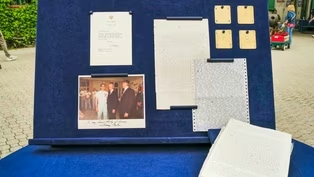
Appraisal: 1979 - 1981 Iran Hostage Archive
Video has Closed Captions
Clip: S30 Ep15 | 4m 24s | Appraisal: 1979 - 1981 Iran Hostage Archive (4m 24s)
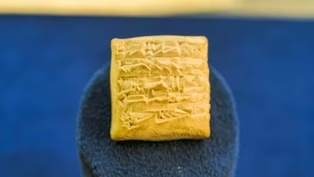
Appraisal: 2038 BCE Sumerian Cuneiform Tablet
Video has Closed Captions
Clip: S30 Ep15 | 2m 55s | Appraisal: 2038 BCE Sumerian Cuneiform Tablet (2m 55s)
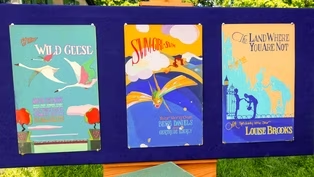
Appraisal: A. Paul Brooks Silent Film Art, ca. 1927
Video has Closed Captions
Clip: S30 Ep15 | 3m 21s | Appraisal: A. Paul Brooks Silent Film Art, ca. 1927 (3m 21s)
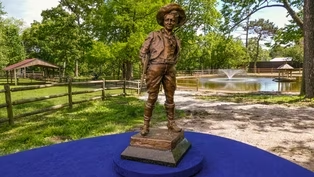
Appraisal: Carl Kauba Cowboy Bronze, ca. 1900
Video has Closed Captions
Clip: S30 Ep15 | 2m 53s | Appraisal: Carl Kauba Cowboy Bronze, ca. 1900 (2m 53s)
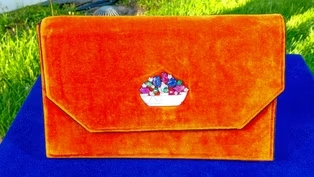
Appraisal: Cartier Art Deco Tutti Frutti Clutch, ca. 1925
Video has Closed Captions
Clip: S30 Ep15 | 2m 21s | Appraisal: Cartier Art Deco Tutti Frutti Clutch, ca. 1925 (2m 21s)
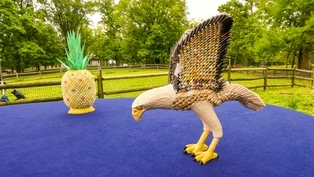
Appraisal: Golden Venture Paper Sculptures, ca. 1995
Video has Closed Captions
Clip: S30 Ep15 | 3m 42s | Appraisal: Golden Venture Paper Sculptures, ca. 1995 (3m 42s)
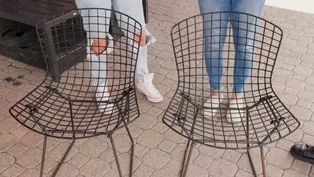
Appraisal: Harry Bertoia for Knoll Chairs, ca. 1970
Video has Closed Captions
Clip: S30 Ep15 | 1m 16s | Appraisal: Harry Bertoia for Knoll Chairs, ca. 1970 (1m 16s)
Appraisal: John Young Apollo 16 & STS-1 Group
Video has Closed Captions
Clip: S30 Ep15 | 3m 25s | Appraisal: John Young Apollo 16 & STS-1 Group (3m 25s)
Appraisal: Laykin et Cie Gold, Lapis & Diamond Bracelet, ca. 1960
Video has Closed Captions
Clip: S30 Ep15 | 2m 15s | Appraisal: Laykin et Cie Gold, Lapis & Diamond Bracelet, ca. 1960 (2m 15s)
Appraisal: Massachusetts Chippendale Slant-front Desk, ca. 1765
Video has Closed Captions
Clip: S30 Ep15 | 3m 2s | Appraisal: Massachusetts Chippendale Slant-front Desk, ca. 1765 (3m 2s)
Appraisal: Victorian Gold & Enamel Bangles, ca. 1890
Video has Closed Captions
Clip: S30 Ep15 | 1m 55s | Appraisal: Victorian Gold & Enamel Bangles, ca. 1890 (1m 55s)
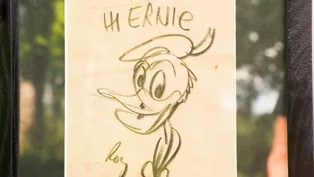
Appraisal: Walt Disney-signed Roy Williams Drawing, ca. 1958
Video has Closed Captions
Clip: S30 Ep15 | 1m 29s | Appraisal: Walt Disney-signed Roy Williams Drawing, ca. 1958 (1m 29s)
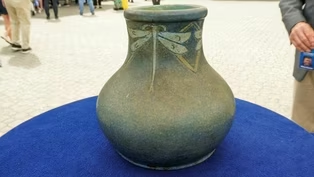
Appraisal: Zark Pottery Vase, ca.1910
Video has Closed Captions
Clip: S30 Ep15 | 1m 57s | Appraisal: Zark Pottery Vase, ca.1910 (1m 57s)
Video has Closed Captions
Preview: S30 Ep15 | 30s | Catch a crop of ROADSHOW discoveries at scenic Grant’s Farm in St. Louis, Missouri. (30s)
Providing Support for PBS.org
Learn Moreabout PBS online sponsorship New Episode
- Home and How To

Hit the road in a classic car for a tour through Great Britain with two antiques experts.
 New Episode
 New Episode

 New Episode







Support for PBS provided by:
Funding for ANTIQUES ROADSHOW is provided by American Cruise Lines and Ancestry. Additional funding is provided by public television viewers.