
PBS Wisconsin Music & Arts
Through the years with John DeMain
Clip: Special | 5m 15sVideo has Closed Captions
Maestro DeMain reflects on 32 years leading the Madison Symphony as he passes the baton.
Maestro John DeMain leads his final concert as music director, a role he held for 32 years, before becoming the orchestra's music director emeritus. He recounts opening a closed orchestra to blind auditions, and the gift of more than $200 million from Jerome Frautschi that built Overture Hall.
Problems playing video? | Closed Captioning Feedback
Problems playing video? | Closed Captioning Feedback
PBS Wisconsin Music & Arts is a local public television program presented by PBS Wisconsin
PBS Wisconsin Music & Arts
Through the years with John DeMain
Clip: Special | 5m 15sVideo has Closed Captions
Maestro John DeMain leads his final concert as music director, a role he held for 32 years, before becoming the orchestra's music director emeritus. He recounts opening a closed orchestra to blind auditions, and the gift of more than $200 million from Jerome Frautschi that built Overture Hall.
Problems playing video? | Closed Captioning Feedback
Where to Watch PBS Wisconsin Music & Arts
PBS Wisconsin Music & Arts is available to stream on pbs.org and the PBS app.
- John DeMain: I just have been so fortunate in my life to work with phenomenally talented people.
The privilege of just rolling up your sleeves every day, going into a rehearsal room, and just working on the art collectively.
I love this job, and who wouldn't?
I started out actually with the St.
Paul Chamber Orchestra professionally, and then I got sidetracked to Houston.
I was 18 years at Houston Grand Opera and had a fantastic time.
But I always loved orchestral conducting and I thought I could be good at it.
If you have a life as a guest conductor, you can't make a difference.
But if you invest in a community, you can make a difference over the time.
And that's what I hoped I would be able to do.
So, I was able to come into Madison and see what we were doing and what we were not doing.
For example, we weren't doing a matinee.
Here we are 32 years later, it's our biggest audience.
So, I started that.
What I didn't know when I arrived was that when Roland took this from an unpaid community orchestra to a paid orchestra back in the 1960s, he invited the heads of the department at the University of Wisconsin to be the principal players in the orchestra.
So, they never auditioned to play.
For me, that was a closed shop, and I blew it open.
One, two, four, and.
We started blind auditions.
Oh, my God, did things change.
You don't get into the orchestra now unless you're really phenomenal.
This is not a full-time orchestra.
This is a fully paid orchestra.
Every time it sits down, it's paid, but it's not full time.
But they fall in love with the city and they find a way to live here and work here, which is really great.
It was a little touch and go when I first came here because the acoustical problems were monumental.
And what are you gonna say?
"Don't come to the symphony 'cause it'll sound like crap."
In 1985, when they opened the Oscar Meyer, which was a refurbished Capitol Theater, they didn't really change it in the sense of what its acoustical problems were.
How I found this out, there was a young people's concert and I wasn't conducting it, and I came to hear it.
And I sat underneath the balcony where there were 900 seats.
And the orchestra sounded like the worst high school orchestra you ever heard in your life.
I mean, awful.
And if anybody sat underneath there, they would never come again.
During the same piece, I went upstairs to the mezzanine and to the upstairs.
And it sounded like Carnegie Hall.
I learned pretty early on that a woman by the name of Pleasant Rowland, who was married to Jerome Frautschi, they demonstrated their interest in being philanthropists for the arts.
And Pleasant, of course, created the American Girl doll.
And then she sold it to Mattel, and Jerry was co-investor with her.
And then Jerry, he gave us the money.
Over $200 million, the largest philanthropical gift ever in, you know, the arts to build Overture Hall.
And I think he saw the possibility of what that could do for downtown, and indeed it did.
Now, we had a hall that had a real acoustical shell.
It had a real acoustical environment that was designed to have great acoustics from the beginning to the end.
I mean, it's beautiful.
And Pleasant wanted it to be high end.
She wanted you to walk in there and feel the beauty of natural wood.
And she gave us the gift of the Overture concert organ, which is a magnificent 4,000-pipe organ.
I sort of had the idea for this weekend because I remembered way back when Overture Hall opened, the open house that Jerry stood in the doorway and welcomed people off the streets, and I thought, you know, we should do that.
You know, Overture Center is our home where we play, and we should just invite people in, and then we bring together the community with all different kinds of music.
It's my last concert as music director, but it's not my last concert because, you know, the orchestra was very nice to name me music director emeritus.
You know, as conductors get older, we don't mind giving up all the planning and the administrative duties and the auditions and all that kind of stuff, and we just want to make music.
And so, I'm glad that that's what I'm doing next year with the symphony is making some music, 'cause that's the most fun.
One, two, three.
[orchestral music] Since I was 14 years old, I have been conducting almost every day of my life.
So, to not do that anymore, it's gonna be different, and it might be hard, but the thing is, most of us who conduct, we play an instrument, and we can have a personal relationship with music, you know, and I love that so much.
I could sit here and play for hours if I wasn't studying, you know, for my next symphony concert.
I'd get out some Chopin and try to work my fingers, you know.
So, I think I'll be just fine.
[rousing orchestral music]
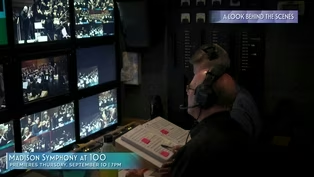
Behind the Scenes: Madison Symphony at 100
Cue the lights. Madison Symphony's 100 year anniversary performance is coming soon. (15s)
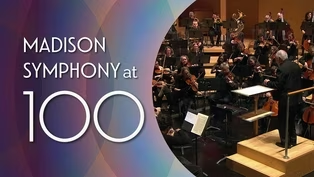
Video has Closed Captions
Madison Symphony Orchestra performs Mars, Venus, Mercury and Jupiter from "The Planets." (29m 19s)
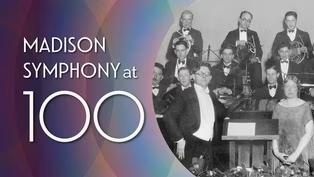
Video has Closed Captions
Executive Director Robert Reed on what reaching 100 years means for the Madison Symphony. (3m 49s)

Preview - Madison Symphony at 100
John DeMain leads a performance of classics celebrating Madison Symphony's 100 years. (15s)
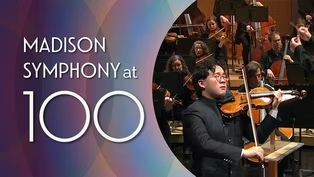
Video has Closed Captions
Guest violin soloist Julian Rhee performs with the orchestra in their centennial concert. (9m 24s)
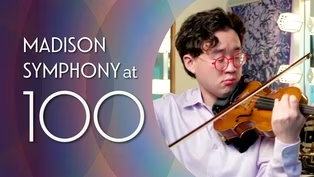
Wisconsin violinist Julian Rhee returns
Video has Closed Captions
Violinist Julian Rhee returns to the orchestra where he first played at age 11. (5m 31s)
Providing Support for PBS.org
Learn Moreabout PBS online sponsorship New Episode
 New Episode
- Arts and Music

Innovative musicians from every genre perform live in the longest-running music series.


 New Episode




 New Episode
 New Episode
 New Episode

Support for PBS provided by:
PBS Wisconsin Music & Arts is a local public television program presented by PBS Wisconsin