
Neurodiversity and the Sandwich Generation
Season 2026 Episode 2 | 26m 46sVideo has Closed Captions
Nelson family; Ask the Experts; Difference Maker Rebecca Tarrant.
Meet the Nelsons, whose neurodivergent nuclear family exploded into a larger collective when Nana moved in. Experts share strategies for navigating sandwich generation issues, while Difference Maker Rebecca Tarrant aims to create a more inclusive world for neurodivergent kids like her son.
Problems playing video? | Closed Captioning Feedback
Problems playing video? | Closed Captioning Feedback
A World of Difference is a local public television program presented by WUCF
Neurodiversity and the Sandwich Generation
Season 2026 Episode 2 | 26m 46sVideo has Closed Captions
Meet the Nelsons, whose neurodivergent nuclear family exploded into a larger collective when Nana moved in. Experts share strategies for navigating sandwich generation issues, while Difference Maker Rebecca Tarrant aims to create a more inclusive world for neurodivergent kids like her son.
Problems playing video? | Closed Captioning Feedback
Where to Watch A World of Difference
A World of Difference is available to stream on pbs.org and the PBS app.
Providing Support for PBS.org
Learn Moreabout PBS online sponsorship(upbeat music) >>Welcome to A World of Difference: Embracing Neurodiversity.
I'm Darryl Owens.
Even in the best of circumstances, real life family life rarely resembles the picture perfect Norman Rockwell portraits of the 1950s sitcoms.
Raising neurodivergent children who think and learn differently adds a heightened level of complexity for moms and dads.
And for parents who find themselves adding their own parents into that family circle, that complexity and stress can ratchet up several notches, leaving them feeling sandwiched.
One side of the sandwich may be neurodivergent children who need advocacy, structure, therapies, educational support, and co-regulation.
The other may be aging parents who need transportation, medical coordination, financial assistance, or increasing physical care.
While those responsibilities may not disappear, relief and functionality can grow as families build capacity, expand supports, and embrace an important truth.
Being responsible for people is different from being solely responsible for them.
On this episode of A World of Difference, we meet a Georgia family navigating life at the intersection of neurodiversity and multi-generational caregiving, when Nana moves in and family routine shift.
Our panel of national experts share strategies for surviving the sandwich generation years without losing yourself in the process.
And later, we'll meet a North Carolina mother with autism who is building a more inclusive future for neurodivergent kids like her son.
First, we head to Stone Mountain, Georgia, where the Nelson family is learning that when Nana joins the household, everyone has to make room for change.
(soft music) >>I try to wake up early and do at least like 30 minutes of cleaning around the kitchen, dining room, the main areas.
And then at 6:30, I wake up pairs.
So I lie on Count Basie's, "Shake, Rattle and Roll", I put that on in the morning to wake her up.
And then I go to the room and tell her that it's time to wake up and she usually says, "No."
And then I say, "Yes," and she says no.
And then I leave out and come back in and say, "It's time to get up," and then she gets up.
That is our routine.
I am the parent to two autistic children.
I am myself autistic, I also have ADHD, I have OCD.
I have sensory processing disorder.
I have PTSD from being a veteran in the military.
And I am a certified positive discipline educator.
And lastly, I'm a disability advocate.
Then we have to, I have to help her with brushing her teeth, washing her face, and then making sure that she gets some type of somatic movement.
And then every morning, yes, every morning, not just for you guys and the cameras, I put her on my back and carry her to the bus.
I wake Ms.
Riley up.
She is always concerned about the clothes being comfortable in her body because she's a sensory avoider.
So we have to make sure no tags.
We have to make sure there are no seams.
She has to eat breakfast, make sure she has on her glasses.
And then I have my two nieces who live with me as well.
Alani and Ava, and they are my darlings too.
Then I or my sister usually drive Ava to school.
And then the girls here, Lonnie and Riley both have to ride the bus, and their bus comes at eight o'clock.
>>Bye, mom.
>>And then I have to do some type of workout.
So sometimes it's yoga, sometimes I run.
I also lift weights and start checking in on my mom.
And we're like, "You got to keep moving, especially as you get older, you want to keep... I'm not saying you should go and lift weights like me, but you want to be active if you want to do things."
I realized that I was in the sandwich generation, particularly when we had a crisis after crisis happening, right?
>>I am Natasha Nelson's mother.
She saying that I was stressed about to be deemed the executor of my father's estate.
>>My mom was having an issue with the probate and we had to go to Marietta, which is in Cobb County, because that's where her estate issues and things are happening.
And then as that was happening, I got a call from Paris' school saying, "Hey, Paris isn't having the best day, I need you to come and pick her up."
And I'm in Marietta, I'm in Kennesaw, and I'm calling my husband and I'm like, "Hey."
And then I was like, "We have a lot going on."
>>And she said that I was overstressed, so she told me to come and live with her and her family.
Well, I got here and it was different.
It was different, to say the least.
I mean, they're my family.
I mean, I love all my family, but I love my grandbabies to death.
I say, Paris, she's wonderful, she's a great kid.
But she's off to herself a lot.
Sometimes she'll come wake me up and I have to go to work in the next morning and she'll come and wake me up and I'm like, "Oh my God, baby, please just please go," you know?
I love them and I love it here.
It's been great, but it's been also challenging at times.
It tests your patience and your resilience.
>>When I say that my mom lives with me, I'll get people who will have this coming of, "Oh, I couldn't do it.
It couldn't be me."
I think the hardest part was me being okay with being different.
But eventually I realized, no, I need to run us like the army.
That works for me, I know how to do that, I was a NCO.
I know how to run soldiers, I can make y'all soldiers.
But what I mean by that is we have to have family meetings.
There is a morning and evening meeting.
You'll see us all doing the activity together.
And when we're doing the activity, we're joking, we're laughing, but we're also like, "Hey, I have this appointment tomorrow."
"Hey, I need a ride here, I got work tomorrow."
Talking about those challenges, talking openly about them, having suggestions together, problem solving together, those things had to happen.
>>She just brought me through everything.
I mean, anything, anything and everything.
Anything that I need, she does.
I don't know how she do it, I really don't.
>>I'm really bad about protecting my bandwidth and mental health.
If someone needs help, I want to help them.
I have friends and family, and that's honestly where they step in.
And that sounds so awful, but I'm trying to be as honest and transparent as possible.
A big part of that is my husband.
>>My son-in-law has been great, he's awesome.
He has been great with them kids, he is awesome.
He is, I mean, he is... I don't see how she would do it without him.
>>I think it's important to note that a lot of times people don't want to live in multi-generational households because there are, people call it generational curses, generational trauma.
There's just things that the older generation did that new generation maybe doesn't want to bring into their household, right?
And I would challenge you that that's a part of the process.
It is a challenge.
Like I remember our first argument, but standing my ground, I think that was in a pivotal important step that wouldn't have happened if she didn't live here.
And so I think sometimes that we get so stuck in this bubble of progress and change that we don't want to be challenged.
But challenge is good.
It helps us to hone our message and our advocacy.
What allows us to all be neurodivergent but still function in this world is really having community and all working together to make it happen, so... >>Next, our expert panel dives deeper into the dynamics, challenges, and survival strategies that can help families thrive during the sandwich generation years without feeling like they're trying to live on half a loaf.
(chiming music) Dr.
Gilbert Franco is a licensed marriage and family therapist, organizational psychologist, and professor at Beacon College in Leesburg, Florida.
With more than two decades of experience, he helps individuals, couples, and families navigate life transitions, burnout, relationships, and resilience while preparing the next generation of mental health professionals.
Gabrielle Juliano Villani is a licensed clinical social worker, speaker, educator, and consultant specializing in neurodivergent affirming care, caregiver wellbeing, burnout prevention, and support for older adults.
A national presenter and former practice owner, she helps families and professionals better understand the connection between caregiving, mental health, and the nervous system.
Alisha Simpson-Watt is a licensed clinical social worker, board certified behavior analyst, and founder of Collaborative ABA Services, and the author of the children's book, "It's Okay, Maddie: A Story About Autism, Big Feelings and Learning to Cope".
She has extensive experience supporting autistic individuals, people with developmental disabilities, and their families through clinical practice, school systems, and community partnerships.
And we're going to begin our conversation with Dr.
Franco.
Many parents of neurodivergent children already feel stretched thin.
When an aging parent suddenly needs care as well, how can families identify which needs are truly urgent and which can wait without feeling guilty?
>>Thank you, thank you.
So when you are caught in the sandwich generation squeeze, survival depends on moving from a mindset of crisis management to triage.
To separate the urgent from the non-urgent, look into the two core areas; immediate physical safety and irreversible regression.
If an aging parent is at risk to themselves today, or if a neurodivergent child is in acute distress, those are the non-negotiables.
On the other hand, everything else, from specialized tutoring to routine household chores, those can be safely paused and delegated.
As for the guilt, remember that guilt is an alarm system telling you that your resources are running thin, and that these resources are mismatched with the reality.
It's not proof that you cannot... That you're not doing anything good.
It's just telling you that you, you know, you are neglecting something that you need to do for yourself.
Some alone time because you cannot pour from an empty cup.
So taking the time to recharge is something that that alarm system is telling you to do.
>>So Gabrielle, parents can spend so much energy caring for others that they miss the warning signs in themselves.
What are some practical signs that burnout is approaching in some practical ways they can deal with it before it reaches that point?
>>Yeah, so unfortunately, burnout is one of those things that tends to creep up on us, and we tend to notice it when it's already here.
However, it's not all doom and gloom.
I think the biggest thing that I notice in my work and even in myself through my own burnout journey, is one of the biggest red flags is apathy.
So just not caring, not caring, you know, if your kid is late to school, for example, right?
Like maybe you're always very punctual.
Maybe you are somebody that loves to cook, and you cook dinner for your kids every night, but now all of a sudden we're hitting up Taco Bell seven days a week, which there's no shame in Taco Bell, by the way.
However, that's information, right?
If your life has changed so much where you are just not caring anymore, then that's information for you.
And I think the biggest thing, especially when we are in the sandwich generation and you are caring for kids and maybe older adults who have significant needs is to reduce demands as much as possible.
Ask for help, make your life easy.
Buy seven pairs of black leggings and wear those black leggings every single day.
Whatever you can do to reduce demands and make things just a little bit easier will make a big shift in your nervous system and feeling that burnout.
>>All right, thank you.
So Alisha, many kids with ADHD or autism or other neurodivergent conditions rely on predictability.
But what can parents do to maintain a sense of stability when an aging parent's medical needs suddenly disrupt family routines?
>>The most important thing they can do is prepare their child in advance as much as possible using age appropriate language, and also using their communication style.
And that might look like having a family conversation.
It can mean incorporating some social stories or even like a visual schedule of the changes.
And also another important point to consider too is try to maintain some of the parts of their schedule that can be consistent that they're familiar with, such as mealtimes and bedtimes or their favorite activities the same, because that would also help with alleviating some of those anxieties and helping with the smoother transition.
>>So Dr.
Franco, whether we're talking about an eight-year-old, a teenager, or a collegiate, how can parents talk about an aging parent's changing medical status without creating fear or confusion?
>>Thank you for asking.
So the key to preventing fear is by replacing that ambiguity with information.
And of course, we have to adjust that information based on the person's age and development.
I use a simple framework when I'm in session, or even when I'm in class.
It's called the three Cs, and basically it's cause, continuity, and I mean, cause, capability, and continuity.
First, name the cause simply.
For an eight-year-old, it could be, you know, grandpa has an illness in his brain.
For a college student, you could be a little bit more detailed and talk about, you know, dementia and, you know, it's challenges.
Then you could talk about capability and defining it.
Explicitly state what the grandparent can and cannot do right now and tell them, you know, "Grandma, grandpa may forget your name, but that doesn't mean that they love you any less.
The love is still there."
And then thirdly, establish continuity.
Assure them that what remains remains unchanged.
The illness may take hold and it may be changing some aspects of them, but their love never changes.
And the family's love for the parent.
The grandparent never changes, and the grandparents love for the family doesn't change.
So these things take something that's scary and unknown to something that's a little bit more defined.
>>All right, thank you.
So Gabrielle, I want to shift gears a little bit.
We've been talking about some of the challenges that come with this sandwich generation situation when neurodiversity and aging intersect.
But I want to talk about, are there any meaningful moments or good things that can emerge when these multiple generations meld together?
>>I love this question.
And I think particularly in the US and our society, we definitely focus a lot on individualism.
And being a part of a family is just so special and so important.
And when I think even about therapy and healing, we do that within our family and within community.
So I think there's so much beauty and meaningful moments, even in the hard parts, even when there is rupture, when you have that repair, it just makes those bonds a lot stronger.
So I think when we're all together, right?
There are so many little moments and little glimmers and stories that come from us being all together in the same house.
>>All right, so Alisha, now I'm going to shift back to the challenges.
Some neurodivergent children become nervous or anxious when a family member becomes ill or routines change.
What are some ways that parents can help neurodivergent children with emotional regulation during these moments?
>>The first thing is kind of talk openly about what's happening, just kind of normalizing or validating their feelings, not necessarily trying to jump in and fix them, but just validating how they're feeling.
And also reminding them and modeling and practicing with them those social skills, like asking for a break, going for a walk, listening to music, and even talking to a trusted adult about how they're feeling.
>>Watch the full "Ask the Experts" segment on our website at awodtv.org if you want to learn more about this topic.
You can also watch or listen on Facebook, YouTube, or on your favorite podcasting platform.
(soft music) Next, let's meet our latest difference maker.
For Rebecca Tarrant, the autism diagnosis she received as an adult brought into sharp focus the reasons behind childhood connection misfires and blind spots that often left her feeling different.
Things had already begun coming into focus when she learned her son Jackson was autistic.
Without realizing it, she had already lived a version of the neurodivergent childhood he could face without someone firmly in his corner.
Tarrant, who holds a law degree, determined she would passionately advocate for Jackson and for all the children like him.
From donating inclusive books to little free libraries across Charlotte and beyond, to organizing online celebrations like Neurodivergent Youth Advocacy Day, to founding the nonprofit, Autistic Youth International.
Tarrant exemplifies what can happen when a mom rolls up her sleeves and begins building the world her son deserves.
(lighthearted music) >>I'm really nervous that no one's going to show up.
Is the children's editor for Online Time.
And the author for this book actually did a video for us where she introduced the book, and let people know that they could come get a free copy, which is really cool.
This book has a... Is the first book we ever donated.
We buy it in bulk all the time.
And we love it because there is a corresponding episode of the TV show that goes along with it.
So you have different ways that you can- Your child can process the information.
So Neurodiversity Pride started in the Netherlands nine years ago.
And one day I fell down the rabbit hole of the internet and discovered it and thought, "This is amazing.
Why doesn't anyone do this over here?"
So I decided to start it in Charlotte.
And I brought it here and we had a very small celebration and a few people came.
And then every year it just got bigger and bigger.
This is actually the ninth annual Neurodiversity Pride Day celebration in the Netherlands, but it's our fourth here in Charlotte.
My name is Rebecca Tarrant, I'm the founder of Autistic Youth International, and we are at my festival, the fourth annual festival and pop-up market for autism.
>>Does Jackson like to make a lot of art?
>>He does, he uses art in part to communicate.
>>Nice.
So if we don't understand him, he'll draw it.
>>Yeah.
>>Can we squeeze it?
Okay, squeeze, squeeze, squeeze.
Muscles, oh my goodness.
Jackson was diagnosed at 18 months.
At 15 months, he was speaking, he spoke early.
And then he stopped almost overnight and he started regressing.
We took him to the doctor and he was diagnosed with autism.
>>There you go.
One foot on one side and one on the other.
There you go.
>>I noticed his world was different obviously when he couldn't communicate.
And he was having a lot of frustration because he couldn't communicate, and I felt so bad for him.
He wanted to reach out, he wanted connections with other people, with friends and with family members, and he just couldn't do it.
When I found out that I was autistic, you know, looking back, it gives you so much clarity, because now I can look back at my life and even as a little child and understand situations that were very confusing to me at the time.
I was diagnosed 10 months ago at the age of 43.
I think that had it not been for Jackson's diagnosis when he was diagnosed, I had already started advocacy.
So when I was diagnosed it was some years later, I was already familiar with the neurodiversity movement.
I knew that a diagnosis was not the end.
It was the beginning.
So I wrote an ABC book, it's called "The Inclusive ABCs".
And it really covers some topics that a lot of parents think are taboo.
So A is for autism, W is for wheelchair.
And we talk about disability and we like to teach children when they're young.
(people chattering) I'm most proud of donating the 1,300 inclusive books, because books are so important to children.
You know, no child is going to believe that they're going to grow up to be the hero of the story if they're not in the book to begin with.
What I want for Jackson is a world where inclusion isn't an afterthought.
Where we flip the script and when an event isn't inclusive, we start asking questions.
Not when an event is inclusive, we ask the questions.
We want it to be the norm.
We want everyone to be involved all the time.
(people chattering) I hope that children learn that it's okay to be different.
And I hope they learn about differences and about all the different ways that they can be different.
And that's okay, and it's all beautiful.
This has been amazing.
I'm actually getting a little emotional.
I didn't know it was going to go this well.
The families seem very, very happy that this place has been designed just for them.
Everyone feels welcome, and it's so positive.
And I just want to thank everyone that was involved for making this such a special day.
(upbeat music) >>Congratulations, Rebecca Tarrant, for making a difference.
And that does it for this episode of A World of Difference: Embracing Neurodiversity.
I'm Darryl Owens, thank you for being a part of our world.
See you back here next time.
You can watch episodes of A World of Difference on the Beacon College Facebook and YouTube channels, and on the show's website, awodtv.org.
The website also provides tip sheets and other resources for your parenting journey.
You can watch the show from the PBS app available on your favorite streaming device, and you can listen on your favorite podcasting platform.
Thank you for watching and supporting A World of Difference.
(upbeat music)
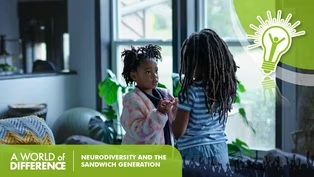
A World of Difference: Neurodiversity and the Sandwich Generation | Preview
Preview: S2026 Ep2 | 30s | Watch a preview of A World of Difference: Neurodiversity and the Sandwich Generation (30s)
Providing Support for PBS.org
Learn Moreabout PBS online sponsorship











Support for PBS provided by:
A World of Difference is a local public television program presented by WUCF