
May 12, 2026 - PBS News Hour full episode
5/12/2026 | 57m 46sVideo has Closed Captions
May 12, 2026 - PBS News Hour full episode
May 12, 2026 - PBS News Hour full episode
Problems playing video? | Closed Captioning Feedback
Problems playing video? | Closed Captioning Feedback
Major corporate funding for the PBS News Hour is provided by BDO, BNSF, Consumer Cellular, American Cruise Lines, and Raymond James. Funding for the PBS NewsHour Weekend is provided by...
May 12, 2026 - PBS News Hour full episode
5/12/2026 | 57m 46sVideo has Closed Captions
May 12, 2026 - PBS News Hour full episode
Problems playing video? | Closed Captioning Feedback
How to Watch PBS News Hour
PBS News Hour is available to stream on pbs.org and the free PBS App, available on iPhone, Apple TV, Android TV, Android smartphones, Amazon Fire TV, Amazon Fire Tablet, Roku, Samsung Smart TV, LG TV, and Vizio.
Providing Support for PBS.org
Learn Moreabout PBS online sponsorshipGEOFF BENNETT: Good evening.
I'm Geoff Bennett.
AMNA NAWAZ: And I'm Amna Nawaz.
On the "NewsHour" tonight: Defense Secretary Pete Hegseth faces congressional scrutiny over how much the war with Iran is costing Americans in the form of government spending and higher gas prices.
GEOFF BENNETT: President Trump departs for China.
What the meeting between leaders of the world's two largest economy could mean for businesses.
AMNA NAWAZ: And Louisiana Republicans rushed to redraw congressional districts after the Supreme Court wiped out key provisions in the Voting Rights Act.
LEONA TATE, Civil Rights Activist: And it does bring back that feeling from a long time ago, and it's not a good feeling.
(BREAK) AMNA NAWAZ: Welcome to the "News Hour."
Defense Secretary Pete Hegseth testified in back-to-back Capitol Hill hearings today, where he faced bipartisan frustration about the Iran war and its rising costs.
GEOFF BENNETT: With neither the Americans nor the Iranians softening their demands, the president left today for a high-stakes visit to Iran's chief ally.
That's China.
Mr.
Trump will land in Beijing no closer to a resolution in the war he started and with a cease-fire dangling on what he said yesterday was massive life support.
Our Stephanie Sy starts our coverage.
MAN: Defense Subcommittee will come to order.
STEPHANIE SY: Amid a diplomatic deadlock with Iran, on Capitol Hill today, Defense Secretary Pete Hegseth didn't get specific about which direction the war might be headed next.
PETE HEGSETH, U.S.
Defense Secretary: We have a plan to escalate if necessary.
We have a plan to retrograde if necessary.
We have a plan to shift assets.
STEPHANIE SY: Hegseth said the cease-fire President Trump yesterday called unbelievably weak was nonetheless still in effect.
Even though military action is paused, the war's costs are mounting.
That was a focus in a pair of congressional hearings today.
The Pentagon's top budget officials said the estimated price tag of the conflict had gone up substantially in less than two weeks from $25 billion.
JULES W. HURST III, Chief Financial Officer, Defense Department: And so now we think it's closer to 29.
That's because of updated repair and replacement of equipment cost and also just general operational costs to keep people in theater.
STEPHANIE SY: In the Senate, both Democrats and Republicans expressed concern to Secretary Hegseth and other top military officials about the war and the soaring costs for American consumers due to the standoff in the Strait of Hormuz.
SEN.
SUSAN COLLINS (R-ME): It seems to me that there's been a different plan almost daily with dealing with this problem.
SEN.
CHRIS COONS (D-DE): My question remains, how do we reopen the Strait of Hormuz to commercial shipping?
If we control it, how do we reopen it?
And your average American is seeing this at the gas pump every single day.
STEPHANIE SY: Whether progress is made in ending the war may hinge on a meeting in Beijing between President Trump and China's President Xi Jinping.
China is Iran's largest oil customer.
PETE HEGSETH: I think the most influence is in President Trump's hands and what he decides to do, and he'll set terms of how this... SEN.
LINDSEY GRAHAM (R-SC): Well, what if China stopped buying... PETE HEGSETH: But, ultimately, China has a lot of leverage.
You're right.
SEN.
LINDSEY GRAHAM: Yes, they do.
STEPHANIE SY: But Trump downplayed Xi's leverage as he departed for China today.
QUESTION: Do you think he needs to intervene at all with the Iranians?
DONALD TRUMP, President of the United States: I don't think he does, no.
QUESTION: Do you think he can help in any way?
DONALD TRUMP: No, I don't think we need any help with Iran.
We will win it one way or the other.
We will win it peacefully or otherwise.
STEPHANIE SY: Iranian officials today said they were ready to resume talks, but not to acquiesce.
Iran's Parliament speaker, Mohammad Bagher Ghalibaf, posted on X: "The longer they drag their feet, the more American taxpayers will pay for it."
The president was asked about those rising prices outside the White House.
DONALD TRUMP: The only thing that matters when I'm talking about Iran, they can't have a nuclear weapon.
I don't think about Americans' financial situation.
I don't think about anybody.
I think about one thing.
We cannot let Iran have a nuclear weapon.
That's all.
STEPHANIE SY: Meanwhile, key players in the region are urging de-escalation and diplomacy.
Turkish and Qatari officials said the Strait of Hormuz should not be used as a weapon amid the ongoing conflict and urged parties to return to efforts led by intermediary Pakistan to find a negotiated end to the war.
But Pakistan's position is not straightforward, according to some on Capitol Hill.
Senator Lindsey Graham addressed news reports that Pakistan is allowing Iranian military aircraft to park on its airfields.
SEN.
LINDSEY GRAHAM: I don't trust Pakistan as far as I can throw them.
If they actually do have Iranian aircraft parked in Pakistan bases to protect Iranian military assets, that tells me we should be looking maybe for somebody else to mediate.
No wonder this damn thing is going nowhere.
STEPHANIE SY: Another barrier in resolving the crisis, continued attacks between Israel and Hezbollah.
The leader of the Iran-backed group, Naim Qassem, said in a written statement today: "We will not abandon the battlefield and we will turn it into hell for Israel."
Qassem called for Lebanon to withdraw from talks between Israeli and Lebanese officials set to resume this week in Washington.
For the "PBS News Hour," I'm Stephanie Sy.
GEOFF BENNETT: Let's turn now to the economic impact of the war with Iran.
The latest inflation report out today showed price increases for American consumers in April hit a three-year high, driven by a spike in the cost of gasoline.
The Consumer Price Index, which includes energy and food costs, rose 3.8 percent year over year.
That's according to the Labor Department.
And that's compared to 2.4 percent in February, before the start of the war and the closure of the Strait of Hormuz.
To unpack today's numbers, let's turn again to Heather Long, chief economist at Navy Federal Credit Union.
Thanks for being here.
HEATHER LONG, Chief Economist, Navy Federal Credit Union: Thanks for having me.
GEOFF BENNETT: So today's headline inflation rate is the highest we have seen since 2023, up half-a-percentage point from last month.
What stands out to you in this report?
HEATHER LONG: Inflation is a major problem again for the U.S.
economy.
And it's not just gas.
We obviously are all feeling it as we go to the pump to fill up our cars.
But it's also electricity prices.
You mentioned food prices.
Everything from coffee to beef to a lot of vegetables are really up in price, some medical care costs.
And don't forget those airfares have gone way up.
So this is a broad problem, and it's hard for many to hide from.
And the other thing that really stood out in this report is, for the first time in three years, inflation is wiping out all wage gains.
So you mentioned 3.8 percent inflation in the past year versus 3.6 percent wage gains.
That means people are not able to make ends meet right now, a lot of Americans.
GEOFF BENNETT: Yes.
When President Trump -- as he said today, he said he's not prioritizing the economic impact to Americans as he negotiates with Iran.
If the strait continues to stay closed or mostly closed, how severe could that impact become?
HEATHER LONG: Well, we're already starting to see the preview of it so far.
I mean, this data was for April, which feels already like a long time ago as prices continue to climb.
I and many economists think inflation will probably hit 4 percent maybe in May or the June readings.
And, look, if we don't have a resolution to the Middle East conflict, then we could see potentially even higher numbers.
But even -- I think, Geoff, the most important point is, even if we do get that resolution to the war, inflation will remain pretty elevated for the rest of the year.
This isn't going away any time soon.
And I think consumers will continue to feel that squeeze of inflation being above their wage gains probably for most, if not all of the year.
GEOFF BENNETT: Inflation at 4 percent or higher, that's the expectation for the second half of the year?
HEATHER LONG: Not the second half.
For May or June, we may -- we could hit that.
But then inflation will continue to stay elevated, probably above 3 percent, maybe in the 3.5 percent range.
And so that's where it's going to eat up all of those wage gains and people just really can't get ahead in an environment like that.
You can't just not eat your avocado toast or not go on to Disney and instead do a staycation in a tent in the backyard.
That all sounds cute.
But when the costs are rising of gas, of food, of the electricity, these are the basics.
You got to pay those bills.
GEOFF BENNETT: The president yesterday floated the idea of suspending the federal gas tax.
There was also this idea of lowering tariffs on imported beef to ease food prices.
But he pulled back on that amid pushback from domestic beef producers.
Realistically, how much power does a president have to fight inflation in a moment like this?
HEATHER LONG: Not a lot.
President Biden learned that the hard way.
And now President Trump and his administration is really grappling with this.
There's not much they can do.
Even the gas tax would need approval from Congress, so they can't just flip a light switch on that.
And so that's -- his hands are really tied for a while.
And, unfortunately, obviously, people are really upset with the current situation that's going on.
I do think tariffs is probably his easiest option.
That's something he can do.
And certainly a lot of Americans, as they're thinking about those Memorial Day cookouts and what they want to cook and looking at these prices for hamburgers and for steaks, would love to see a little relief.
GEOFF BENNETT: Let's talk about the Fed because Friday's jobs report was relatively steady, but the inflation number complicates this picture considerably.
The president is pushing for lower interest rates.
That, we know.
But with inflation running close to double the Fed's target, what does that mean for the incoming Fed chair, Kevin Warsh?
HEATHER LONG: The outgoing Fed chair, Jerome Powell, probably has to leave a note on his desk for the new Fed chair, Kevin Warsh.
And it probably has to say "Good luck" there somewhere.
These are -- really tough situation right now.
The traditional advice for central banks in an oil price crisis is to kind of ignore it for a while, knowing that eventually it'll go away and prices will reset.
The problem for the Fed right now is, it's not just oil prices, as we were talking about.
Those food prices are going up.
Some medical costs are starting to go up, the electricity prices.
So they can't just totally ignore what's going on.
What it really means for you, me, and everyone we know in America, it means that the Fed is on hold, interest rates are going to stay the same probably for the rest of the year, although December's a long way away.
So maybe we get one cut at the end of the year.
GEOFF BENNETT: Heather Long, always great to speak with you.
Thank you.
HEATHER LONG: Thanks a lot.
AMNA NAWAZ: The president is traveling halfway around the world for less than two days for that state visit to China.
And he's bringing a host of top American executives with him.
Talks there are expected to encompass the complex economic and security postures of both nations.
Nick Schifrin is in Beijing for the summit, and he joins me now.
So, Nick, give us a preview.
What's at stake here?
NICK SCHIFRIN: Well, Amna, it's a cliche, but this is the most important bilateral relationship in the world that will help determine everything from the prices we pay to the apps we use to the fate of our alliances.
And this is a summit, frankly, between two men who have centralized decision-making.
So as we will talk about all week, there's national security concerns, Iran, of course, whether China will put pressure on Iran.
Taiwan.
Will President Trump agree to delay an arms sale or even weaken diplomatic language over Taiwan?
But the deliverables, as we call them, from this summit are really expected to focus on trade and investment.
And that is a good thing, says Sean Stein, the president of the U.S.-China Business Council, who I spoke to earlier today in Beijing.
SEAN STEIN, President, U.S.-China Business Council: When the two presidents talk, good things happen.
So we're quite optimistic that the two presidents are going to find a really good landing zone on a lot of different areas.
So, what both countries need more than anything else is, they need stability.
And I think having the two presidents talk is going to be an injection of stability that's going to help keep the relationship on an even keel that it needs to be for the next year or even beyond.
NICK SCHIFRIN: To that point, President Trump will come here with CEOs.
That hasn't happened in decades.
The U.S.
is pushing announcements on boards of trade and investment.
And at the summit or shortly thereafter, we expect the U.S.
and China to announce deals over Boeing jets, agriculture, including sales of American beef and pork.
And, as we know, President Trump is always looking for that big number when it comes to investments.
And so that's what we will be looking for, that number, but also what he gives up or what concessions he may consider in order to get that number.
AMNA NAWAZ: Nick, as you have been reporting, both sides have been pressuring each other economically over this past year.
Does one side come in with more leverage than the other?
NICK SCHIFRIN: Well, I think both sides feel like they have more leverage than the other.
The U.S.
could always raise tariff rates, which have been reduced.
The U.S.
has maintained restrictions on semiconductors.
And the U.S.
believes that Beijing has overplayed its hand when it comes to its own export restrictions.
But the fact is that China has weathered President Trump's tariffs, which have had much less of an economic impact than Beijing feared.
Beijing is now much more self-sufficient when it comes to technology, despite those U.S.
export controls.
And Beijing has found a real leverage point, and that is rare earths, especially rare earth magnets, which the U.S.
and the rest of the world need and China has a near monopoly on.
And all of that adds up to an emboldened China, and a rising group of Chinese advisers who are U.S.
hawks, says Stein.
SEAN STEIN: Just like the United States' system has got pragmatists, it's got China hawks, it's got this whole spectrum of views, I think, on the Chinese side, they have got their America hawks and their pragmatists and all that.
And what it means is, it means that the America hawks' voice is growing louder on the Chinese side.
I think the Chinese are feeling much more self-confident now than they were a year ago.
I think they're no longer intimidated by tariffs the way they were.
And I think that they're feeling more comfortable at their place in the world.
NICK SCHIFRIN: Now, that said, the U.S.
is China's single largest trading partner, and Chinese -- China's economy faces serious headwinds.
So, Amna, the focus here on Beijing, the language that we hear from Chinese officials and also the state nationalist tabloid Global Times, as they put it -- quote -- "They are looking for more stability in a world undergoing turbulence and transformation."
AMNA NAWAZ: Nick, the other big question is whether or not we'll see any cooperation on Iran, which is an ally of China's.
What do you see?
NICK SCHIFRIN: Well, earlier today, President Trump said at first that he and Xi would have a long talk about Iran.
Then he said that he doesn't need Chinese help on Iran.
And then he said that Xi had been - - quote -- "relatively good" about Iran.
Look, the bottom line, Amna, as you say, China is an important ally of Iran.
They hosted Iran's foreign minister here in Beijing just last week.
China has supported Iran's ballistic missile program and, perhaps most importantly, provided an economic lifeline by buying Iranian oil.
The U.S.
has sanctioned small Chinese oil refiners that import that oil.
But the U.S.
has held back on some sanctions, including sanctioning bigger state-owned oil refineries that import that oil and, crucially, those Chinese banks that facilitate the transfer of Iranian oil to China.
Of course, the U.S.
wants Chinese pressure on Iran to reopen the strait and to make a diplomatic deal.
But, Amna, the U.S.
has been asking China to use that leverage for years.
And a senior U.S.
official tells me that, yes, while China does suffer a little bit economically because the Strait of Hormuz is closed, it also thinks it benefits from the fact that the U.S.
is bogged down in a war in the Middle East.
And so it is unlikely that China is really willing to exert significant pressure on Iran, even despite this summit, Amna.
AMNA NAWAZ: All right, that is Nick Schifrin reporting from Beijing.
China.
Nick, thank you.
NICK SCHIFRIN: Thank you.
AMNA NAWAZ: In the day's other headlines: The head of the Food and Drug Administration, Marty Makary, is resigning after an uneven tenure at the agency.
The surgeon and researcher made a name for himself in Trump circles as a critic of COVID era health policies.
But he frustrated administration officials and health industry executives alike over his approach to new vaping products and the abortion drug mifepristone.
As he left the White House today, President Trump wished Makary well, saying he -- quote -- "was having some difficulty."
Makary will be replaced on an acting basis by Kyle Diamantas, the FDA's top food official.
Meantime in the U.K., Prime Minister Keir Starmer is refusing to resign, despite growing pressure from within his own party.
In their weekly meeting today, Starmer told his Cabinet -- quote -- "The country expects us to get on with governing.
That is what I'm doing and what we must do as a Cabinet."
At last count, some 90 Labor lawmakers have urged Mr.
Starmer to set a timetable for his departure following hefty losses in last week's local elections.
Several junior ministers have quit and the public remains frustrated over his handling of the economy.
But some Cabinet members have voiced their support, with one urging Labor Party members to, as he put it, take a breath.
A Spanish passenger who was on the cruise ship at the center of a hantavirus outbreak has tested positive and remains in quarantine in Madrid.
That brings the number of confirmed cases to at least nine, with two more suspected cases.
TEDROS ADHANOM GHEBREYESUS, Director General, World Health Organization: Viruses do not respect borders.
Our strongest immunity is solidarity.
AMNA NAWAZ: The head of the World Health Organization says, as of now, there are no signs of a larger outbreak, though more cases could emerge.
On Monday, the last of the ship's passengers finally disembarked in Spain.
It's now sailing back to the Netherlands to be disinfected; 18 American passengers are back in the States and are being monitored by health officials.
The Justice Department announced criminal charges today against the operators of the ship that crashed into Baltimore's Francis Scott Key Bridge two years ago.
Officials laid out the charges against Synergy Marine and Synergy Maritime, along with the ship's technical supervisor, at a press conference this morning.
They include conspiracy and obstruction of an agency proceeding, among others.
JIMMY PAUL, FBI Baltimore Special Agent in Charge: As alleged, the bridge was struck and collapsed because those who were responsible for the ship's operation deliberately cut corners at the expense of safety.
AMNA NAWAZ: In March of 2024, the ship called the Dali lost power twice and slammed into the bridge.
Six construction workers were killed.
Maryland officials say it will cost as much as $5.2 billion to replace the bridge, which would then open to traffic in 2030.
FBI Director Kash Patel pushed back today against accusations that he drinks to excess on the job and is at times unreachable by his staff.
Appearing before a Senate budget hearing today, Patel called the allegations unequivocally, categorically false.
When Senator Chris Van Hollen pressed Patel about a report in "The Atlantic" that included instances of his drinking, Patel fired back, referencing a visit Van Hollen made to El Salvador last year to visit the mistakenly deported Kilmar Abrego Garcia.
KASH PATEL, FBI Director: Unlike your baseless reports, the only person that was slinging margaritas in El Salvador on the taxpayer dollar with a convicted gangbanging rapist... (CROSSTALK) SEN.
CHRIS VAN HOLLEN (D-MD): Director Patel, come on.
These are serious allegations that were made against you.
AMNA NAWAZ: There is no evidence Van Hollen engaged in any inappropriate behavior while in El Salvador.
Abrego Garcia has not been convicted of any crimes, but is facing human smuggling charges in the U.S., which he denies.
Director Patel is suing "The Atlantic" over its reporting.
A mayor in Southern California plans to plead guilty in the coming weeks to acting as an illegal agent for the Chinese government.
Eileen Wang resigned as mayor of Arcadia yesterday.
That's a suburb of Los Angeles with a large Chinese-American population.
The 58-year-old has been charged with one count of acting as an illegal agent of a foreign government after she shared pro-Beijing articles online.
Wang could face up to 10 years in prison.
Her lawyers say she is sorry for the mistakes she's made.
In the corporate world, eBay is rejecting a $56 billion takeover bid by video game retailer GameStop.
The online marketplace called the offer - - quote -- "neither credible nor attractive"; eBay's market capitalization is roughly four times the size of GameStop's, and many on Wall Street had questioned the financing of the deal.
Shares of GameStop fell today, while eBay's stock rose more than 2 percent.
Elsewhere on Wall Street, stocks ended mixed as technology shares cooled.
The Dow Jones industrial average managed a slight gain of around 50 points, but the Nasdaq fell nearly 200 points.
The S&P 500 also ended lower on the day.
And the annual Eurovision song contest kicked off today, with Israel's participation striking a dissonant chord.
PROTESTER: Free, free, Palestine!
AMNA NAWAZ: In the host city of Vienna, some demonstrators called on countries to boycott the contest.
Spain, Ireland the Netherlands, Slovenia, and Iceland all chose not to send contestants.
Part "American Idol," part World Cup, Eurovision is now in its 70th year, with singers and bands from 35 nations representing their home countries.
Last year, an estimated 166 million people tuned in, more than the Super Bowl.
This year's winner will be crowned on Saturday.
And Memphis Grizzlies forward Brandon Clarke has died.
Clarke was a first round pick in the 2019 NBA draft and earned All Rookie First Team honors in his first season.
He spent his entire seven-year NBA career with Memphis, though injuries limited his playing time in recent years.
Last month, Clarke was arrested for speeding and possession of a controlled substance.
He was later released on bond.
The NBA and Clarke's agency confirmed his death today, with the Grizzlies calling him -- quote -- "an outstanding teammate and an even better person."
They offered no details on how he died.
Brandon Clarke was 29 years old.
Still to come on the "News Hour": we report from a frontline Ukrainian city threatened by Russian occupation for a second time; artificial intelligence raises questions about the costs and benefits of a college degree; and a food historian joins the "News Hour" podcast to explain why so many children are picky eaters.
GEOFF BENNETT: There were several developments today in the ongoing redistricting battle.
Missouri's Supreme Court cleared the way for a new map supported by President Trump that could net the GOP an additional seat in Congress.
But, in South Carolina, efforts to redraw that state's map stalled after that state's Senate failed to reach the required two-thirds majority.
Five Republicans joined Democrats in opposing the proposal.
And, in Louisiana, lawmakers there are pressing ahead with a new redistricting plan just days before the state's now-delayed House primary elections.
All of it comes as the U.S.
Supreme Court has continued to narrow key protections in the Voting Rights Act.
As Liz Landers reports for our Race Matters series, once the lines are finalized in Louisiana, the political consequences will be measured not only in red and blue, but also in black and white.
PROTESTER: Whose house?
PROTESTERS: Our house!
PROTESTER: Whose house?
PROTESTERS: Our house!
LIZ LANDERS: Protests outside the state capitol echo the heated debate inside, as lawmakers deliberate over how political dividing lines are drawn.
PROTESTERS: Shut it down!
LIZ LANDERS: This is the Louisiana Statehouse.
The Senate and the Governmental Affairs Committee here has started the process of redrawing the congressional maps in this state.
Hundreds of people have shown up for the public testimony.
Just a couple weeks ago, the U.S.
Supreme Court struck down Louisiana's congressional map, the conservative justices narrowing the Voting Rights Act and a provision protecting minority voting power when states draw district lines, as Louisiana did when it carved out a second majority-minority district in 2024.
That sent state lawmakers back to the drawing board, where they may eliminate one or both of the seats, both held by Black Democrats.
A map like this would give U.S.
House Speaker Mike Johnson, whose Louisiana seat they will protect, a better chance of holding on to his Republican majority and gavel next year.
REP.
MIKE JOHNSON (R-LA): And I think all states who have unconstitutional maps should look at that very carefully.
And I think they should do it before the midterm.
LIZ LANDERS: The fallout from the Supreme Court's decision isn't limited to Louisiana.
In the days that followed, Republicans in Alabama, Mississippi, South Carolina and Tennessee began the process of shifting districts in their political favor, joining an unparalleled mid-decade redistricting fight that has the potential to net 10 or more seats for the GOP in November.
Back in the bayou, the state's primary elections were already under way when Republican Governor Jeff Landry declared a state of emergency, suspending the House races so new boundaries could be drawn.
In the past, new maps would often take effect for the next election.
But Landry told "60 Minutes" Louisiana couldn't wait.
GOV.
JEFF LANDRY (R-LA): The highest court in the land says the map that you have is unconstitutional, so we don't have a map under which our voters can vote on.
If anybody has a grievance, take it to the United States Supreme Court.
LIZ LANDERS: Just outside the crowd of protesters, Jonathan Davis, a small business owner involved in Republican politics, says the race cancellation is weird, but the court's decision was overdue.
JONATHAN DAVIS, Republican Voter: I would look at that as this was supposed to happen previously.
We should have gotten rid of the racist districts a long time ago and made sure that people could have equal representation among the voters.
LIZ LANDERS: On the other side of the political aisle, Democratic Congressman Troy Carter is waiting to see if a new map will erase his base of support.
Are you worried that you're going to lose your seat?
REP.
TROY CARTER (D-LA): No, I'm not worried about me at all.
I'm worried about us.
This is not a singular battle.
This is about the people.
African Americans have the right to choose the person of their choice to represent them.
But that means you can't just come in and summarily crack us up, break us up.
LEONA TATE, Civil Rights Activist: So now we move backwards with the Supreme Court decision that will go down as one of the most racist rulings in our nation's history.
LIZ LANDERS: For voter Leona Tate, the civil rights movement isn't just history; it's memory.
She was 6 years old when she enrolled in what had been an all-white school in New Orleans.
She and several other young Black students became the first to desegregate a New Orleans school.
LEONA TATE: I had no idea what racism was at that time, but I knew by third grade that it was the color of my skin that made a difference.
I just can't believe that it's still happening 66 years later.
It's cheating, to me.
That's how I feel.
It's really cheating.
And it's really illegal.
It does bring back that feeling from a long time ago, and it's not a good feeling.
LIZ LANDERS: The state's congressional map has been challenged and changed several times recently.
After the 2020 census, legal battles ultimately led to the creation of a new majority-minority district, District Six.
Democratic Congressman Cleo Fields was elected to that seat in 2020.
You have been hosting a number of town halls here in your district.
What are you hearing from voters?
REP.
CLEO FIELDS (D-LA): I mean, voters, first of all, they are confused.
The election had already started, and ballots had already been cast.
Over 100,000 early vote ballots had been cast.
Over 40,000 had already turned their ballots in.
That's the number one thing I try to deal with.
Is the election on?
Is it off?
All these lawsuits, what does it mean?
LIZ LANDERS: Fields told us he's not interested in running against Carter if Statehouse mapmakers draw them into the same district.
He places blame for the redistricting arms race squarely on President Trump and argues Republicans are twisting the Supreme Court's ruling for their political gain.
REP.
CLEO FIELDS: It didn't say you had to suspend the elections.
That's for sure.
And it didn't say you -- Representative Carter's district had any problems.
And the third thing it did not say, it didn't say you could not draw a second majority-Black district.
LIZ LANDERS: Fields has seen this show before.
In the 1990s, he was a congressman for Louisiana's Fourth Congressional District.
That was also redrawn and he lost his seat in 1997.
JIM ENGSTER, Host, "Talk Louisiana": For him, it's Groundhog Day 32 years later.
He's facing the same thing he did in the mid-'90s.
But the more things change, the more they stay the same.
This is Jim Engster and welcome to "Talk Louisiana."
LIZ LANDERS: Jim Engster has spent his career covering Louisiana politics.
What have you heard from callers and people that you speak to in Louisiana?
Are people supportive of this decision or do they think that it is confusing or potentially unfair or even racist?
JIM ENGSTER: All of the above.
LIZ LANDERS: Engster walked us through Republican leaders' calculus as they draw new maps.
He says the GOP can safely create a 5-1 map; 6-0 would be a bit riskier.
The Supreme Court's ruling prevents dividing districts by race, but party is fair game, and, here, blue and red can functionally produce the same map as black and white.
JIM ENGSTER: In Louisiana about 80 percent of the white people are voting Republican and about 90 percent of the Black people are voting Democratic.
So it is nearly impossible to separate race from partisanship.
LIZ LANDERS: Governor Landry defends the Supreme Court's decision and distinction.
GOV.
JEFF LANDRY: You cannot say that we are all created equal and that states must treat everyone equal under the law and then allow a law to sort people based upon race.
LIZ LANDERS: He's hoping the Supreme Court's decision will mark the end of a decades' worth of near constant legal fights over political maps.
Leona Tate doesn't see the fight of her lifetime ending any time soon.
You have been fighting this fight for a long time.
Is that tiring?
LEONA TATE: It can, but it has to be done.
It has to be done.
And I feel like I was chosen to do this, you know?
So I can't give up.
I can never give up.
LIZ LANDERS: The new map hasn't been drawn yet.
The suspended elections don't have a new date.
But if history is any guide, there are likely more political and legal fights to come.
For the "PBS News Hour," I'm Liz Landers in Baton Rouge, Louisiana.
AMNA NAWAZ: As Russia prepares to launch a new large-scale spring offensive, one city just 15 or so miles from the front line is preparing for the worst.
Control of Izyum is vital for Ukraine, strategically linking the Kharkiv region to Donetsk.
Izyum was occupied by Russian forces for six months in the spring of 2022.
Ukrainian forces liberated it and exposed brutal Russian war crimes.
Now that threat of occupation is again all too real.
Producer Amanda Bailly in Izyum and Nick Schifrin report.
NICK SCHIFRIN: In Eastern Ukraine, a frontline city once again braces for battle.
Izyum's streets and buildings are covered with hundreds of miles of nets to try to protect from Russian drones, as the city's scars remain unhealed.
Everywhere here, there are painful reminders of Russian bombardment and a brutal six-month occupation in 2022.
Perhaps more than any other city, Izyum today combines Ukraine's pain from its past with fear for its future.
Russian troops and the front line are only about 15 miles away, and Russian missiles strike next to residents' homes.
Serhii Saltovskyi has lived here all his life.
These days, he fears he may have to take his family and leave.
SERHII SALTOVSKYI, Resident of Izyum, Ukraine (through translator): We are always talking about the front getting closer.
It's difficult to imagine testing your destiny again.
I don't know how you could overcome it twice.
NICK SCHIFRIN: This former school is the scene of his suffering.
During the occupation, Russian soldiers took over the building and one day brought him inside.
SERHII SALTOVSKYI (through translator): I was tortured with electricity in the basement.
I was in there for almost 24 hours.
They beat us up.
They took us to the forest and pretended to execute us.
They did whatever they wanted with us.
The streets were full of dead bodies.
We were not human beings for them.
We were slaves.
NICK SCHIFRIN: One resident was enslaved in this shed, Alah (ph), who counted the days of her detention by scratching them on the wall as Russian troops tortured and raped her.
Others were slaughtered.
In September 2022, Izyum was liberated and revealed the death of Russia's dehumanization, more than 1,000 people killed, more than 400 buried in a mass grave.
For many victims, there were no names, no markers of lives lived, only numbers.
And Russian occupiers forced Saltovskyi to bury his neighbors' bodies.
SERHII SALTOVSKYI (through translator): I try to forget, but it's very difficult because it's stuck in the soul.
From time to time, the memories and images just appear.
If you haven't lived through occupation, it's impossible to understand what we lived through.
NICK SCHIFRIN: Today, the crosses mark no bodies.
They're instead standing reminders of Russian war crimes.
It is a living memorial and a hope that Ukraine can ensure, never again.
The bodies have now been reburied properly, although some are still unidentified.
OLEKSANDR KOBOLEV, Head of War Crimes Unit, (through translator): You understand that behind every grave is a human life.
The overwhelming number of these dead are civilians.
NICK SCHIFRIN: Oleksandr Kobolev is the region's lead war crimes investigator and was one of the first on the scene in 2022.
OLEKSANDR KOBOLEV (through translator): It was terrible, to be honest.
It's hard to describe in words.
There were also people who were executed.
Some were kept in torture chambers.
A lot of these people are people who died as a result of an airstrike on a five-story building.
NICK SCHIFRIN: Killed in that strike, entire families, including 6-year-old Olesya Stolpakova (ph), her older sister, 8-year-old Sasha, both their parents and maternal grandparents, their bodies buried in the mass grave, their likeness drawn on the building where they died.
Across the city during occupation, residents labeled their doors with the words "Kids," "People," a desperate plea for humanity that the invaders denied.
Today, in Ukraine, there is a collective trauma that does not spare its children even during this holiday to welcome spring.
YULIA NYSOVA, Displaced Ukrainian (through translator): The explosions are getting louder and louder, and the front line is getting closer and closer, so I don't know what is next for us.
NICK SCHIFRIN: Yulia Nysova moved to Izyum after being displaced three times.
She's worried that the war will force her and her family to flee yet again.
And yet her daughters try their best to celebrate this holiday, which marks new beginnings.
(LAUGHTER) NICK SCHIFRIN: And Nysova knows that kids need space to be kids and enjoy Slavic traditions together.
YULIA NYSOVA (through translator): They have been doing online school for four years now, so it's important for them to still socialize and communicate.
NICK SCHIFRIN: For Izyum's residents, the daily drumbeat of life is a kind of defiance to the doom of the front line just outside the city's walls.
Izyum is known as the City of Heroes for what it survived, and communal support is an antidote to trauma.
The facade of Izyum's women's center is still crumbling from a 2022 Russian strike.
But, inside, psychologist Natalia Noshenko (ph) runs art therapy classes to help heal invisible injuries.
Tetiana Shapovalova stayed in Izyum through occupation with her then-6-year-old son.
Their wounds are still deep.
TETIANA SHAPOVALOVA, Resident of Izyum, Ukraine (through translator): My son is a very strong person.
We went through hell, and he's so brave.
I'm always checking in and asking, how are you?
NICK SCHIFRIN: Today, she and her son have decided never again to risk those horrors, and so they will leave if the threat comes too close to home.
TETIANA SHAPOVALOVA (through translator): I don't want to stay here if there's real danger, because it's my child's life and my responsibility.
Half of my stuff is already in boxes.
NICK SCHIFRIN: Fifty-six-year-old Larysa Yerokhina has lived here for two years.
Her village Bohuslavka was first occupied in 2022, with Russian troops destroying much of the settlement.
Ukrainian soldiers liberated it, but now it's under siege again.
LARYSA YEROKHINA, Displaced Ukrainian (through translator): Our whole street is destroyed.
My home doesn't exist anymore.
NICK SCHIFRIN: She shows photos of her home the day she evacuated and what it looks like today, reduced to rubble by a Russian strike.
LARYSA YEROKHINA (through translator): There was a kitchen there and this was the house.
NICK SCHIFRIN: Grief for a home and life shattered by war is heavy.
And so now she needs to create a new home.
The drawing says "Izyum, a safe space," an adopted home that provides her support.
LARYSA YEROKHINA (through translator): We are strong.
Everything is going to be OK.
We will overcome it.
Everything is going to be OK.
NICK SCHIFRIN: Resilience, yes, but, here, even soldiers appeal to the divine for protection in this once captured city facing an uncertain future.
For the "PBS News Hour," with Amanda Bailly in Izyum, I'm Nick Schifrin.
GEOFF BENNETT: Commencement season is under way around the country, but this season's celebrations come at a sobering moment for many public colleges and universities confronting major challenges, funding cuts, attacks from the Trump administration and declining enrollment prospects.
For their part, students are facing steep loans and too often dicey job prospects, especially in this era of artificial intelligence.
That's led many to openly question whether a college degree is even worth it anymore.
Economics correspondent Paul Solman visited the state of Michigan to find out how some schools and students are approaching this question.
It's part of our series Rethinking College.
WOMAN: Anyone else feel like their college degree was absolutely not worth what they paid for it?
PAUL SOLMAN: This is a feeling that's all the rage on TikTok.
WOMAN: I'm literally 22 years old and jobless.
That college degree, I guess, means nothing because I have literally been applying to jobs for six months.
PAUL SOLMAN: And thus a prime charge against higher ed these days: MAN: I truly believe that going to college only set me back farther from the goals I wanted to achieve and where I wanted to be in life.
PAUL SOLMAN: The cost of a degree just too damn pricey, given the iffy benefit of a job today, much less a job tomorrow.
On the scale of one to 10, how worried are you about going into the world of work now?
ITZEL SEGOVIA, Student, Michigan State University: I'd give it an eight as of now.
PAUL SOLMAN: One to 10?
REILLY COON, Student, Michigan State University: Probably about a seven or eight.
The larger climate for entry-level jobs right now is really hard and scary as somebody -- like, as you're graduating or anticipating graduation.
PAUL SOLMAN: And yet these are students at Michigan State University where the president, Kevin Guskiewicz, boasts: KEVIN GUSKIEWICZ, President, Michigan State University: Ninety-three percent of our graduates over the last five years have been placed before they graduated in either a first job or to graduate school.
PAUL SOLMAN: At much smaller Eastern Michigan University, the same job anxiety.
How worried are you on a scale of one to 10?
ALYSSA THORNTON, Student, Eastern Michigan University: I will go with a seven.
I know Eastern will hold career fairs and everything, but it's not necessarily guaranteed, so you just never know.
PAUL SOLMAN: How scared are you on a scale of one to 10, one fear at all, 10 terrified?
NADIA CONRAD, Student, Eastern Michigan University: I would say I'm at like an 8.5, like really high.
Yes, it's all very scary to me.
PAUL SOLMAN: Didn't used to be this way, of course.
A wage premium for a college degree has far outweighed the cost for as long as anyone can remember, those with a degree earning a million dollars or more over their lifetimes compared to folks with just a high school diploma.
But, nowadays, the question has become, is the education worth the price?
ANTONELLA MENNA, Student, Eastern Michigan University: It was my cheapest option, so... PAUL SOLMAN: How much does it cost?
ANTONELLA MENNA: I come here for under four grand a year.
PAUL SOLMAN: Compared to a national average all in of about $27,000 at public universities, out-of-state costs nearly double, so a stratospheric price tag, as much as six times the price of the BA at my school back in the '60s, inflation-adjusted.
The main suspects, major growth in specialized programs and the personnel to support them, part of what's been called administrative bloat.
There's also the amenities arms race, rec centers, food courts, climbing walls, but, most significantly for major public schools, years of cuts in federal and state funding, all of which has led to an affordability crisis and declining enrollments at places like Eastern Michigan, not to mention schools now going extinct.
So what's a university president to do?
KEVIN GUSKIEWICZ: We have to adapt with the changing landscape of society and of the various industries that higher education has to serve.
PAUL SOLMAN: For Michigan State, that means reaching out to its 550,000-person alumni base and asking them, what skills are most important for the modern work force?
KEVIN GUSKIEWICZ: Bring alums to the table, create a think tank group and learn from them about what it is that would be attractive to them if they were going to hire an alumnus.
PAUL SOLMAN: So the focus is on hiring, on getting jobs for grads?
KEVIN GUSKIEWICZ: It is, and creating internships are so, so important today, so much more than ever before.
PAUL SOLMAN: Brendan Kelly, the newly installed president of Eastern Michigan University, agrees.
BRENDAN KELLY, President, Eastern Michigan University: Landscapes change, and the businesses that are serving those landscapes have to change with them.
Higher education hasn't done that very well.
Our business is rooted in the student, and then has to be connected to their participation in the economy after graduation.
PAUL SOLMAN: A favorite example of the president's, student Megan Davis' ankle brace project.
BRENDAN KELLY: And I said: "So, was it successful?"
And she goes: "No."
I said: "Why are you so excited?"
She goes: "Because now I know that won't work."
MEGAN DAVIS, Student, Eastern Michigan University: It wasn't necessarily a failed project.
It was an experimental project just to see what would happen.
I learned it didn't work for the specific patient, but it could work for someone else.
So it was good research.
Any research is good research.
I also liked that our program was completely in person.
So I was here since the beginning.
My full two years were in person, and I was able to get hands on right away.
PAUL SOLMAN: But, even here, the economics are getting worse.
NATHAN KEARNS, Associate Professor, Eastern Michigan University: The Department of Education has put caps on federal student loans for graduate programs.
PAUL SOLMAN: In, Professor Nathan Kearns says: NATHAN KEARNS: Professions such as nursing, physical therapy, orthotics and prosthetics.
PAUL SOLMAN: That's your field.
NATHAN KEARNS: That is our field.
They have taken away the professional degree designation.
So now we're considered a nonprofessional degree.
PAUL SOLMAN: Pricier loans for students due to Trump administration restrictions, for the schools, federal funding R&D cuts, even funding cuts at the state level.
BRENDAN KELLY: The state does make an investment in EMU every year, absolutely.
But if you go back to the 1970s, it was a very different ratio.
Now states just make much less of a contribution than they used to.
PAUL SOLMAN: Now, there is one more major critique of higher ed that needs to be acknowledged long made by conservative scholars like Peter Berkowitz.
PETER BERKOWITZ, Hoover Institution: Universities had begun to lose their way a long time ago.
And over the last decade, we have seen even stronger attempts to regulate speech.
PAUL SOLMAN: This is a critique the Trump administration has adopted as a reason for punishing universities by defunding them, further exacerbating, obviously, their economic woes.
PETER BERKOWITZ: We now confront the problem of viewpoint diversity on campuses and, from my point of view, a broken curriculum.
PAUL SOLMAN: Which is why Berkowitz also slams DEI.
PETER BERKOWITZ: Even where DEI sprang from honorable motives, in practice, diversity, equity and inclusion has meant race-based allocation of benefits, and it's meant imposition of a progressive orthodoxy.
PAUL SOLMAN: It will come as no surprise that some folks think this is right-wing orthodoxy, like USC Professor and researcher Shaun Harper, who defended DEI before Congress last year.
SHAUN HARPER, University of Southern California: I stand on more than 50 years of evidence, highly credible research published in my field and in others, that consistently shows that all students, not just students of color, not just women, not just queer students, but all students benefit from being educated in a diverse and inclusive educational environment.
PAUL SOLMAN: So what do students we talk to say about DEI and woke?
ITZEL SEGOVIA: I don't think that it's more about being woke or not.
It's just like, can you see different perspectives without getting mad and understand their viewpoint?
You don't have to agree with it.
REILLY COON: I don't think it's an indoctrination in any sense of the word.
I don't particularly use the word woke.
JACK MCGUIRE, Student, Michigan State University: It's kind of just tired.
JACK MCGUIRE: It's tired and it doesn't really describe anything.
I don't really know a lot of people who seriously use it to describe anything at this point.
PAUL SOLMAN: To which Michigan State President Guskiewicz adds: KEVIN GUSKIEWICZ: The world we're living in today, it's so polarizing and we're heading down this path where everybody's digging their heels in, and where are we going to be in a decade from now?
So I think we do have a responsibility to model civil discourse.
PAUL SOLMAN: Is it unfair of critics to say that American universities are left-leaning because of their faculties?
KEVIN GUSKIEWICZ: It is.
It's not the faculty that are -- quote, unquote -- "indoctrinating" students.
Most studies show that more conservative students feel as if their voices are stifled, that they're being censored by their peers.
What we have to do a better job of is creating the classroom environment where all voices can be heard.
PAUL SOLMAN: Sounds fine in principle, but ideology is far from the main problem of higher ed in today's economy, the cost-benefit equation of going to college at all.
For the "PBS News Hour," Paul Solman.
AMNA NAWAZ: So, how did American kids become such finicky eaters?
Our "Settle In" podcast asked that question to author and historian Helen Zoe Veit, whose latest book is "Picky: How American Children Became the Fussiest Eaters in History."
Here now is an excerpt of that conversation.
You go back to the 1800s, you say kids back then were eating like little omnivores, meaning they ate everything, rabbit and codfish cakes, deer liver, vinegary pickles.
Why were they doing that?
What was it about the time and the food that had them eating that way?
HELEN ZOE VEIT, Author: Yes, I came to see the 19th century as this crucially important time.
It's really the last moment in America where, like, childhood pickiness didn't even exist as a concept.
They were playing outside more.
They were doing physical chores.
Most Americans lived on farms at the time, so farm children were just involved in the work of the home.
They often walked to school, and at the same time they weren't snacking much.
So, they weren't -- there just wasn't much edible food between meals.
So, children would typically come to meals hungry, sometimes really hungry.
They hadn't eaten since lunch a lot of the time.
Another thing that changed in the 20th century too was milk drinking.
So, starting in the early 1900s, nutritionists started saying, milk is the essential food of childhood.
Kids have to have milk to grow.
And, by the way, they hadn't actually been drinking that much milk in the 19th century, because, unless you lived on a dairy farm, there wasn't refrigeration.
It was hard to get fresh, unspoiled, uncontaminated milk.
So, milk drinking hadn't been that common in the 19th century, but it explodes in the 20th century.
The recommendation is that kids as young as 2 years old drink a quart of milk -- that's four cups of creamy whole milk -- a day, and it really tamped down appetites for meals.
So, kids would come to meals, they weren't exercising as much, they were snacking more, they were drinking large amounts of milk, and it really affected their ability to learn to like new foods.
AMNA NAWAZ: There's so much fantastic, useful advice in the book as well that's based in history and in science.
So, this whole idea of sitting a kid down at mealtime and saying, you got to clean your plate, you got to finish the food in front of you, should that be a goal?
Is that something parents should do?
HELEN ZOE VEIT: I -- well, I will just speak for myself.
I never said you have got to clean your plate.
But the idea that you should never tell a child to eat or that children should always decide the quantity, that's not a long historical idea.
I think parents often have a better idea than children of what an appropriate amount is.
And if a child has eaten very little at a meal, I think it can be appropriate to ask them to have one or two more bites or three, depending on their age and what you see, especially if you're the parent and you know they say they're full and then 15 minutes later they ask for a snack.
If you have that experience and you know your child, I do not think it is necessarily traumatic or bad to say like, hey, you haven't had dinner yet.
You need to have two more bites and then we will call that dinner.
AMNA NAWAZ: OK, if a kid doesn't want what's on offer at the table, should you offer them something else?
HELEN ZOE VEIT: I am more radical than most people today on this.
There are many pediatricians who say, no, but you can offer them fruit.
I stuck with the historical method, 300,000 years of human history.
And I didn't offer them any alternatives.
But, again, my children never once went actually went hungry.
I would always offer them the same food warmed up if they got hungry later.
It always worked with my kids.
AMNA NAWAZ: OK, is it ever OK to offer a reward for trying a new food or eating less popular food, like, hey, if you finish your spinach, you can have a cookie.
Is that OK?
HELEN ZOE VEIT: Psychologists in the 1940s and 50s said, no, don't ever reward your kid.
They will associate desserts with love and rewards.
That -- they just made that up.
There was literally no evidence.
There were no comparative studies.
Europeans and Americans have been having desserts after dinner for centuries with good outcomes.
So to say you can't have dessert until you finish your dinner, or if you finish your dinner, if you have two more bites, whatever you as a parent decide, you can have a snack afterwards, or you can have a gold star or a sticker, I think those are incredibly great tools for helping kids learn to like new foods.
And there's literally no evidence that they're harmful.
AMNA NAWAZ: And you can check out that full episode of "Settle In" on our YouTube channel or wherever you get your podcasts.
GEOFF BENNETT: I will be watching that.
GEOFF BENNETT: And that's the "News Hour" for tonight.
I'm Geoff Bennett.
AMNA NAWAZ: And I'm Amna Nawaz.
On behalf of the entire "News Hour" team, thank you for joining us.
 New
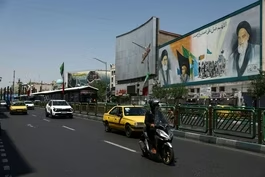
NewHegseth grilled over direction and cost of Iran war
Video has Closed Captions
Hegseth grilled over direction of Iran war and costs for Americans (4m 42s)
 New
NewHelen Zoe Veit and Amna Nawaz discuss picky eaters on 'Settle In'
Video has Closed Captions
Helen Zoe Veit and Amna Nawaz discuss picky eaters on 'Settle In' (4m 31s)
 New
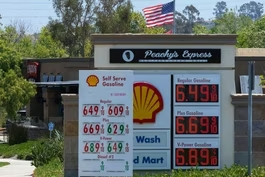
NewInflation could stay high for rest of year, economist warns
Video has Closed Captions
Inflation could hit 4% next month and stay elevated for rest of year, economist warns (5m 18s)
 New
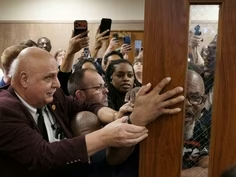
NewLouisiana map ignites debate over race and representation
Video has Closed Captions
Louisiana’s redistricting rush ignites debate over race and representation (8m 8s)
 New
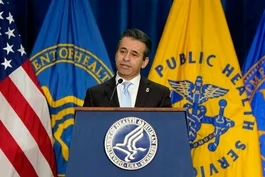
NewNews Wrap: FDA head Marty Makary resigning
Video has Closed Captions
News Wrap: FDA head Marty Makary resigning after uneven tenure (6m 52s)
 New
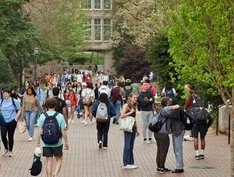
NewStudents question college as costs rise and AI impacts jobs
Video has Closed Captions
Students question value of college as costs rise and AI reshapes jobs (9m 19s)
 New
NewUkrainian city faces threat of 2nd Russian occupation
Video has Closed Captions
Inside Izyum, the Ukrainian frontline city facing the threat of a 2nd Russian occupation (7m 43s)
 New
NewWhat’s at stake as Trump heads to China for talks with Xi
Video has Closed Captions
What’s at stake as Trump heads to China for talks with Xi (5m 32s)
Providing Support for PBS.org
Learn Moreabout PBS online sponsorship
- News and Public Affairs

Today's top journalists discuss Washington's current political events and public affairs.

- News and Public Affairs

FRONTLINE is investigative journalism that questions, explains and changes our world.












Support for PBS provided by:
Major corporate funding for the PBS News Hour is provided by BDO, BNSF, Consumer Cellular, American Cruise Lines, and Raymond James. Funding for the PBS NewsHour Weekend is provided by...