
Single Parenting Neurodivergent Kids
Season 2025 Episode 6 | 26m 46sVideo has Closed Captions
Maryland single mom; Ask the Experts; Difference Maker golfer/advocate Carter Bonas.
A Maryland mom is rewriting the playbook for single parenting kids who learn and think differently. Experts share strategies for solo caregivers — from building support networks to balancing self-care. Plus, meet Carter Bonas, a young golfer and autism advocate driving change.
Problems playing video? | Closed Captioning Feedback
Problems playing video? | Closed Captioning Feedback
A World of Difference is a local public television program presented by WUCF
Single Parenting Neurodivergent Kids
Season 2025 Episode 6 | 26m 46sVideo has Closed Captions
A Maryland mom is rewriting the playbook for single parenting kids who learn and think differently. Experts share strategies for solo caregivers — from building support networks to balancing self-care. Plus, meet Carter Bonas, a young golfer and autism advocate driving change.
Problems playing video? | Closed Captioning Feedback
How to Watch A World of Difference
A World of Difference is available to stream on pbs.org and the free PBS App, available on iPhone, Apple TV, Android TV, Android smartphones, Amazon Fire TV, Amazon Fire Tablet, Roku, Samsung Smart TV, and Vizio.
Providing Support for PBS.org
Learn Moreabout PBS online sponsorship(upbeat music) >>Welcome to A World of Difference: Embracing Neurodiversity.
I'm Darryl Owens.
Life as a single parent can feel like you're Eddie Murphy in the Dr.
Doolittle movie franchise, playing every part, and when you're raising neurodivergent children, the roles only multiply.
One moment brings pure joy watching your child's unique strengths shine.
The next brings exhaustion, juggling work, school, therapies and wondering if you're doing enough.
The challenges are real.
Navigating IEP meetings solo, managing meltdowns without backup, and carving out time to care for your own mental health.
But here's the truth, single parents can and do raise thriving neurodivergent kids with the right strategy, support, and mindset.
On this episode, we meet a Maryland mom who's crafted her own winning playbook for parenting solo.
Turning obstacles into opportunities for her kids who learn and think differently.
Then our panel of national experts shares practical advice for single parents, from building a support network to balancing self-care with caregiving.
And later we introduce our newest difference maker, a young golfer, entrepreneur and autism advocate who's crushing drives on the links, but isn't old enough to drive.
But first we head to Maryland to meet the Walker family, where mom Pheona keeps it all together.
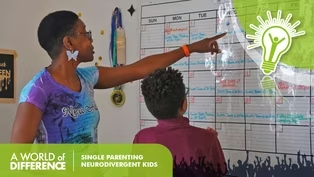
A calendar wizard, making childhood magic for her kids.
(upbeat music) >>Well, my name is Pheona Walker and I'm a single mom of twins, Gabriela and Isaiah.
We're a household of, I guess, ADHD family.
That folks think that your kids are supposed to typically be able to do this or that at a certain age.
Like, your kid's not sitting still, they should know how to sit and quiet, or you should know how to control your child.
Or, you know, I feel alone in those spaces that my kids and I were just too much at times.
And it makes me feel like, you know, I don't wanna meet too many new people because I'm like they're gonna look at me strange or looking at my kids strange or they're too loud, or you're too, they're flipping all over the place, or they're yelling in the background.
(Gabriela playing) >>Ta dah!
>>I think the hardest part is the afternoon, actually, before they come home.
Right before they come home, and leading up to when they're home.
>>You need help?
I got you.
>>Yeah.
>>There you go.
>>Thank you.
(door creaks) >>Wee!
>>Good afternoon.
>>Good afternoon.
>>Make sure dinner is set.
Make sure I get dinner ready.
I'm currently teaching them to cook and use the air fryer and stuff, so just prepping meat, prepping things, and just having, when they come home, take turns and teaching them and having that patience.
>>My mom always helps me with my homework, so I appreciate her for helping.
I really need to finish the science work.
>>Okay, so you gonna work on it, and let me know if you need help.
>>And if this doesn't change up, I just already asked them for extra credit.
>>Okay, so do you understand what you have to do?
>>Yes.
I like her for being her.
I mean, she's nice, very kind, thoughtful, creative, helpful even things when it gets tough, and she just inspires me.
>>So I got the call about her being suspended for getting into a fight.
This is the day in the life of a family with ADHD, neurodiversity.
You know, this is us.
Remember that?
I gotta remember being in middle school, I gotta remind myself, you know.
When I was that age, you know, you have kids who will come at you, and so I gotta look at the stuff and be like, she's been on the honor roll.
She did her baptism class.
You know, she's been honor roll three quarters, both of them.
She's doing her best.
We have good days, we have bad days, and I just remember that by looking over things 'cause I don't wanna just jump in and attack, and say, why didn't you do this?
She had this coping plan that I gave to school when she was in elementary school.
It's not for middle school where I gave it to her to keep, and I gave her teachers, like when things, someone's making fun of me, these are my triggers.
Someone blames me.
I can't figure, and what we can't do is hit someone, break, shout, curse, and then what you can do, draw pictures, breathe, you know, stuff like that.
Ask for a break, just to help her with, you know, trying to figure out.
Was it from that?
>>Yes.
>>Because you told me >>Yes.
>>You tripped on the sidewalk.
>>Yes, from that.
>>That's why your glasses all scratched up.
>>Yeah, I put it down on the ground.
>>So what did you tell me it was from tripping on the sidewalk?
>>Because I didn't want you to know that I got that in trouble.
That I fought.
>>But you didn't know that?
You know, the school would've called me.
I wanna be that person that when they see I'm going through hard stuff, I tell them, but I'm looking for solutions.
I don't want 'em to give up and think, okay, 'cause this is hard.
You just give up, so I always try to push through.
I have to watch myself because I'm like, okay, this is hard, but, you know, the kids are watching.
Show them how you can still make it through even hard times, things can come back around.
>>So let's go through the other.
>>I love that she's always supporting and there's somebody that I can talk to.
Next time what I would do is I would talk to her when I have a problem because she really understands it, and she doesn't just say yes to anything that I say.
She actually listens and tell me what's right and wrong.
That's what I love about my mom.
>>They help push me through 'cause I know they're looking at me 'cause they're not listening.
Sometimes they're not listening, but they're watching.
They watch me a lot and I make sure I'm like, okay.
You know how they say kids don't listen to what you say, but they watch what you do when they follow, and it's true.
I hear them and I see them do things when they don't think I'm around.
I'm like, oh my gosh, they were listening.
They'll tell kids, oh just, you know, pray, God loves you and stuff.
I'm like, I look and I see, I'm like okay.
Everything I'm doing, it's helping them, it's benefiting them.
(gentle music) >>Next our panel of national experts offers actionable strategies for single parents raising neurodivergent children.
Tips to help you manage stress, advocate for your child, and create a home where differences are celebrated.
(upbeat music) Dr.
Sarah Bren is a clinical psychologist and parenting expert focused on child development, attachment and neurodiversity.
She co-founded Upshur Bren Psychology Group and host the "Securely Attached" podcast, translating research into practical strategies for families.
Her work emphasizes emotional regulation, resilience and compassionate parenting from infancy through adolescents.
Clarissa Harwell is a licensed clinical social worker in a psychotherapist specializing in neurodivergence, trauma, and LGBTQIA+ care.
She directs behavioral health programs, conducts autism, and ADHD assessments, and trains schools and agencies on neurodivergent affirming parenting.
Clarissa brings extensive experience in crisis intervention and family support.
Dr.
Meghann Sallee is a licensed psychologist and professor at Beacon College.
The nation's first accredited baccalaureate institution dedicated to educating neurodivergent students.
She specializes in neuropsychological assessment, ADHD, and evidence-based therapies with extensive clinical experience in family systems and behavioral health.
She trains psychiatry residents and supports caregivers through interventions like CBT, DBT, and ACT promoting mental health across diverse populations.
And we're gonna begin our conversation with Sarah.
How does secure attachment influence a child's resilience when raised by a single parent?
>>So we know that from many long-term studies that secure attachment is associated with all kinds of positive outcomes that are connected to a child's resilience in childhood all the way through adulthood.
Things like better mental and physical health, stronger relationships, even academic and vocational success are all associated with secure attachment, relationships formed early on in life.
And I do feel like a lot of single parents can often worry that, you know, if their child is maybe potentially missing that the benefits of that secure attachment potential, if there's only one parent.
But the attachment science is very reassuring here.
Decades of research shows us that secure attachment, it's much less about how many caregivers a child has and much more about the quality of the attachment relationship.
And even at least one key relationship that is secure in nature is predictive of secure attachment in childhood and through adulthood.
So when we have at least one adult who's generally, as much as they can be, emotionally available, who tries to understand their child, who comes back to repair when we miss attune and just helps that child feel seen and safe, and soothed a good amount of time, it doesn't need to be perfect and doesn't have to happen all the time.
The child can really truly internalize this sense of I matter, I'm not alone.
When things are hard, someone shows up for me.
These are all the building blocks of that secure attachment.
And it's really important, I think, for single parents to know, like, the attunement and emotional responsiveness that predicts this relationship and the security, it does not have to happen all the time.
Good enough is actually optimal here.
So we know that the research says that when parents are able to kind of get it right, even 30% of the time, we still are able to predict a secure attachment outcome.
So that's very, very helpful and hopeful for parents who are doing this on their own.
>>Alright, well great.
Well, Clarissa, how can a single parent take some steps to create a neurodivergent affirming household?
>>I really appreciate this question and there's a few things that parents can do that are fairly affordable, straightforward.
One of those things is, I think of it as putting on your detective hat for a week or two.
Ideally, this means parent is noticing their child's daily rhythms and patterns.
What is your child drawn to when they're bored, when they're stressed, when they're seeking comfort, when they're seeking sensory input?
And then adding in things that you notice your child needs at certain times.
Many kids, for example, come home from school if they attend school, and either need to zone out or they need to have a big rambunctious play period with a lot of growth, motor play, pushing things, pulling things.
So incorporating things into your home.
When my kids were little, they're both neurodivergent, we had a mini trampoline in front of the TV, bean bag chairs to jump on instead of, you know, "real furniture," and swings in the yard, monkey bars.
And we certainly don't need all that, but we do want to keep our mind on the sensory needs of our child.
A place to retreat when they need to retreat and decompress after being out in the world, which can be difficult and overwhelming, and overstimulating, as well as novelty and sensory input when they are bored or seeking connection.
>>All right, thank you.
So Meghann, can you walk us through some psychological factors that single parents need to understand about their way that their child thinks and learns early on?
>>Yeah, sure, so for our neurodivergent kiddos, this is not going to be a secret to them from early on that maybe they're feeling different than their peers.
They are probably getting a lot more negative feedback from the adults in their life, and so they may become pretty quickly more sensitive to some of these things and we may see some bigger emotions, you know, they may be more anxious, more frustrated, sad about things, and this may be displayed in maybe crying or acting out, yelling, being a little destructive.
And so for the parents it's really important to not overreact to that and not over interpret that and start thinking, oh, no, here we are, this is what it's going to look like forever.
And so we wanna employ some strategies that can help with those big emotions, and help that not be sort of the center of the child's development.
Excuse me.
So, you know, some things we talk about is catching the child being good, right?
And so for neurodivergent children, they're getting a lot of negative feedback or corrective feedback.
We need to catch them at times when they're doing things that they should be doing or they're doing things well, or they're on their way to doing something well.
So catching them while they're still sitting in that chair and saying, oh, "I love how you're staying "in your seat during dinner."
You know, those little moments where they're getting some positive feedback, and then that helps us enjoy the parenting too, where we're not feeling like we're constantly having to give negative feedback, right?
So there's a magic number.
Some people say four to one, some five to one of positive to negative.
So for every negative interaction we're trying to find four or five opportunities where we can give some praise to our child on the things they're working on and the things they're doing well.
And then one other thing would be, you know, some of these kiddos have a slower processing speed.
So we need to give them time to hear, and interpret, and understand, and put into action anything we're asking them to do.
So in my house we have a ten second rule, so if I give a command, I'm waiting 10 seconds until I say anything else so that their brains don't get jumbled and overwhelmed, and they can start to take some action.
So those are the things that I think early on can be really helpful in their development.
>>Alright, well thank you, so Dr.
Bren, how can single parents foster emotional regulation during stressful transitions like school mornings?
>>Yes, this is, oh, the school mornings are probably one of the most common stressors I hear parents talk about because they present this very unique, perfect storm, of time pressure, a lot of sensory overwhelm, and also a lot of executive functioning demands on the parents and the child.
And so I think we have to understand when we wanna talk about emotion regulation, it's like what are the building blocks of self-regulation in children?
And that really is gonna come from the capacity for the adults in their lives to co-regulate and also for the environment to be predictable and manageable for them.
And so basically this means before a child is gonna be able to regulate their emotional state, we have to be their external regulator, their external planner, and we have to share our calm with them.
So in order to do that, we have to possess these skills, we have to have access to them, we have to have gas in our tank to be able to access our own regulation, and we have to be kind of maintaining an environment that's relatively conducive to a calm and organized morning.
So a lot of the practical suggestions I work families through are actually more about what the parent needs in these mornings than the kid because it's gonna flow through us to them.
So any place where we can regulate our own state, where we can make sure our basic needs are met, that means maybe we're waking up a little bit earlier and having a cup of coffee or having some food or at least a glass of water.
We need to be able to have our own needs met so we can kind of manage the energy of the morning, and then anything that we could do to triage or, you know, prioritize.
So what can we do the night before?
What can we say we're not doing at all?
Anything to get things more organized and ready that in, you know, ahead of time so we're not having to make these decisions in the morning or get our kids to make decisions in the morning.
And then finally, I think there's a level of stress resilience, and stress management that we have to take.
So when we can reduce urgency, when we can reduce a sense of panic that this isn't gonna go well, that can also be super helpful.
So mindset, breathing, reminding ourselves, you know, even if it gets messy, we're gonna get through this.
We have a try again tomorrow can all be really helpful.
>>Watch the full "Ask the Expert" segment on our website at awodtv.org, if you wanna learn more about this topic.
You can also watch or listen on Facebook, YouTube, or on your favorite podcasting platform.
(upbeat music) Now, let's meet our latest difference maker.
Golf isn't just a game for Carter Bonas, it's a lifeline.
Diagnosed with Asperger's syndrome before his first birthday, Carter faced speech delays, bullying, and moments of deep struggle.
Then he discovered the golf course, a place where focus replaced frustration and confidence began to grow.
That spark led to something bigger.
At just 14, Carter is the founder and CEO of Spectrum Golf, an apparel brand built for comfort and inclusion.
He showcased at the PGA show, earned a full college golf scholarship, and launched a non-profit to provide free lessons and gear to kids and veterans.
Honored as Sports Illustrated Sports Kid of the Year and recognized as a UPS Unstoppable CEO, Carter's mission is clear, turn challenges into championships and show the world that differences are strengths.
(upbeat music) >>Can you pass the vinegar?
The doctors diagnosed me with autism when I was one.
Back then having autism was a struggle.
I couldn't talk until I was five.
I had some difficulties learning, focusing in class, and making friends.
>>It was difficult at first.
I think every parent getting a diagnosis like that is hard to accept.
So I said, okay, so what do we do?
What are the interventions we put in?
His favorite quote that he shares all the time is one by Nelson Mandela that, "Everything seems impossible until you do it."
Right, and he shared that with me when I say, Carter, we can't... yes we can.
Right, to him, any and everything is possible, and he is teaching me that.
>>I got started with my business and playing golf.
Found a good business idea and that was a line of comfortable golf clothes.
The clothes that fitted the dress code felt really uncomfortable for me, so I wanted to have my own golf apparel line so I could have my own comfortable golf clothes.
And so I can give comfortable golf clothes to people who have a skin sensitivity just like me.
I started a non-profit called Carter Spectrum Golf, where I give free golf lessons to youth and veterans, and introduce them to the game of golf, and I noticed that not a lot of people who looked like me were playing golf.
Golf is just a really expensive sport.
Buying the golf bags, golf clubs, fitting them when you grow out of them, and the fees for the golf course.
So I wanted to start my own nonprofit so I could cover those costs, and just let people discover the joy of playing golf just like I did.
Currently, I'm working with 85 kids and it's a lot, but it's just really fun teaching them and introducing them to the game of golf, and it's just something I have a passion for.
>>Knowing the type of stuff that he's been through and knowing how he's gotten over that is really inspirational.
So the fact that he even saw a problem with people having a place to connect and actually made the initiative to go out there was really good because some people on the spectrum don't do that.
He did it and I like it.
I don't know if I would have found this new version of myself if I hadn't have found Carter.
>>So one day I woke up or my mom woke me up and said, get ready by 10, we have a photo shoot we need to go to, and fast forward we finish, and everyone is kind of gathering around me and I find out that I was gonna be a Sports Illustrated Sports Kid of the Year for 2022.
And it was just, it was amazing.
I was shocked, I was excited.
One of Ernie Els' friends saw my news interview.
One day we woke up and we checked our emails, and we were just really surprised when he reached out to us.
He invited us to the Chubb Classic where I got to meet him and we, I actually got to walk 18 holes with him, which was amazing.
2023 I was UPS's Unstoppable CEO, and it was awesome.
I wrote my own book called, "Swinging Beyond the Spectrum: "How Autism Became My Superpower "On and Off the Golf Course," and it's about the story of my life, and the struggles and challenges I had to get through and overcome.
>>He's become a little motivational speaker, and at first I was afraid to have him share his story and I told him, Carter people are not always nice.
And he says, whether I share it or not, people aren't nice.
My hope for Carter is to be able to continue to do what he's doing because he loves what he's doing.
>>One of the projects that I'm working on is called Carter Spectrum Farm, where we are going to have a place where people can retreat to detox from unhealthy foods, and one of my main goals is helping kids, and people with diabetes beat it just like I did.
I just want to help as much people as possible and I think sharing my story is one of the things I can help people with.
(upbeat music) >>Congratulations, Carter Bonas for making a difference, and that does it for this episode of A World of Difference Embracing Neurodiversity.
I'm Darryl Owens.
See you back here next time.
You can watch episodes of A World of Difference on the Beacon College Facebook and YouTube channels, and on the shows website awodtv.org.
The website also provides tip sheets and other resources for your parenting journey.
You can watch the show from the PBS app available on your favorite streaming device and you can listen on your favorite podcasting platform.
Thank you for watching and supporting A World of Difference.
(upbeat music) (upbeat jingle)
Single Parenting Neurodivergent Kids | Preview
Preview: S2025 Ep6 | 30s | Watch a preview of the next episode of A World of Difference. (30s)
Providing Support for PBS.org
Learn Moreabout PBS online sponsorship













Support for PBS provided by:
A World of Difference is a local public television program presented by WUCF