
U.S. ambassador on tensions between Israel, Turkey, Syria
Clip: 8/21/2026 | 7m 52sVideo has Closed Captions
U.S. ambassador responds to rising tensions between Israel, Turkey and Syria
The Israeli military bombed an airbase in Syria, far from the Israeli border, sparking condemnation not only from Syria, but also Turkey and the Trump administration. U.S. Ambassador to Turkey Tom Barrack accused Israel of an “unnecessary escalation that does not advance regional stability.” Nick Schifrin spoke with Barrack to discuss the tensions.
Problems playing video? | Closed Captioning Feedback
Problems playing video? | Closed Captioning Feedback
Major corporate funding for the PBS News Hour is provided by BDO, BNSF, Consumer Cellular, American Cruise Lines, and Raymond James. Funding for the PBS NewsHour Weekend is provided by...
U.S. ambassador on tensions between Israel, Turkey, Syria
Clip: 8/21/2026 | 7m 52sVideo has Closed Captions
The Israeli military bombed an airbase in Syria, far from the Israeli border, sparking condemnation not only from Syria, but also Turkey and the Trump administration. U.S. Ambassador to Turkey Tom Barrack accused Israel of an “unnecessary escalation that does not advance regional stability.” Nick Schifrin spoke with Barrack to discuss the tensions.
Problems playing video? | Closed Captioning Feedback
Where to Watch PBS News Hour
PBS News Hour is available to stream on pbs.org and the PBS app.
Providing Support for PBS.org
Learn Moreabout PBS online sponsorshipAMNA NAWAZ: Much of the world's attention has been focused on the stalemate in the U.S.-Iran war.
Meanwhile, elsewhere in the Middle East, tensions are mounting between U.S.
allies, Israel and Turkey in the once hotbed of civil war, Syria.
Nick Schifrin has more.
NICK SCHIFRIN: Turkey and Israel are two of the U.S.'
most important allies in the region.
The strike exposes their increasing tension, with Syria caught in the middle.
It was overnight Monday when Israeli warplanes bombed the Abu al-Duhur Air Base.
Those circles are craters made by Israeli bombs on the runways.
The air base is about 45 miles from the Turkish border, 180 miles north of Israel.
At first, Israel did not claim responsibility.
But then U.S.
Ambassador to Turkey Tom Barrack, who is also U.S.
special envoy to Syria, wrote on X: "The confirmed Israeli airstrikes on Abu al-Duhur Air Base constitute an unnecessary escalation that does not advance regional stability."
After that, Israel acknowledged the strike.
And Israeli Prime Minister Benjamin Netanyahu said he was trying to prevent a Turkish troop deployment.
BENJAMIN NETANYAHU, Israeli Prime Minister (through translator): We saw that Turkey intends to establish a presence in the airport south of its current lines.
So we conveyed a message.
The message went through, but it seems that they did not listen.
And so we made sure that they understand it better.
NICK SCHIFRIN: And, today, the rhetoric only increased.
Netanyahu called Turkish President Recep Tayyip Erdogan a -- quote -- "antisemitic dictator," a statement that Erdogan's office called a - - quote -- "cheap political ploy aimed at gaining an advantage for Bibi himself in the upcoming elections."
So to talk about this, I welcome Ambassador Tom Barrack.
Thank you so much, Ambassador.
Appreciate it.
Welcome to the "News Hour."
Why is this moment so important to the Trump administration?
Why'd you publicly call out Israel's strike?
Why are you talking about it to me today?
TOM BARRACK, U.S.
Ambassador to Turkey and U.S.
Special Envoy to Syria: It's important to the Trump administration because President Trump has engaged in a new kind of Middle East regional program.
We want all of the different regional partners to start usurping their own responsibility.
The answer to all this is, lower the temperature, increase the dialogue, increase the discourse, and avoid these -- abrupt kinetic action.
The long and short of this is that the mistake that was made was not miscommunication.
Israel had thought that they had had a tacit agreement with Syria and a discussion with Turkiye of saying, guys, after October 7, everything has changed.
We, Israel, want a clear line of sight between us and Iran, and we are really encouraging you not to put defensive or offensive military equipment or people between us.
NICK SCHIFRIN: I spoke to multiple Israeli officials today, and they make a few arguments.
One, they attack Erdogan personally, as you know.
Two, post-October 7, they argue that they will not trust Turkish or Syrian troops anywhere near their border.
And, as you said, there's an agreement between Israel, Syria, and Turkey to maintain the status quo, and the Turkish move into this base broke that status quo, they warned against it, they're enforcing their red line.
What do you say to that argument?
TOM BARRACK: I would say I understand their point of view.
They have communicated that point of view.
I don't think any of the other parties agree.
I know that they don't agree that there is a definitive agreement to that effect.
There's a tacit understanding that that is what Israel communicated, and we understand why they communicated it.
So what happened here was not a miscommunication.
They had communicated to us and to the Syrians.
The problem here is -- which has already been reported, the director of Mossad, who's also a very good professional, had engaged in a back-channel discussion with the prime minister, the foreign minister of Syria on Friday.
They had had a discussion about this.
Israel had told us for a preceding five days they were concerned about what was going on.
We went to our intelligence agencies.
Syria talked to Mossad, gave them the information that there were no Turkish military, there was no Turkish convoy, there were no Turkish armaments, and that there was nothing adversarial or offensive going on.
That was on Friday.
They were supposed to meet again the next week.
The Syrians, the Americans all thought that was going to be a continued dialogue.
We had set up a fusion cell if they needed to keep discussing it.
And something went awry, and Israel decided that they needed to bomb the craters on two runways.
The problem with this is, Turkey did not know it was coming.
So the real issue here is, without notice to a country like Turkey that has a powerful military, a forcible air force, a difficult political rhetoric between Israel and Turkiye -- by the way, in my opinion, it's mostly politics.
But it came 80 kilometers to their border without notification Israeli jets.
NICK SCHIFRIN: But it sounds like your message here, you're coming on here to send the message that you understand Israeli concerns, but you are concerned about how Israeli communicated leading up to this strike.
TOM BARRACK: Yes, I mean, I think every -- I think everybody's concern is that there was some miscommunication, because they had been communicating their concern, which as they should, and it was being received and dealt with, as it should.
But the attack was unannounced.
It's all a matter of, let's bring this back to a table where you can all sit down and talk.
That you're going to have issues with each other, fine, but avoiding kinetic interaction or surprises is the goal.
And that's all we're trying to do, is bring everybody back to the table.
There was -- there was no, what we can see, malintent or aggressive action by Syria or Turkey, understanding that Israel is very sensitive to all of those issues that are going on.
NICK SCHIFRIN: Does Israel really care about this site because of the airspace?
Does Israel have a legitimate concern that Turkey would, for example, put missiles inside of Syria that could shoot down Israeli planes that would be flying toward Iran?
TOM BARRACK: Look, Israel is smart.
They have one of the best intelligence organizations in the world.
We all have great respect for them.
We also understand they're in an election cycle, that these kind of issues which they have everywhere, which is unfortunate, can cause them to have a rational judgment on all these issues.
But the way to handle that is to have a discussion with Turkiye on a back channel or front channel, rather than taking independent action.
Turkey said openly that they don't have an aggressive or offensive posture with Israel.
They do not want to engage in kinetic or military operations.
They want a sovereign and independent Syria.
We want an independent, sovereign Syria.
It's what everybody wants.
It's what Israel wants also.
It's what they need, what they're concerned about.
And they were rightfully concerned at the beginning with the new regime.
Now we're almost two years in.
And we're hoping that we can build trust in tiny baby steps.
But this was a bit of a setback, but I think it's a temporary setback.
NICK SCHIFRIN: Tom Barrack, the ambassador to Turkey and special envoy to Syria, thank you very much.
TOM BARRACK: Thanks, Nick.
Thanks for your time.
Brooks and Capehart on how the economy defined the primaries
Video has Closed Captions
Brooks and Capehart on how economic concerns defined the primaries (12m 7s)

Paramount's threat to leave California divides Hollywood
Video has Closed Captions
Paramount's Warner Bros. bid and threat to leave California divide Hollywood (6m 36s)
Poorna Jagannathan joins Amna Nawaz on 'Settle In'
Video has Closed Captions
Poorna Jagannathan and Amna Nawaz discuss representation in Hollywood on 'Settle In' (3m 44s)
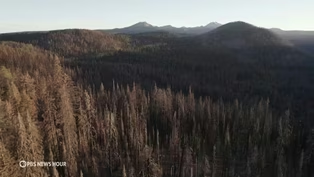
Record amounts of glyphosate sprayed in California forests
Video has Closed Captions
U.S. Forest Service, timber companies spraying record amounts of glyphosate in California (9m 20s)
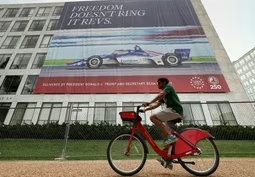
Trump's ballroom gets boost from Supreme Court
Video has Closed Captions
From White House ballroom to IndyCar race, Trump's spectacles take center stage in D.C. (5m 55s)
Providing Support for PBS.org
Learn Moreabout PBS online sponsorship
- News and Public Affairs

FRONTLINE is investigative journalism that questions, explains and changes our world.
 New Episode
- News and Public Affairs

Today's top journalists discuss Washington's current political events and public affairs.

 New Episode
 New Episode
 New Episode
 New Episode
 New Episode
 New Episode

 New Episode
 New Episode
Support for PBS provided by:
Major corporate funding for the PBS News Hour is provided by BDO, BNSF, Consumer Cellular, American Cruise Lines, and Raymond James. Funding for the PBS NewsHour Weekend is provided by...