
Iran War Reaches 60 Days. Will Trump Need Congressional Approval Going Forward?
Clip: 4/29/2026 | 11m 27sVideo has Closed Captions
The U.S. and Iran are in negotiations after the countries agreed to a cease-fire.
The 1973 War Powers Act gives President Donald Trump 60 days to wage war without congressional approval.
Problems playing video? | Closed Captioning Feedback
Problems playing video? | Closed Captioning Feedback
Chicago Tonight is a local public television program presented by WTTW
WTTW video streaming support provided by members and sponsors.
Iran War Reaches 60 Days. Will Trump Need Congressional Approval Going Forward?
Clip: 4/29/2026 | 11m 27sVideo has Closed Captions
The 1973 War Powers Act gives President Donald Trump 60 days to wage war without congressional approval.
Problems playing video? | Closed Captioning Feedback
How to Watch Chicago Tonight
Chicago Tonight is available to stream on pbs.org and the free PBS App, available on iPhone, Apple TV, Android TV, Android smartphones, Amazon Fire TV, Amazon Fire Tablet, Roku, Samsung Smart TV, LG TV, and Vizio.

WTTW News Explains
In this Emmy Award-winning series, WTTW News tackles your questions — big and small — about life in the Chicago area. Our video animations guide you through local government, city history, public utilities and everything in between.Providing Support for PBS.org
Learn Moreabout PBS online sponsorship>> This week marks 60 days since the start of the war in Iran.
Under the 1973 War Powers Resolution.
The president needs congressional approval to continue military action after 60 days, though, he is allowed an additional 30 day extension.
The U.S.
and Iran are in negotiations after the 2 countries agreed to a cease-fire.
However, President Donald Trump has made threats of further escalation after rejecting a potential agreement earlier today.
Joining us to talk about all of this are Ibrahim Abu Sharif, journalism and Middle Eastern studies, professor at Northwestern University and author of Social Media, Religious Authority and the Arab Gulf Crisis.
Richard Porter, an attorney and longtime member of the Republican National Committee from Illinois.
He was a White House adviser to President George HW Bush and Vice President Dan Quayle and Ralph Donaldson, professor of law the fee at the Chicago can't College of law with a specialization in constitutional law.
Gentleman, welcome back.
Thanks for joining us.
Richard, let's start with you first.
Where would you say negotiations stand right now between White House and Iran?
I think that what we're looking for is a surrender essentially.
so I don't really think I think the negotiation is window dressing or they want to give the Iranians some face Saving avenue out by Green.
>> To basically surrender.
look, surrender worked out well for Japan after World War.
2.
It's the right move for Ron.
The RIAA was crashing today.
It's almost worthless.
They always run out of space to hold the oil that they've been pumping once they run out of space.
They have to cap out those well as it could have real damage to the petroleum industry in the run.
So it's time for Iran to smell the coffee and agree to some terms.
The president has said they're going cry uncle what is what is his strategy here?
His strategy is to really lean on them.
He's got got he's got them on the ground and they're pinned and he's slowly choking at out until they realize that they've got tap it out.
They can tap floor, be done with for him.
>> I have a different point of view on the I negotiations has nothing to surrender.
What it does he going to give our takes the Iranians are more willing give up?
I think nuclear ambitions, although they will not get released their right to have nuclear enrichment.
So I think that we're looking at messaging here.
That's erratic.
mean, one point Donald Trump is seems conciliatory.
Another point he was surrender.
And so I don't think that we can read the situation simply by what the White House puts out.
What the what those at the apex of American political military power are saying because the messages are are mixed.
So I don't think Iran is going to surrender.
If this is what they're waiting for, they'll be waiting for According to a Reuters poll, just 34% of Americans approve of this conflict making it one of the lowest approval.
>> Ratings for any war in American history for him to you first.
What does that mean for the Trump administration?
Well, it used mean a lot more before bur right now.
I think this administration depends on bluster and rhetoric.
That to satisfy their own moves.
eagles.
>> So right now, this has ultimately go to legislations.
That has to go to last because know if if they're really concerned about the midterms and then they have to pay attention to that.
However, vines that are making decisions on the ground seemed to have little respect for what the polls are saying.
yeah, so well and night we're going to come back to the impact on the midterms as well.
Briefly, Richard, what do you think all of this means for the Trump administration?
I think they're going to hang in there until they get the job done.
And I think that's possible that they'll go back some more kinetic action.
>> You know, bring the bombs back if they don't get any further progress, they will open the Strait of Hormuz.
And so that or later, this will come to an end.
I think that like to get it done without putting any more American lives at risk, most striking things about this whole engagement has been the extent to which President Trump has been trying to avoid U.S.
casualties, avoiding putting troops on the ground in Iran, putting them in harm's way.
I think he's trying to finish this up without putting boots on the ground.
It might be that they have to do some more work in that regard.
>> Reptiles and Friday marks 60 days since the start of the war.
The 1973 War Powers Resolution says that Congress would have to approve any continued action either within these 60 days or after an additional 30 day extension.
What options are on the table for Congress here?
So Congress assuming that the War Powers Act is constitutional.
Congress has a couple of options.
So the War Powers Act itself says that Congress can at any period whether within the 60 days or without >> call that back in the action by resolution of the Congress.
So that's one option that they have.
It's not clear, however, if they're really the votes to do that, at least at this time.
Congress also can defund the war.
They can choose not to continue spending.
Congress has the power of the purse.
It's also a lot of talk with their whether they have the political will to do that either.
But those are the 2 basic options that that Congress has at this time.
Okay.
>> So, Richard, as we mentioned, we're coming up on the midterms with an increasingly unpopular war.
Where does that leave House Republicans?
Well, I I think that they're just as a matter of principle, not going to leave the president hanging on this engagement that some people that are unhappy with the war.
There's a split within the >> overall movement because there's been some sense of isolationism among some of the right.
There's concern about having boots on the ground most wars.
What I think Donald Trump has been able to pull off so far is remarkable amount of of work in terms of defending the run without having troops on the ground and it shouldn't be long-term engagement.
So I look, I think the presents real issue for something earlier.
He wants to have this all cleaned up by the 200 50th anniversary of the Declaration Independence, July 4th.
So I think he really wants to kick off the fall campaign season them with with a victory and and you're on a victory in Venezuela and frankly, also a victory in Cuba.
so we'll see.
I mean, I think that he wants to wrap it up, but he's going to wait it out.
If you to.
>> So Department of War were Department of Defense Secretary Pete Hegseth testified on Capitol Hill today sparring with lawmakers including here he is start with lawmakers over why the war started.
Here he is with Representative Adam Smith, a Democrat from Washington.
>> Their nuclear facilities have been obliterated underground.
They're buried.
People watching will winning wars.
That we know where any nuclear material be.
Claiming time for watching second here.
>> We had to start this war.
You just said 60 days ago because the nuclear weapon was an imminent threat.
Now you're saying that it was completely obliterated, not giving up their nuclear ambitions and they had a conventional shield of operation midnight.
Obama is nothing of substance what exactly the place we were before.
>> Okay.
So there's been some conflicting reports from the intelligence community as well before and after the war started.
Former director of the National Counterterrorism Center, Joe Kent resigned saying that Iran had posed no imminent threat to the U.S.
acting CIA director John Ratcliffe said that there is a constant threat.
Ibrahim, how solid are the reasons for the war in?
Do you think that the messaging is landing with the general public for I think the messaging is outlining because it's not based on something that's real.
>> Because Iran has not and was not a threat to United States.
It was not imminent threat.
And nuclear ambitions did not include the bomb.
And if this was a case they would have had it.
And so for the last 25 years around this whole thing and a very bizarre twist of time.
Special realities was 2 weeks away from having a bomb.
>> And so that that rhetoric pass, if it has to stop because it's untrue because we're talking about cleaning up kinetic continue with the operations in Iraq were talking about killing people.
civilians like the schoolgirls who died and the very first early days of the war.
And so you're on.
think for 40 years Iran has been demonized American Western mentality.
And so when your demonize and when you are can, when your humanity is changing or or converted into an obstruction, you can do whatever you want with them.
But I think right now Iranians messaging system is probably better more mature than the Americans.
I'm not an apologist for Iran not to pause for a repressive regime, a regime in the world.
But I do think that Iran is a victim here.
United States attacked Iran.
And we can never forget that.
I think the whole notion that there are in a threat to United States is and are not reporter.
So the whole death to America thing was made up.
I mean, come on.
That's ridiculous.
100 bison have 60%.
>> Refined uranium, other than to make bombs and they can take that from 60 to 90% less than 2 weeks.
They told the U.S.
negotiators uranium for 11 bombs and they had every intention was they took it out of trying to do that.
And if they had the bomb, we would be able to do any of this.
That's precisely why we had to go They have a missile that hit these did able to or see a 2000 miles away.
They they have the ability to love nuclear weapons into Europe.
In a short period time the bill actually North America.
This was a real risk.
It's been a real risk and they've been blowing up Americans for 39 to 49 years.
It's crazy lines us up first on the radar.
Not they were not.
not going up for Americans.
This is nonsense and I'm sure they were Iraq.
Iran has been surrounded by American bases in before they pulled out a path pass completely surrounded by American bases.
>> It's only past pathway to head to preserve its sovereignty is to the threat of nuclear weapons.
It's never been serious that once we got to talk about constitution draft because what is the president when it comes to war powers resolution and how have past presidents do with it?
To dealt with this in a couple of ways.
Most presidents have not conceded that it's constitutional.
And there are a number of scholars, including myself.
We think that there are some >> constitutional issues with the with the war powers resolution.
President Obama actually was one president who actually conceded that resolution is constitutional.
But most presidents have, despite those homes have attempted to follow the framework that it sets up.
So as we mentioned at the top, there's a framework that the war powers resolution sets out that says essentially presidents have 60 days to conduct military action and then they can either seek explicit was an authorization from Congress or they can pull out or they can do another 30 days to essentially wind down the operations.
So that is the president likely to take advantage of those 30 days.
And if so, then what is Congress likely to do in about 20 seconds?
>> So that the president elect take the extra that line is is coming up.
And I imagine that our Congress we'll probably not do very much but allow this to continue as it has so far, OK?
Well, watch it.
Play out them.
What have to have
 New
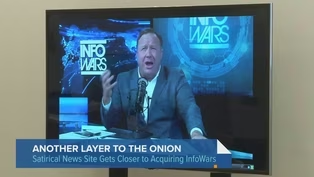
NewThe Onion Reaches New Deal to Take Over Alex Jones’ Infowars
Video has Closed Captions
The deal is close to two years in the making. (7m 20s)
Providing Support for PBS.org
Learn Moreabout PBS online sponsorship
- News and Public Affairs

Top journalists deliver compelling original analysis of the hour's headlines.

- News and Public Affairs

FRONTLINE is investigative journalism that questions, explains and changes our world.












Support for PBS provided by:
Chicago Tonight is a local public television program presented by WTTW
WTTW video streaming support provided by members and sponsors.