Florida Road Trip
Florida Lighthouses
Season 2026 Episode 3 | 26m 46sVideo has Closed Captions
Explore the keepers, shipwrecks, and stories of Florida’s lighthouses.
Join the ride along Florida’s coast, where towering lighthouses guided ships through dark waters and shifting shorelines. Explore stories of keepers and families, shipwrecks and storms, from Amelia Island to Key West. Florida Road Trip uncovers the people, places, and history that keep these coastal beacons shining.
Problems playing video? | Closed Captioning Feedback
Problems playing video? | Closed Captioning Feedback
Florida Road Trip is a local public television program presented by WUCF
Watch additional episodes of Florida Road Trip at https://video.wucftv.org/show/central-florida-roadtrip/
Florida Road Trip
Florida Lighthouses
Season 2026 Episode 3 | 26m 46sVideo has Closed Captions
Join the ride along Florida’s coast, where towering lighthouses guided ships through dark waters and shifting shorelines. Explore stories of keepers and families, shipwrecks and storms, from Amelia Island to Key West. Florida Road Trip uncovers the people, places, and history that keep these coastal beacons shining.
Problems playing video? | Closed Captioning Feedback
Where to Watch Florida Road Trip
Florida Road Trip is available to stream on pbs.org and the PBS app.
Providing Support for PBS.org
Learn Moreabout PBS online sponsorship>>This program is brought to you in part by the Paul B. Hunter and Constance D. Hunter Charitable Foundation, a proud partner of WUCF and the Central Florida community.
>>On this edition of Florida Road Trip, we're following the lights along Florida's coast where towers were built to guide ships, warn mariners, and stan watch over changing shorelines.
>>When we say the oldest in Florida, we mean the oldest lighthouse structure continually stood without any major rebuilding.
>>And where Florida's beacons tell the stories of storms, shipwrecks, keepers and the families who made these towers their lives.
>>We were such a busy shipping channel here in the keys we couldn't not have a lighthouse.
>>Plus, where history stretches from the age of sail to the Space Coast.
>>So you take this 1800 lighthouse, and we share a space with this 2026 technology of blasting into space.
It's a really cool mix of past and future.
>>From dark coasts to guiding lights, Florida Road Trip is climbing higher for a look at Florida's lighthouses.
♪♪ >>Hi there and welcome to Florida Road Trip, I'm Scott Fais.
For centuries, Florida's lighthouses have assisted mariners when navigating dangerous waters and dark coastlines.
Today, we'll climb into the history of these cherished towers.
>>The light atop the Amelia Island Lighthouse shined for the first time in 1839.
Today, it's the oldest standin lighthouse structure in Florida.
But the tower didn't start here.
It was originally buil on Cumberland Island, Georgia, and then taken apar piece by piece and moved across the Saint Mary's River and rebuilt on Amelia Island.
>>When we say the oldest in Florida, we mean the oldest lighthouse structure continually stood without any major rebuilding.
>>For Tom, this tower is part of his family's story.
His grandfather and his great grandfather served as keepers here, caring for the light and raising their families right on the property.
The O'Hagans were lighthouse keepers here in Amelia for almost 50 years.
They lived in the cottage here.
My mom was born here.
My uncle was born here.
>>Lif at the lighthouse had a rhythm.
Before electricity, keeping the light burning required constant attention.
>>The duties of the lighthouse keeper.
The filling of those oil lamps.
The trimming of the wicks.
So they gained the nickname "wickies" at that time because of that.
They had to, you know have everything ready to go to for that night so that it could burn as bright as it could.
>>Through the night, the work continued.
>>They had to wind a cable.
They had like a 40 pound weight on the bottom of it.
And that was kind of like a clockwork mechanism that was attached to the bottom of the lens.
And so it was that weight fell and the lens would, would rotate in turn.
That cable had to be rewound about every four hours.
>>His family's lighthouse story didn't begin on Amelia Island.
Tom's great grandfather served as the keeper at Ponce Inlet.
In 1905, he moved his large family to Fernandina and then began a new chapter at Amelia.
Years later, during Worl War Two, the lighthouse operated around the clock, and new faces became part of daily life.
>>During the war, all lighthouses on the coast were to have a 24 hour watch from the tower.
So they sent my grandfather six young coastguard men, to help take those watches.
They became lik part of the family in a sense.
>>Nearly two centuries after it was first lit, the Amelia Island Lighthouse is still active.
The Coast Guard maintains the beacon, while the city of Fernandina Beach cares for the historic structure.
Visitors can walk the grounds and take in the views, but this is one lighthouse visitors can't climb.
Preserving this illuminating part of Florida history takes ongoing care and strong community support.
>>It's great that we live in a time where historic preservation is important to people.
Even if you're not into lighthouses, I think a lot of people want to preserve history, and I think that's important.
>>For Tom, the Amelia Island Lighthous is part of his family's story.
Generations lived here, worke here, and cared for the light.
Today, that same commitment continues to keep the beacon shining bright and its history alive for the community.
♪♪ >>Before completion of the Saint Augustine Lighthouse in 1874, there was just a simple structure keeping watch.
In the centuries that have followed, mariners have looked to the beacon on Anastasia Island to safely guide them.
Today, the Saint Augustine Lighthouse remains one of the oldest operating navigational aids in the United States.
>>Not many people are awar that the lighthouse that's here today is actually the second lighthouse to stand here in Saint Augustine.
That first lighthouse originated as a Spanish watchtower.
Then during the first British period, about 30ft was added.
Then late on, another ten feet was added.
It was also reinforced with coquina to become a coquina lighthouse.
It kind of looked like a fort, which was very cool.
It's gone through many change up until the shoreline started creeping up to the doors, and then it was commissioned to build a lighthouse here, back awa from those weathered elements.
>>That decision to move the lighthouse more inland is a major reason why it still stands today.
From its new spot, the beacon continues guiding ships through the area's challenging waters.
>>Throughout history and Florida's history.
That origin story of our state starts here in Saint Augustine as well as Pensacola.
We have that tie to the Spanish.
However, navigation was important.
The only way we connecte through the world was by boat.
And how do you keep boats safe?
Hundreds of years ago and lighthouses were the key.
>>Today, this coastline holds reminders of the voyages that didn't make it.
And the stories waiting beneath the waves.
>>One of the discoveries made by our team was of a British Revolutionary War shipwreck, nicknamed the Storm Wreck.
And what this discovery did is tie us closely to the American Revolution.
And it flips the script.
All of the people on board were escaping the Carolinas, coming down to Saint Augustine, because during the British period and the American Revolution, Saint Augustine was loyal to the Crown.
Imagine being forced from your homes to escape as a refugee to a safe haven.
And then when you get there, you shipwreck.
>>Keeping that navigational light burning required commitment and sometimes breaking expectations.
>>One of the most fascinating stories that is a two-parter is that we've had two female lighthouse keepers in our legacy.
One who was named Maria Andreu, and she served at the old Saint Augustine Lighthouse just before the Civil War.
And then Kate Har who was the first woman to live in this house with her husband, Major Brevet William Harn.
But unfortunately, he passed away from tuberculosi and she stayed after his death to serve as assistant keeper here to collect his pension.
It was pretty rare but you would see it throughout lighthouse history everywhere.
Where in these remote areas, you know, these women were really tough and they knew what had to be done.
>>With the current house completed.
The structure was designed to be instantly recognizable both day and night.
>>One of the common questions we get is why is it painted in a funky way?
And that funky way is very important.
That is what's called a Lighthouse Day Mark.
Mariners could tell where they were based on the color scheme, and the paint scheme of a lighthouse.
Ours is very unique, with a red lantern black and white spiral which would notify or signal that mariners were in Saint Augustine.
Conversely, in the evening the light source from the lens was very unique.
Not many people are aware, but every lighthouse has a different light pattern.
Think of it like Morse code, but with light: Dot, dash, in a unique pattern.
For example, if you're somewhere this evening or you're somewhere on the beach where you can see our lighthouse beam, at night you would see one beam, then nothing for 30 seconds, a second beam, nothing for 30 seconds, and a final beam and a complete rotation of 90 seconds, which signal those mariners.
Oh, I'm in Saint Augustine.
One of the other popular concerns we get is that there's so many steps in this lighthouse.
And while there are so many steps, our lighthouse is actually really easy to climb.
There are eight landings to stop and rest as visitors climb.
And we often get remarks on, wow, it's so grandiose.
There's so much space in here.
Our lighthouse is 165ft tall.
There are 219 cast iron steps all the way to the top.
We are the second tallest lighthouse in the state of Florida, and I believe we are the seventh in the United States.
But of course, I think we're the most beautiful.
This is the most iconic view in Northeast Florida.
Not only can visitors take in the rolling waves, whether they're big or small, based on a windy day here in Saint Augustine, they also can take in the pristine, preserved nature of the Anastasi State Park just across Salt Run.
And lastly look over our beautiful skyline of the historic downtown Saint Augustine and a bird's eye view of the Fort, the Cross, the Treasury and Flagler College.
>>Visitors to the Saint Augustine Lighthouse and Maritime Museum can climb the tower, along with finding the exhibits on maritime navigation, archeology, and the lives shaped by Florida's coast.
>>One of my favorite objects from our collection of over 20,00 objects is our lending library.
Lighthouse keepers would be stationed in different areas, sometimes really remote.
Here in the Lighthous of Saint Augustine, originally there was no bridge to this island, so one of the source of entertainment and education was throug an established lending library.
And the one we have on display had bee at other lighthouses in Florida.
And what a unique way that something we all connect with today is education, reading, books.
And that was so important back then.
>>This small detail, like the books themselves, allow the lighthouse to feel less like a monument and more like a place where people actually lived.
>>I think lighthouses are kind o like a time capsule of the past.
Throughout our lives, we learn about history in different ways, and what I've found is a connecting piece for me is that if a lighthouse has been around long enough, it has experienced every part of history.
We've talked about a watchtowe during the Spanish time period, all the way up through Civil War, as well as the birth of our country.
We need people to care.
There are so few o these historic structures left.
They hold so much memory of Florida's coast and it's such a unique story to tell for future generations.
♪♪ >>Across Florida, every lighthouse has a different story that contributes to our coastal history.
Ponce Inlet's chapter begins with the name, a name that still throws some folks off guard.
>>A lot of newcomers are fascinated when we tell them the story that this area, and also parts of other counties, as a matter of fact, about a fifth of Florida was referred to as Mosquito County.
>>One of those area with that name, the Ponce Inlet.
The area was originally known as the Mosquito Inlet until it was changed by the state in 1927.
But that meant the original name of the Ponce Inlet Lighthouse was... >>When it was first lit in 1887 was the Mosquito Inlet Lighthouse.
The Ponce Inlet Lighthouse is the tallest in the state, and one of the tallest brick lighthouses in the United States.
Its construction addresse the need for better navigation along this part of Florida's coast.
>>Florida's east coast by the 1870s is bustling with a lot of traffic heading down to the Gulf of Mexico and going nort and south along Florida's coast.
Well, specifically our lighthouse, for a lot of reasons, owes its existence to the fact that Cape Canaveral which was built about 15 years before, was in existence.
Saint Augustine Lighthouse was in existence, but you had approximately a hundred miles of what was called "dark coast," and something had to be done about that.
>>To illuminat that stretch, engineers needed a place that could support construction and access.
>>And of course, the ideal place to do that well, to bring building materials in, to build and construct the lighthouse would be an inlet.
And hello, Mosquito Inlet was the place.
>>But a tall tower wasn't enough.
The guiding power came from the light within.
>>You can almost trace the development of lamps with the fac that we started with kerosene.
These were huge lamps, required about three gallons of kerosene per night and they were lit inside.
If you can see over my shoulder.
Massive first order Fresnel lens.
>>Today, people can see firsthand how much lighthouse technology changed over time.
>>We have both our first order lens, first order meaning the largest lens, and we also have the Cape Canaveral first order lens for safekeeping.
They were very, very worried about damage from vibration from rocket launchers.
So we are a guardian of the Cape Canaveral Lighthouse right now.
>>As visitors climb the tower, they journey through history.
>>We're one of 12 National Historic Landmark, so designated we're probably the best example of what are called brick giants.
>>And after more than 200 steps to the top, the reward is the view.
>>Unparalleled.
You are seeing the Atlantic Ocean like you've never seen it before.
You're able to look at Daytona like you've never seen before, to the south.
New Smyrna, the inlet.
You're actually able to relat to things that you've only heard about before, like for instance, the inlet.
So it's amazing.
♪♪ >>Along a stretch of Florida coastline known for rockets and launch pads awaits another landmark that ha led travelers for generations.
The Cape Canaveral Lighthous first began guiding expeditions well before the space age.
>>People from here know tha our cape juts out quite a bit.
So if you think about back in the 1800s how dark it was, there's no lights or anything like that.
The fact that it juts out makes it a hazard for shipping and for commerce.
And there's also shoals, which are 13 miles offshore.
You take that with the shallow water because o the type of posts that we have.
And the ships are having shipwrecks.
>>Th first Cape Canaveral lighthouse went up brick by brick in the 1840s.
But the version people know today is different, and that difference is a part of what makes this lighthouse stand out from so many others in Florida.
>>Brick is great for being on the coast.
Weather exists and all the things that they though were the amazing aspect of it.
However, it was only 65ft tall and the light wasn't very bright.
Technology of the time.
So what they did is they built an iron one and they built it 151ft tall.
>>In it, they put a new technology, a Fresnel lens that shined its light further out to sea.
Yet this wouldn't be the only change to the lighthouse.
In the 1890s, concerns about erosion and flooding led crews to dismantle the iron lighthouse and move it inland to the site where it stands today.
>>It is still on dry land, but in the last ten year since I first visited that site, I would say half o the beach has been eroded away.
It's on the north side of what is now Cape Canaveral.
So if you kind of think of Cape Canaveral like a point, it's slowly doing this.
And the old lighthouse is on that northern part that's being sort of choked away.
>>That kind of erosion gives researchers another way to understand the Cape, not just as a landmark for navigation, but as a place where the shoreline itself has shifted.
>>Archeological sites, including historic sites like the lighthouse site, give us a sense of where shorelines were and how people chose to use the landscape.
>>The relocation helps with th preservation of the lighthouse, but also presents a challenge for those looking to visit.
>>The fact that we're on an active military base, it's a very sought after lighthouse for lighthouse enthusiasts because it's hard to get on and you have to plan ahead so you can't just go and run in there and bring the family and go.
So you have to have based access in order to get on base.
Anyone else has to book a tour through our website.
>>But Cape Canaveral's biggest twist, maybe what grew up around it.
Over time, the surrounding land became part of America's launch complex.
So this 19th century beacon built for ships now shares the horizon with rockets.
>>When NASA found this land and saw all this land around here, they decided that it was a great place to put the space program.
And of course, now we share the space.
So you take this 1800 lighthouse and we share a space with this 2026 technology of blasting into space.
It's a really cool mix of past and future.
>>That contrast is what makes the Cape Canaveral lighthouse different.
It's part maritime history, part engineering story and part Space Coast landmark.
You can trace Florida's path from coastal commerce to modern launch history by just standing right here.
>>So it's seen every launch that's ever occurred, and it's the only lighthouse that I'm aware of that has actually been a part of a space program and a gateway to space.
>>At Cape Canaveral, the view has changed in a big way over the years.
The mission of the lighthouse has stayed remarkably steady, helped people find their way, and stand watch over a coast that is always looking toward what comes next.
♪♪ When you envision a lighthouse, you probably get a picture of a tower standing on the shore or hugging the coastline.
In Key West, the lighthouse is actuall located in the middle of town.
And when you hear the story why, it's placement makes a lot of sense.
>>We had an original lighthouse, and it sat right on the shoreline that was built and opened in 1825, and it worked great until it didn't.
We had a big storm, a big hurricane come through, and in 1846, it toppled into the ocean during that hurricane.
>>After the hurricane, the island needed a working light again.
Ships were still moving through these waters, and the lighthouse was part of the island's connection to the rest of the world.
>>The Federal government wasted no time in replacing that tower.
We were such a busy shipping channel here in the keys we couldn't not have a lighthouse.
They temporarily used a light ship in order to navigate traffic through the area, but they expedited the building of that tower and it opened in January of 1848.
>>The new tower became part of Key West's identity in a different way.
As the island grew around it, the lighthouse became a landmark woven right into the neighborhood.
We didn't need a tall lighthouse here.
Our houses are two stories.
It's very visible because everything around it is shorter than that.
The reason they never had to do any day marks on ours is because we're really the only masonry structure.
All of our other lighthouses here in the Florida Keys, with the exception of the Dry Tortugas, are all marking the reef system.
So they're built on top of th Florida coral reef, not on land.
And they're all a metal framework.
So instantly you can tell the difference.
>>Today, visitors experience the lighthouse in a much different way than what mariners once did.
The climb is part history, part adventure, and part reward.
>>They can take 88 steps up to what I think is one of the best views of Key West.
Get to the top of the tower.
We have a full 360 degree viewing platform that anybody can access, because Key West is two miles by four miles.
When you are at the top of that tower, you see this island from edge to edge to edge.
It's amazing.
You can see the other islands that make up the Florida Keys archipelago.
And while you're up there, we have placards that indicate what you're looking at.
>>You can see a lot from the top The view is only part of the visit.
The lighthouse also preserves the lives of the keepers and the families who mad this place work day after day.
>>Barbara Mabrity's an interesting lady that's associated with our lighthouse.
First of all, she was a female lighthouse keeper in the 19th century, which was unheard of in a lot of locations.
She survived the hurricane of 1846, when that tower toppled into the ocean, and she was the lighthouse keeper when it was rebuilt inland.
She served as a lighthouse keeper until she was 82 years old.
>>Her story shines a light on the larger piece of Key West lighthouse history, one that gives women a central place in the story of keeping the light.
>>We had two other female lighthouse keepers on that property as well, and it's our responsibility, we think, because we think that's a really unique story about our lighthouse, that we share, that three women lighthouse keepers.
It's just not a normal jo for women in the 19th century.
We want people to not only climb the lighthouse to get that great view, but we want them to lear about the people that live there because this was their life, this was their livelihood.
>>The Key West lighthouse tell more than one story at a time.
It's about navigation, surviva and the people who kept watch.
It's also about community.
>>I think one of our headlines, right, is resilience in the community.
I mean, you look at it an you think about where you are.
Think about building back and other communities when things happen, they tend to rebuild exactl where the disaster has happened.
And I think part of the resilience of this community is kind of stopping taking stock and understanding where we live.
What is the potential for something like that to happen in the future, and how do we build it back that it's safe not only for the lighthouse keepers who are having to tend to that light, but also the mariners who were using it.
>>From the base of each tower to the top of every light.
Florida's lighthouses remind u that history is never far away.
These beacons have lit the path home for centuries, and today that traditio continues through their stories.
Thanks for joining us for Florida Road Trip, I'm Scott Fais.
We'll see you on our next cruise through history.
Until then, safe travels everyone.
♪♪ >>This program is brought to you in part by the Paul B. Hunter and Constance D. Hunter Charitable Foundation, a proud partner of WUCF and the Central Florida community.
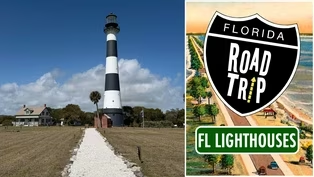
Preview: S2026 Ep3 | 30s | Watch a preview of the Florida Lighthouses episode of Florida Road Trip! (30s)
Providing Support for PBS.org
Learn Moreabout PBS online sponsorship















Support for PBS provided by:
Florida Road Trip is a local public television program presented by WUCF
Watch additional episodes of Florida Road Trip at https://video.wucftv.org/show/central-florida-roadtrip/