Here and Now
Chris Taylor on the 2026 Wisconsin Supreme Court Race
Clip: Season 2400 Episode 2431 | 9m 44sVideo has Closed Captions
Chris Taylor on her perspectives on the law and the politics of judicial elections.
Wisconsin Court of Appeals District IV Judge Chris Taylor, a liberal running for an open Wisconsin Supreme Court seat, discusses her perspectives on law and the politics of judicial elections.
Problems playing video? | Closed Captioning Feedback
Problems playing video? | Closed Captioning Feedback
Here and Now is a local public television program presented by PBS Wisconsin
Here and Now
Chris Taylor on the 2026 Wisconsin Supreme Court Race
Clip: Season 2400 Episode 2431 | 9m 44sVideo has Closed Captions
Wisconsin Court of Appeals District IV Judge Chris Taylor, a liberal running for an open Wisconsin Supreme Court seat, discusses her perspectives on law and the politics of judicial elections.
Problems playing video? | Closed Captioning Feedback
How to Watch Here and Now
Here and Now is available to stream on pbs.org and the free PBS App, available on iPhone, Apple TV, Android TV, Android smartphones, Amazon Fire TV, Amazon Fire Tablet, Roku, Samsung Smart TV, and Vizio.
Providing Support for PBS.org
Learn Moreabout PBS online sponsorshipFitzgerald, we leave it there.
Thank you so much.
>> Thank you.
Good to be with you.
>> Turning to the spring election for the Wisconsin Supreme Court, the seat opening up after Conservative Justice Rebecca Bradley decided not to run again will not change the balance of the court.
The conservative candidate is appellate court judge Maria Lazar, and the Liberal candidate is appellate court Judge Chris Taylor.
Here and now, senior political reporter Zac Schultz sat down with each of the candidates last week.
We heard from Maria Lazar tonight, Chris Taylor.
>> Judge Taylor, thanks for your time today.
>> Thanks so much for having me.
I really appreciate it.
judicial philosophy.
Tell me how you came by it and how it impacts you when you're on the bench.
>> Well, in every case, I'm guided by the same things.
I'm guided by a desire to do justice for the people who are in front of me.
I'm guided by a obligation to apply the law as fairly and as consistently as possible.
And then I'm also obligated to hold those who violate the law accountable, regardless of who they are or how how powerful they are.
So those are really the three principles that guide us.
My decisions in cases.
>> So you've been in this race for a while, and originally your opponent was going to be the incumbent, Justice Rebecca Bradley.
What was your reaction when she decided not to run again?
>> You know, my focus really is on the people, the state of Wisconsin, regardless of who my opponent is.
I am in this race because I care deeply about the people in our state.
They deserve a justice and a court that is going to stand up for their rights and protect their freedoms, and they deserve a court that is going to make sure that the other branches of government are held accountable, including the federal government, when they overreach into the independence of our state.
So I'm very focused on getting to the people, talking with the people.
My approach doesn't change based on who I'm running against.
This is a campaign about the people of the state of Wisconsin, and I'm going to be a justice for the people of the state of Wisconsin.
you don't see a big difference between Rebecca Bradley and Maria Lazar your opponent.
>> Now.
You know, I think they're very similar in a lot of ways.
They have very extreme positions that are out of touch with the people.
Wisconsin on reproductive health care.
My opponent, Maria Lazar, celebrated the overturning of Roe versus Wade.
She has made comments that she would have enforced an 1849 criminal ban that would have outlawed abortion.
In almost every instance, she has made comments that she thinks a six week abortion ban would be a good thing, signaling to the legislature that this might be a law that she would be okay with as a judge.
So those things indicate that she cannot be counted on to protect rights and freedoms of Wisconsinites.
And she wants to take us backwards.
I want to take the state and the people of the state forward.
>> Given the last couple of races we've seen in Wisconsin, how much money do you think it's going to take to win this race?
>> You know, I'm hoping not as much as what we have seen.
It has gotten ridiculous how much money are in these races.
And when I was in the legislature, I fought against the erosion of our campaign finance laws.
The reality is, here in Wisconsin, we have very little laws that prevent these out-of-state billionaires and big money special interests from coming into this race.
They're going to be coming in to support my opponent.
That is how she got elected to the Court of Appeals.
These same right wing billionaires that we saw last April have supported her in the past.
>> The first fundraising numbers that came out showed you with a commanding lead in fundraising.
Is there a danger that some of your supporters may think, oh, this race is over?
>> I hope not, because this race is not over.
We are right in the thick of it.
I take nothing for granted.
I worked very hard to get out in all corners of the state, and of course my campaign worked very hard to raise the resources that I would need out of my, I think, 19,000 campaign contributions, 15,000 of those are $100 or less.
So I am receiving a lot of support from the people of the state of Wisconsin.
That contrasts with my opponent.
Her average campaign donation was $1,800, and she only had 16 donations that were $100 or less.
So she's clearly getting her support and will continue to do so from the billionaires, from the big corporations.
I'm going to the people and asking for their support because this race is about them.
>> Unlike the last couple of races, this one's not going to likely determine the majority on on the bench.
Does that run the risk that this flies under the radar for some people because they don't feel the stakes are as high?
>> I mean, I don't think so because the majority on this court can be changed on a dime.
We have five state Supreme Court elections coming up.
And so just because there's now a pro-democracy majority on this court by only one vote does not lessen the importance of this court.
And when we have so many elections coming up, there's four more state Supreme Court elections coming up after mine.
No one should take anything for granted.
This court can change very quickly, but if I am able to get elected, there will be a pro-democracy majority on the court until at least 2030.
>> A couple of years ago, when Janet Protasiewicz won her race, she kind of changed the game in terms of talking as a candidate about her values versus issues and making sure to stay away from how she would decide.
But explaining to voters, this is what I care about.
This is what I'm passionate about.
How do you approach talking about your values or issues?
>> Well, I think it's really important that voters see who I am and they deserve that.
They are electing me to a ten year term to the highest court in our state.
So I am very open about what my values are.
You know, I value every person's ability to make their own personal private health care decisions.
My opponent does not.
She has stated that that is not a value that she has.
I value courts protecting people's rights and freedoms and holding people and entities accountable when they violate our law and violate our Constitution.
My opponent has shown that she is a rubber stamp for the most powerful and the right wing extremists in the decisions that she has issued.
And so I think it's really fair game for the public to know.
These things are things we value.
>> How do you approach precedent?
Because we've seen as the court shifted majorities over the last few years, a number of cases looking at old cases that have been settled in the past, Marklein being one of those.
But in that category, what would you do to when you approach a precedent decision?
have to look at does the precedential case violate the Constitution?
Does it does it protect or take away people's rights?
So that is the first thing that I would look at.
Secondly, I think if it is an issue that evolves in constitutional rights, you look at, well, has this been in place for a long period of time such that people have relied on these protections like Roe versus Wade?
It's a perfect example.
The Dobbs case took away rights that American women in Wisconsin women had come to depend on over the last 50 years, throughout the duration of my life.
And so that was very alarming that it was so flippantly done, 50 years of precedent.
Again, that conflicts my opinion about Roe versus Wade, conflicts with my opponent, who celebrated the reversal of Roe versus Wade.
So what I look at, though, in looking at precedent, is did this case comport with constitutional protections or did it not?
So there is appropriate cases where precedent should be overturned.
I mean, look at Plessy versus Ferguson.
Separate but equal.
We all know that is wrong.
And thankfully there was a case that overturned that type of discrimination in Brown versus Board of Education.
>> You're running for Wisconsin Supreme Court position.
But how much of what's happening nationally and President Trump's impact will will overshadow this race, as voters take all that into account when they're making their choices at the ballot box?
>> Well, look, I think that we have an incredible opportunity in this race, the people of the state of Wisconsin, to elect a justice who is going to stand up for their rights, for their freedoms, who is going to hold the federal government accountable when they overreach into the state?
And I'm going to protect the independence of Wisconsin.
We are an independent state.
We have our own constitution, our own laws, and everyone is subject to those when they come in the state of Wisconsin.
So I will be a strong justice making sure our people are protected and our state is protected.
>> All right, Judge Taylor,
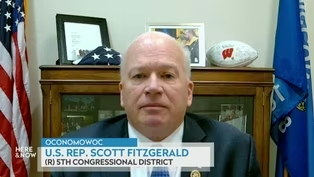
US Rep. Scott Fitzgerald on De-escalation and Funds for ICE
Video has Closed Captions
Clip: S2400 Ep2431 | 9m 42s | Scott Fitzgerald on law enforcement de-escalation and the Department of Homeland Security. (9m 42s)

Wisconsin's Tribal Nations Assert Reciprocity and Resiliency
Video has Closed Captions
Clip: S2400 Ep2431 | 5m 39s | Chairwoman Nicole Boyd delivers the 2026 State of the Tribes Address. (5m 39s)
Providing Support for PBS.org
Learn Moreabout PBS online sponsorship
- News and Public Affairs

Top journalists deliver compelling original analysis of the hour's headlines.

- News and Public Affairs

FRONTLINE is investigative journalism that questions, explains and changes our world.












Support for PBS provided by:
Here and Now is a local public television program presented by PBS Wisconsin