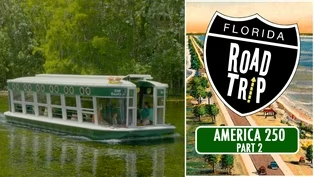
Florida Road Trip
America 250 (Part 2)
Season 2026 Episode 8 | 26m 46sVideo has Closed Captions
Explore how Florida shaped America through agriculture, art, tourism, and space.
Discover how Florida helped shape America through agriculture, transportation, tourism, art and space exploration. From citrus groves and railroads to Silver Springs, Seminole patchwork, the Highwaymen and Kennedy Space Center, explore the innovations, industries and creative traditions that connected Florida to the nation and helped define its place in America's 250-year story.
Problems playing video? | Closed Captioning Feedback
Problems playing video? | Closed Captioning Feedback
Florida Road Trip is a local public television program presented by WUCF
Watch additional episodes of Florida Road Trip at https://video.wucftv.org/show/central-florida-roadtrip/
Florida Road Trip
America 250 (Part 2)
Season 2026 Episode 8 | 26m 46sVideo has Closed Captions
Discover how Florida helped shape America through agriculture, transportation, tourism, art and space exploration. From citrus groves and railroads to Silver Springs, Seminole patchwork, the Highwaymen and Kennedy Space Center, explore the innovations, industries and creative traditions that connected Florida to the nation and helped define its place in America's 250-year story.
Problems playing video? | Closed Captioning Feedback
Where to Watch Florida Road Trip
Florida Road Trip is available to stream on pbs.org and the PBS app.
Providing Support for PBS.org
Learn Moreabout PBS online sponsorship>>This program is brought to you in part by the Paul B. Hunter and Constance D. Hunter Charitable Foundation, a proud partner of WUCF and the Central Florida community.
>>This Florida Road Trip America 250 special is sponsored locall by the Duke Energy Foundation.
Additional funding for America 250 comes from the Ginsburg Family Foundation.
♪♪ >>Hi there, and thanks for joining us for this special America 250 edition of Florida Road Trip.
I'm Scott Fais.
In part one, we explored the history of Florida, from the indigenous communities to early settlements and wars and to Florida's path to statehood.
Now we'll dive into some of the important industries and contributions that Florida made to our nation.
>>Whe people first came from Europe, they did not know how to farm in North America.
The agriculture was primarily to feed themselves, and at some level they depended on indigenous people to keep them alive.
Most of what we eat now actually came from indigenous people in the Americas.
The crops that they gre that were so good for everyone were beans, squash, pumpkins, and they grew them in a way that was different from the way Europeans grew their crops, where European spread the crops out along rows and took up a lot more land to grow food than indigenous people did.
>>At the same time, the Spanish introduce new crops and animals that would shape Florida's oldest and become long lasting agricultural traditions.
>>Importation of citrus came during the Spanish period.
Cattle were first brought by Juan Ponce de Leon in 1513.
>>When the British took control, the direction of the state began to change.
British leaders saw Florida' land as an economic opportunity.
>>The very first commercial grove of citrus was established by a British citizen by the name of Jesse Fish in 1765.
You're going to see cash crops introduced for the first tim things like sugarcane, indigo.
And believe it or not, in limited quantities, sea Island cotton and the cultivation of silk.
>>But the British weren't the ones bringing much of that agriculture know how.
>>The primary producers of rice, the ones who had the knowledge of how rice is produced, were the Africans.
And so the rice producer are enslaved people, and they're the ones who bring the knowledge of how to produce rice.
>>Yet Florida's agriculture boom depended on more than what was growing in the fields.
>>Cotton doesn't become an export crop until after the American Revolution.
That's when cotton becomes really important.
>>Black labor was the foundation because agriculture was the basis of the Florida economy.
The system in which the agricultural was produced was the slave system.
Black women actually bore the brunt of enslavement.
They were caugh between the enslavement system and they were caught between this patriarchal society.
They had to make up the work around the plantation as a whole.
>>Even after slavery ended, agriculture remained central to Florida's economy.
>>The economics of Florida depended upon it.
It depended now more so on Black labor.
And that's why we see the shift to sharecropping.
>>Citrus had been growing in Florida for generations, but after the Civil War, it began to expand rapidly.
>>People become interested in that citrus, and they see a possibility for men to come to Florida and on a few acres of land, be able to produce enough citrus to have a decent living.
>>By the late 1800s, as the industry grew, citrus face one of its biggest challenges.
Cold weather.
>>It didn't just freeze the fruit on the trees, which often happens, but it actually, in essence, froze the tree all the way down to the roots.
So citrus production went from a few million crate a year, down to almost nothing.
>>Many growers never recovered, and the citrus industry began to change.
But even as the industry shifted, citrus remained an important part of Florida's economy and identity.
>>Florida is synonymous with citrus.
People think about citru when they think about Florida.
Florida oranges.
>>If there's one thing that history shows, it's that Florida's agricultural roots run deep.
From the knowledg shared by indigenous communities to the rise of ranching and citrus.
Generations of people helped build an industry that still aids in defining the state today.
It's a legacy that continues to grow right here in Florida.
♪♪ Whether it's by water, rail, road or sky, Florida's history reveals a state on the move, and those modes of transportation did more than just bring people to the Sunshine State.
They carried what was grown and made here to the rest of the country and beyond.
In the 1800s, rivers were some of Florida's most important transportation routes.
>>Steamboat provide the major connectivity to the wider world and all sorts of ways transportation, cargo and tourism, and also people coming here if you want to get here, that's how you get here.
>>But steamboats depended upon rivers and coastlines.
By the late 19th century, a new transportation system would help connect parts of Florida that waterways could not reach: railroads.
>>It's not until the 1890s that the real railroad boo comes about with the two Henrys.
Henry Flagler build the Florida East Coast Railway down the east coast of Florida.
Henry Plant build his plant line across the state and then down the West Coast, opening up Tampa and southwest Florida.
>>Railroads made transportation faster, more reliable, and more accessible.
The network of rail connected growing communities across the state and helped drive a new era of economic growth.
>>So if you're an orange grower or strawberry grower, tomato grower, you're not putting your commodities in a wagon or on a ship.
That could take up the two week to arrive to northern markets.
You're putting it on a train that within 36 hours gets to the market.
And so think about how much fresher those things are.
Reduced spoilage, which means more money in your pocket.
>>Railroads also help determin where Florida's largest cities would grow.
Communities connected to the rail network would often expand rapidly.
>>Miami doesn't exist until, really, it's Fort Dallas.
There's a few settlers down there.
It's not connected anywhere.
The railroad connects it.
>>Transportation coincides with the Florida population boom.
A good example is by the early 1900s, we have the rails that are laid throughout a lot of Florida, and a lot of people are going to then move to Florida because they're connected to Florida through this vast rail system.
>>What' the most important thing, person or thing to happen between 1865 and 1920?
There's lots of answers, but the default answer is Henry Flagler and the railroads.
They change Florida dramatically.
>>As the 20th century began, another revolution in transportation revved up: the automobile.
>>The Dixie highway is not one highway.
It's a series of roads that are connected from the Midwest all the way down to Florida.
Understanding that the future of America is not going to be railroads it's not going to be steamboats.
It's going to be the automobile.
>>Building the Dixie highway required cooperation between communities, states and business leaders who supported better roads for a growing number of automobiles.
The result?
One of the first major highway networks connecting Florida to the rest of the country, making travel and transportation easier than ever before.
♪♪ Millions of people visit Florida for relaxation and adventure.
But tourism started long before a theme parks and beach resorts.
Early visitors came for the sunshine and healing waters before the evolution into the attractions an experiences that we know today.
Laying the foundation for the global destination that is modern Florida.
>>When people heard about Silver Springs, it was because of its natural beauty that was here before anything else.
It was just pure nature and just pure beauty.
The crystal clear waters just brought people from around the world here, just to see how beautiful this truly is.
>>Silver Springs also helped create one of Florida's most iconic early attractions, the Glass Bottom Boat.
>>And actually became a very, very big tourist attraction for people to come and see.
>>Florida' natural attractions offered more than just beautiful scenery.
Many visitors believ the state's warm climate, fresh air and clear waters can improve their health and well-being.
>>Florida springs have alway been known for its rich mineral deposits and springs like Weeki Wachee, Silver Springs and Wakulla Springs were know for the clarity of their water.
Florida was seen as a natural site to open up your lungs, to restore yourself through the clarity of the waters.
>>As automobiles became more common, traveling to Florid became easier than ever before.
>>The automobile really changes tourists relationship to Florida as well, because when new roads get built, they're able to go to different places.
They go to wilderness spots they go to roadside attractions.
So we see all these technologies when it comes to transportation.
They play a really important role in the development of different sectors of Florida's tourist economy.
>>Tin can tourists.
Some of the first auto tourists would begin to set up camping grounds near Silver Springs and Wakulla Springs.
Sulphur Springs.
Florida Springs were far more accessible to working and middle class Americans, compared to the sprawling resort hotels that had begun to appear in West Palm Beac in Sarasota in Saint Augustine.
>>As Florida's tourism grew, visitors began seekin more than just natural beauty.
In 1936, Cypres Gardens opened in Winter Haven, drawing crowds with its botanical gardens, southern bells and world famous water ski shows.
Each transformed tourism from outdoor recreatio into entertainment experiences.
>>People would come not just to camp, not just to hike, not just to swim, but they were also expecting a sho when it came to Cypress Gardens.
It was known as the water skiing capital of the country.
>>A decade later, another unique attraction emerged in Hernando County.
In 1947, Weeki Wachee Springs and an underwater theater where visitors can watch performers become the world famous Weeki Wachee Mermaids.
>>The Weeki Wachee Mermaid became a mainstay of Florida's early tourism industry with the completion of the Interstate Highway System.
Rocket launches becam a attraction in their own right, along with the waters of Cocoa Beach.
Additionally, with the completion of Walt Disney World in 1971, another major tourism attraction had been secured.
>>Florida's growing tourism industr expanded in many different ways.
Challenging landscapes also inspired one of the most unique attractions.
The swamp buggy emerged in the 1920s.
>>And back then the Florida Everglades was water almost year-long.
You know what I'm saying?
And it was really u to your chest most of the time.
So he had to make a vehicle that could navigate the Florida Everglades and be all super dependable.
>>In 1949, the swamp buggy became the center of organized races that drew competitors, spectators, and visitors from across Florida.
>>This is the vehicle that the natives of Naples, Florida, used to transport this quiet tow into a rip roaring celebration.
>>But they don't need turnpikes in Naples.
They have swamp buggies.
>>More than 75 years later, these races remain a popular attraction.
For many here, swamp bugg racing is more than just speed.
It's about keeping a Florida tradition alive.
>>This is really the last bit of culture that we have with all the development.
I mean, people all the time, they say they've never met a native before.
Well just come to the swamp race >>From crystal clear springs to world famous attractions, Florida helped shape how Americans travel and vacation.
What began with sunshine and healing waters grew into one of the world's mos successful tourism industries.
♪♪ Some of Florida's most iconic art didn't stay in Florida.
It traveled beyond state lines, from practical designs to traditional art forms.
These works did more than just capture snapshot of the state's background.
They helped shape American culture itself.
>>The main purpose of the citrus crate art was to sell the brand, and it was so successful because the artwork was just uniquely beautiful, and it depicted an era.
>>To build those brands, artists filled the labels with colorful images that reflected both Florida products and the Sunshine State experience.
>>I've always called them Florida's first billboards because they would depict th women, the beaches, the flora, the fauna of Florida.
>>By promoting Florid citrus, these labels help shape how people across the nation viewed the Sunshine State.
>>Th growers wanted their customers to think of Florida and think of forest Citrus in a way that made them want to come down to Florid and pick that fruit themselves.
And it did a lot for our tourism.
>>As citrus growers used artwor to build a recognizable brand, another Florida industry was doing much of the same thing.
In Tampa cigar factories, colorful labels and decorative boxes help market Florida-made cigar to customers across the nation.
>>The cigar label that would be on the inside lid of the cigar box was really the advertising that was used by cigar manufacturers to sell their product.
You could go to Cleveland, you could go to Boston or wherever, and you'd find Tampa cigars in these places.
And so it really was another way for us to be connecte with the broader outside world.
>>While citrus crate labels and cigar boxes were designed to market Florida products, other art forms served a different purpose.
For generations Seminole patchwork has preserved the culture, identity, and tradition while becoming one of Florida's most recognizable artistic contributions.
>>Seminole patchwork is a traditional Seminole arts and crafts that has been passed dow from generation to generation.
>>Back during the Seminole Wars, they had a way of doing our clothing, which was appliqué, being hand-stitched clothing on top of clothing to make our designs.
>>Years later, a new tool helped transform both the clothing and the art form itself.
>>Early 1900s, the sewing machin came to our camps and the ladies found out that one, it made your clothing very, very light.
And second, it was more durable.
It wouldn't ripp as easy.
>>As the patchwork evolved, so did the designs.
>>The colors and the patterns.
It really is up to each seamstress.
And that's what I love about Seminole clothing.
You will not see duplicate of one item to the next.
It's very unique.
It's very bright and very colorful.
And it also allowed us to create a form of tourism back when we're still isolated.
And it allowed us to bring in income to our families and provide for them.
>>For Seminole people, patchwork is more than just clothing.
It's a way to share identity, history, and tradition.
>>I think that Seminole Patchwork should be included into American history as art, because the stor of the United States isn't just one culture, isn't just one tribe, isn't just one people.
It is a collection.
>>Just as Seminole patchwor preserved cultural traditions, another group of Florida artists worked to preserve something else.
Beginning in the 1950s, a group of black artists in Fort Pierce, later known as the Highwaymen, found a new path through art.
>>Everything was totally segregated so you could not go and put your art someplace they knew they couldn't be in galleries or anything.
It's just wasn't possible.
>>The artist loaded paintings into their cars and traveled across Florida' highways looking for customers.
Along the way, they painted the Florida they saw every day, calming waterways, tropical landscapes, and colorful sunsets, which became their signature style.
>>The colors.
It was the that looks like a highwaymen painting, because the colors just jump out at you.
>>The paintings make you feel as though you are part of it, that you are in there, right, experiencing that scene.
>>Among the most influential artists was Alfred Hare whose energy and determination expanded the movement and inspired other painters.
>>He figured out that he coul sell more if he spent more time painting, and hired somebod to go out and sell it for him.
>>The 26 artists painted and sold thousands of landscapes, including work by Mary Ann Carroll.
The only woman of the group.
But they weren't know as the highwaymen at the time.
That all changed in the 1990s, when art historian Jim Fitch began documenting their work.
>>Fitch gave them the name The Highwaymen because he found ou that's how they sold their art, up and down the highway.
And when he did that and put them in a book.
Then the art really started taking off.
>>Today, their painting serve as a snapshot of Florida and a landscape that has changed dramatically over time.
>>Years into the future, this art will be standing because Florida is changin and so many people coming here and they're building.
So this landscape you're no going to see it's disappearing.
So this will be a lifeline to Florida's art history.
>>From citrus crate labels and cigar boxes to Seminole patchwork an the paintings of the highwaymen.
Florida art has done far more than decorate walls or sell products.
This artistic representation preserved traditions, offered a snapshot of history, and helped shape how Americans saw the Sunshine State.
♪♪ For generations, Americans look to the skies and asked a simple question what's out there?
When the nation set out to find the answers, Florida launched the journey.
From the Space Coast, America began reaching out further than ever before.
And that is where this story begins.
>>There's a lot of things that come together that end up making Florida the nation's number one spaceport.
And part of it is geography.
If you look at a map and you see Cape Canaveral, what you'll see is it looks like the backside of a boomerang.
And that was really helpful for launch officials, because as rockets got bigger and more powerful, they wanted to be able to launch over the Atlantic Ocean.
And this solved a problem when they were doing launches in the American Southwest where you had population centers close by.
So you have the Atlantic Intracoastal Waterway, and you had easy water transportation into the spaceport.
The other thing is that it's very flat in Cape Canaveral, s there's really good sightlines.
So all of these things came together to really make Cape Canaveral the number one place to launch rockets in the United States.
>>The first rocket launched from the Cape in 1950.
Before countdowns became a part of life here, this corner of Florida looked very different.
>>What you had was a smal but also a thriving community.
So when you think about some of those traditional Florid industries commercial fishing, orange groves, agriculture, that's kind of what the Cape was like before space technologies got here.
>>The rockets began transforming the landscape.
And by the 1960s, Florida had a new identity.
Ever since the space program comes to Florida, it slowly starts to define it.
But it's really in the 1960s when things take off.
One thin the public is really interested in is in crewed missions.
So with the first Mercury flights, of course, with Alan Shepard going into space and then later the Apollo program, that's when Florida really starts to become synonymous with space technologies in the minds of Floridians, and also in the minds of Americans throughout the nation.
>>From Mercury and Apollo to the shuttle era and today's missions, that connection has stuck.
Yet launching rockets from Florida also meant dealing with something else.
Salt air, humidity, lightning and wildlife who never got the mem that this was now a spaceport.
>>Becaus we're here in a nature preserve, one thing we have at Kennedy Space Center are hundreds of thousands of birds.
And so there is a concern about birds and space technologies early on.
So there's an attempt to track bird movements, make sure that we preserve bird habitat, but also to make sure that w don't hit birds during launches.
The other thing about east central Florida is there's a lot of lightning here.
As anybody in Florida knows, lightning is going to affect launch operations from the very beginning.
Because of this, NASA has been on the cutting edge of research and development of lightning technologies.
For example, in the 1970s and into the shuttle program, they create the Lightning Detection and Range system, which is an attempt to track lightning.
Figure out where it is and if it's going to b threatening space technologies.
But this is also important civilian technology and meteorologists start to use simila technologies to provide better forecasts to help obviousl protect the people of Florida.
>>Over time, rockets became as much a part of Florida's identit as beaches, citrus and sunshine.
>>I do think that Florida has become really synonymous with space in the minds of a lot of Americans, and if you did launches somewhere else in a different state, I do think people might think of the space program differently.
>>That gives the Space Coast a unique place in America's 250 year story.
Exploration begins with a question what's out there?
>>When yo think about scientific endeavors stretching really all the way back to Lewis and Clark, which one of the first NAS administrators, when he talked about the importance of research and development in NASA, he harkened back to that, this idea that we need to go out, we need to learn new things.
We need to seek out new information.
>>The next chapter of the story continues with Artemis.
The rockets have changed.
The technology has evolved, but the people behind them still share a sense that their work is part of something bigger.
>>You definitely see the passion and mission in today's cultur and with the workforce we have.
When you're a part of a program and you're working with these astronauts.
Hand in hand, working on the vehicle and understanding what you're doing is not just a job.
You are part of the mission.
You are part of the team.
>>And after years of work, sometimes the mission comes down to one moment.
>>When Artemis I launched.
That was an unforgettable moment for me.
Being on the NASA causeway with my family and coworkers who had dedicated years to this program.
It was incredible to see thos engines light for the first time and lift off the pad.
It was a sense of pride and just wonder of where the program was going next.
>>For 250 years, each generation of Americans has built on the discoveries of the one before it, and pushed a little farther.
On the Space Coast, the next chapter is already being written.
>>I think as we see new technologies that may lead to new things like lunar bases and further exploration of the cosmos, you're still going to see the Kennedy Space Center be a center of launch operations, and Greater Cape Canaveral is going to play a central leading role in the development of the space technologies.
>>For 250 years and beyond, Florida' impact on America is profound.
Etched into its land found on the faces of its people and recognized in the progress here at home and beyond.
This journey reminds u that history continues to shape our story, and Florida keeps writing it every day.
Thanks for joining us for this special America 250 edition of Florida Road Trip.
I'm Scott Fais.
I look forward to seeing you down the road on our next episode.
Until then, safe travels everyone!
♪♪ >>This program is brought to you in part by the Paul B. Hunter and Constance D. Hunter Charitable Foundation, a proud partner of WUCF and the Central Florida community.
>>This Florida Road Trip America 250 special is sponsored locall by the Duke Energy Foundation.
Additional funding for America 250 comes from the Ginsburg Family Foundation.
 New
America 250 (Part 2) | Preview
Preview: S2026 Ep8 | 30s | Watch a preview of Part 2 of Florida Road Trip's America 250 Special. (30s)
Providing Support for PBS.org
Learn Moreabout PBS online sponsorship













Support for PBS provided by:
Florida Road Trip is a local public television program presented by WUCF
Watch additional episodes of Florida Road Trip at https://video.wucftv.org/show/central-florida-roadtrip/