Florida Road Trip
America 250 (Part 1)
Season 2026 Episode 7 | 26m 46sVideo has Closed Captions
Explore Florida's role in America's founding, from colonial rule to statehood.
Travel through Florida's early history as part of America's 250th story. Explore Spanish and British Florida, the importance of Fort Mose, Revolutionary War battles in East and West Florida, loyalist communities, and the struggle for freedom. Discover how conflict, migration, Indigenous resistance, and statehood shaped Florida's place in the nation's founding.
Problems playing video? | Closed Captioning Feedback
Problems playing video? | Closed Captioning Feedback
Florida Road Trip is a local public television program presented by WUCF
Watch additional episodes of Florida Road Trip at https://video.wucftv.org/show/central-florida-roadtrip/
Florida Road Trip
America 250 (Part 1)
Season 2026 Episode 7 | 26m 46sVideo has Closed Captions
Travel through Florida's early history as part of America's 250th story. Explore Spanish and British Florida, the importance of Fort Mose, Revolutionary War battles in East and West Florida, loyalist communities, and the struggle for freedom. Discover how conflict, migration, Indigenous resistance, and statehood shaped Florida's place in the nation's founding.
Problems playing video? | Closed Captioning Feedback
Where to Watch Florida Road Trip
Florida Road Trip is available to stream on pbs.org and the PBS app.
Providing Support for PBS.org
Learn Moreabout PBS online sponsorship>>This program is brought to you in part by the Paul B. Hunter and Constance D. Hunter Charitable Foundation, a proud partner of WUCF and the Central Florida community.
>>This Florida Road Trip America 250 special is locally sponsored in part b the Ginsburg Family Foundation.
♪♪ >>Hi there, and welcome to the special America 250 edition of Florida Road Trip.
I'm Scott Fais.
This is part one of a two part journey exploring how Florida fits into America's 250-year story.
When we talk about the American Revolution, we usually start with the 13 colonies.
But Florida's story starts much earlier.
Long before the American Revolution, Florida was home to indigenous communities.
When the Spanish arrived in the 1500s, they entered a place where those communities had lived for generations.
>>There are many tribes that were here.
Many different people that were here in the Floridas.
And they have very, very complex lives, but they all connected to the land because we are part of the land.
We aren't we aren't on the land.
We don't own the land.
So they were part of Florida.
So Florida was Paradise.
>>Yo had the Spanish coming in 1559.
Although we were the first attempted settlement.
Spanish came here with Tristan de Luna.
>>Tristan de Luna's mission was to set up starting at Pensacola Bay because they knew it was a good bay.
They brought a year's worth of food.
They brought 1,500 peopl with them, and five weeks later, a hurricane came and destroyed their ships, destroyed it, turned it into a rescue mission.
And Tristan de Luna was a total failure.
After that, Pensacola was kind of forgotten about.
>>It's not until the French begin setting up shop in Fort Caroline in 1564 that the Spanish take a much more serious interest in Florida.
Saint Augustine is founded b Pedro Menendez de Aviles in 1565 as a counter to French expansion in North Florida.
>>The primary importance Florida has in this period why these empire are even interested in Florida in the first place all has to do with geography and the technology of the time, the sailing ships.
And that's really what Saint Augustine is founded by the Spanish for.
The support keeping the shipping lane open.
>>An so the people that were coming to what would become Florida were people that were coming here eithe for strategic military purposes or because they were looking to make a quick buck.
>>Spain established the first lasting European presence here and remained in control for centuries.
>>What they come to find out is keeping Florida as a part of their colonial empire, which at that point spanned all across the northern and souther hemispheres, was very expensive.
The one thing Florida ha a lot of is land and mosquitoes and swamp, but it does not have precious materials like gold, silver and gemstones.
Florida just was bleeding them dry.
The only again, reason why the Spanish had enough people here is they said we just want to keep the British and everyone out.
>>But not everyone experienced life in Spanish Florida in the same way.
>>Fort Mose was a community created for blacks who absconde from English plantation society, who agreed to live under Spanish authority.
And so Fort Mose became the first line of defens for the city of Saint Augustine.
At Fort Mose, the primary people there were Gullah, and they spoke their ow language, which we call Geechee.
It's a mixture of West African languages, and it includes English plantation dialect.
And so there were certain rules that had to be applied to them.
Resident had to convert to Catholicism, and then all of the men had to join the military.
This was an important piece of not only Florida history, but American history.
This was the first free black settlement.
>>Before Florida became part of the United States, the territory was already part of a larger Atlantic story shaped by Spanish power, military strategy, land and people all searchin for a different kind of future.
♪♪ Spain controlled Florida for centuries.
But that change after a global war in the 1700s, and when the British took control, Florida's role in the Atlantic world changed too.
In 1763, after the Seven Years War, Spain lost its dominance as Britain took control of Florida.
>>And at the peace negotiations in 1763, the British, who had won that war, they had defeated the French.
They had defeated the Spanish.
They said, what do we want from the people that we've just beaten?
And they believed that kicking the Spanish out of Florida would ensure the protectio of colonies they had established in Virginia, North and South Carolina and Georgia, which were very, very profitable for the British in the colonial period because they were growing cash crop like rice, indigo and tobacco.
>>British leaders focused on using the land to build an economy.
>>Most people, when the British took over, they had to agree to swear not only loyalty to the British king, but they also had to pledge that they were going to be of Protestant faith.
And so many of the people who had been of the Catholic religion prior to 1763 chos to leave for other destinations.
What ends up happening i you see Great Britain inheriting what was almost empty lands.
They tried to entice settlers with land allotments because that was something.
Land back in the day meant wealth, power and prestige.
>>At the time, the territory was divided into East Florida and West Florida, where each region had its own identity.
>>East Florida is most of today's state, and it had its capital at Saint Augustine.
And then West Florida ran from the Appalachicola River, which is the dividing line between the two colonies.
West Florida ran from the Appalachicola Rive west to the Mississippi River, which means that West Florid included not only the panhandle of today's state of Florida, but also portions of Alabama, Mississippi and some of Louisiana as well.
>>West Florida had a different experience than East Florida, because West Florida had a tremendous advantage in the fact that it ha two incredible bodies of water.
It had the Mississippi River and the Gulf.
>>When the American Revolution began, Florida didn't join the fight for independence.
>>East and West Florida were also very fierce havens for loyalists to remain very close to the Crown and very firmly committed.
So much so that on August 11th, 1776, that's when news of the signing of the Declaration of Independenc finally reached Saint Augustine, and images of both Samuel Adams and John Hancock were burned symbolically by a crowd of protesters.
And this is, I think, a very interesting counter to what we would think of where we at the same time, or seeing a statue of King George being torn down in Manhattan.
And this is what made Florida a bit of an outlier.
>>Yet there was another critical issue at hand.
Where could enslave black people find freedom?
Florida Maroons are the predecessors to the Black Seminoles.
In Florida you still had that division between those that were in these maroon villages, eking out their own existence and those that were enslaved.
You had those blacks who decided to join with the British with the promise of freedom, and then those who joined with the Patriots with the promise of freedom.
>>While Florida did not join the fight for independence, the revolution still reached this place in powerful ways.
The war shaped who came here, who found refuge here, and who saw the battle as a chance to claim freedom.
♪♪ >>Florida stayed loyal to the Britis during the American Revolution, but the war still reached this place.
Here the fighting followed Florida's geography along borders through ports, across waterways, and into the stronghold that made East and West Florida strategically important.
>>Florida does get a very understated position within the scholarship on the American Revolutionary War.
Even if major battles did not necessarily take place in Florida, it was a very important logistical objective.
George Washington orders nearly five different invasions over the course of his time as commander in chief of the Continental Army.
These two very fiercely loyal British colonies were one of the most important thorns in the side to many of the ambitions of the Continental Army.
>>In East Florida, fighting along the Georgia border, including the Battle of Thomas Creek, showed how difficult it was for Patriot forces to gain ground.
>>The Battle of Thomas Creek.
It takes place in northeastern Florida.
This is the battle that took place in 1777, where the American force is waiting for the rendezvous to coming by sea that never comes.
Whil the Native Americans have gone and told the British the enemy are up here, and then they go back altogether and they attack on one side and drive the Americans to a blocking force that has bayonets.
So the failure in their objective to attack East Florida.
Another battle that's fought in East Florida is the Battle of Alligator Creek Bridg that says Florida all over it.
>>American troop move south from Georgia, hoping to agitate British positions in East Florida.
Along the way, they encountered the East Florida Rangers, a loyalist militia force.
After fierce fighting, the Americans briefly gained the upper hand pushing the Rangers back towards the main British position at Alligator Creek Bridge.
>>Nobody has any uniforms on, neither the Rangers nor the Americans.
All these guys who look the same are rushing towards you.
They opened fire on everybody and began hitting some Americans, but also some of their own forces.
So it's just a scene of chaos there.
>>Once the Rangers regrouped, they outflanked the Americans and turned the tide of the battle.
>>And that's that's just deadly.
And they're not able to make it.
So the British are able to defeat the Americans at the bridge.
And after that, the Americans decide this is not worth it anymore.
General Benjamin Lincoln, who has command of the Southern Theater, he writes a letter to General Washington saying that it would be embarrassing to continue any further assaults on East Florida.
>>Life across Florida was changing.
And who called this place home?
East Florida became a refuge for loyalists and families escaping conflict in the colonies to the north.
>>You see refugees moving left and right.
Families, civilians end up flooding into East Florida because it's seen as a loyalist refuge.
It's seen as safe.
But we think that the population that had stayed around 3,000 going back to 1763 swells to as many as 20,000 by 1780.
>>In West Florida, the siege of Pensacola became a turning point.
So the campaigns in West Florida are really led by the Spanish.
And the man at the top of those campaigns is the governor of Spanish Louisiana, working out of New Orleans, Bernardo de Galvez, and Galvez is the one who puts together the forces.
>>Galvez started chipping away at British control of West Florida, first capturing Baton Rouge and then Mobile.
With both of these victories secured, the biggest prize remained: Pensacola.
The capital of West Florida.
>>Pensacola itself is well protected.
There's a fort called Fort George that defends the city.
And then there are two what are called redoubts.
A redoubt is kind of like a mini fort.
Galvez and the Spanish forces, they arrive off the coast of Pensacola.
And there's an argument that develops between Galve and the Spanish naval commander.
The navy commander says, no, I'm not taking my ships in there.
Look how well it's defended.
Galvez probably calls him a coward or something.
And then he says, fine, I'll show the way in.
>>Galvez decided to lead the way himself, proving the harbor wasn't as dangerous as many feared.
Spanish soldiers then came ashore surrounding the city, where they began laying siege to British forces.
>>Well, one morning there is a enormous explosion at the fort.
Well, what's happened is that just by luck, one of the cannonballs fired by the Spanish has gotten into the powder magazine at the Queen's Redoubt.
And then the Spanish forces They know what that is.
Right.
Something big has happened.
And then Galvez says we go now.
And they stormed the fort.
Fortunately, the British commander has a sense of humanity.
He realizes that the Spanish victory is inevitable.
So in order to avoid getting lots of guys killed, he sends out one of his soldiers with the white flag and negotiates a surrender.
The British surrender of Pensacola was an important moment in the southern theater of the war, because by achieving that victory, the Spanish have now conquered West Florida.
The surrender of Pensacola in May of 1781, with what ends up being the las major battle in North America, the British surrender at Yorktown in October 1781.
So two British surrenders within the same year.
Suddenl you have two pieces of evidence that the war is not going the British way.
>>And Florida's role wasn't limited to land.
>>Florida has the honor of being the closest land to the last naval battle of the American Revolution, a contes that was fought in March of 1783 with the American vessel Alliance and a French vessel as companion.
And they are attacked by th Royal Naval vessel, the Sybil.
Now the Americans are headed from Havana, Cuba, back to Philadelphia, bringing a cargo of Spanish silver.
Now that Spanish silver is absolutely essential for the purpose of paying the American troops as the war is ending.
Engagement happens off the coast of Florida, and the American are able to defeat the British, and they're able to bring that payment to Philadelphia, allowing them to be mustered out of service with some hard money in their pockets, decreasing their likelihood of mutiny.
>>While the war shaped Florida's future, much of daily life and the work of keeping families going was carried by women.
>>What we have are women who were, for the most part, their names and storie have been lost to the narrative.
But we do know what they were doing.
They were living her and supporting their families.
They were acting as mothers and wives, helping to support their husbands as they went through this very very harsh wartime experience.
And that's not to say that yo didn't have women taking risks.
Some of them were actually even owning their own farms and working as economic contributors to trying to to keep their families and their colony afloat.
>>For black women, those responsibilities came with even greater challenges.
>>They may not have been expected to actually fight, but all of the preparation for war would b put on their shoulders as well.
And then when we're talking about the loss of manpower on plantations they're sending the enslaved men to fight for the cause.
It is the women who have to make up the slack in work, in manpower, in the fields.
>>In 1783, the American Revolution came to an end, and as part of the peace agreement, Britain returned Florida to Spain, forcing many people to decide whether to stay or to leave.
>>The Treaty of Paris is signed.
And the United States is formally recognized by the British Empire and independence is achieved.
This is where once again, Florida became a bargaining chip.
So just as when the British agreed to evacuate Havana and received Florida as a consolation prize, the British will continue to hold on to Gibraltar and they will, as a consolation prize, give control of Florida back to Spain.
>>So the Spanish have reacquired the Floridas.
That's a disaster for the British colonists who are living in the Floridas because they had grown accustomed to British rule.
And the Spanish.
That's their land now.
>>But this question that all of them faced, and they had a very short amount of time to deal with it, is what do we do?
What do we do with our family What do we do with our property?
And I thin the one thing that everyone sees is that these people, whether they stayed or whether they went, they knew they were going to be facing the challenge and they faced it bravely.
And I think that legacy of having courage in the face of uncertainty and fear that they must have been embracing, whether they were men, women or children, it was facing that that fear of the unknown and going out very bravely to tr and make their way in the world.
And I think that that' something that they passed down, whether in physical part or in spirit, to the people who live in Florida today.
>>Florida stood outside the revolution's most familiar story, but Florid never stood outside the fight.
Armies pushed across its borders.
Refugees poured into its towns, and ships battled off its coast.
By war's end.
Florida helped change the balanc ♪♪ After the American Revolution, the future of Florida was uncertain.
Competing interests, shiftin borders, and a growing migration were reshaping life across the region.
>>The early 1800s was definitely a place in transition.
The Spanish didn't really have a good hold of Florida other than Saint Augustine and Pensacola.
There really wasn't a whole lot of settlements.
And so the border was something that was very loosely patrolled and controlled.
And then there were the indigenous people, the Seminoles, who, you know, didn't no used to these kind of borders.
So you have beginnings of this conflict between Americans and Seminoles.
>>As the conflict grew, the United States became increasingly involved in Florida, which was still under Spanish control.
>>And then we also have Andrew Jackson, part of the War of 1812, also an effor to retaliate against Seminoles and also maybe try and retrieve formerly enslaved people, actually comes in to Pensacola and captures Pensacola, a Spanish city in the 18-teens, I think just after the War of 1812.
So Jackson's actions, though maybe perhaps never punished for them, led to Spain to negotiate with the United States, which led to the Adams-Onis Treaty, which in 1821 made Florida become a U.S.
territory.
>>For Seminole communities, American control brought growing pressure to leave their homeland.
>>President Andrew Jackson created an ac called the Indian Removal Act.
It forced the indigenous people to either be removed from their homeland that had caused the Trail of Tears.
And when it came to our people in Florida, we actually started out towards northern Florida.
We were pushed dow and we were fighting skirmishes with the United States government and with the army.
But you are either removed and you were you made the choice to leave to Oklahoma.
And that is where there is a tribe there called the Seminole Nation of Oklahoma.
>>The struggle that followed would last decades.
>>In history, we call it the three Seminole Wars.
That's what it's called in the books the three Seminole Wars.
To the Seminole people, it's not three Seminole Wars.
It was one continuous war with different breaks depending on the generals on the United States side.
We never lost our leadership.
We never lost our way.
We were continuous at war with the United States because that's how they were treating us.
>>Many Seminoles pushed west, but others stayed and continued the fight.
>>I am a descendant of the ones that stayed and fought, and we survived the the wars.
It was it was genocide among the indigenous people.
The Seminole people are worried society.
And we we fought and we used guerilla warfare to survive and use the land, the fight and to survive.
>>We considered the Seminole Wars genocide and what happened during those years.
We never, ever want that ever happening in in the United States or throughout the world.
It's very, very importan to understand that what happened to us was wrong, that the Seminole people survived.
We are not part of Florida history.
We are Florida.
It's very important people for people to really understand that, that we are Florida.
We're not part of the history.
We are part of Florida.
>>In 1842, after what's historically considered the Second Seminole War and the longest, bloodiest and most costly conflict between indigenous people and the United States came to an end.
The federal government encouraged new settlements throughout the territory.
>>Most of the Seminoles in Florida were removed to the Indian Territory out west, although there were several hundred Seminoles, and Miccosukee of course remained in Florida, particularly in the the Everglades.
That same year, 1842, the U.S.
Congress passed something called the Armed Occupation Act, and that basically said, if you move to Florida, both men and women, white men and women were eligible for this.
If the woman was the head of household, would be given a grant of land up to 160 acres of land.
And if they stayed there and defended that land for five years, they would get to keep it for free.
So as a great inducement for settlement, white settlement to come into Florida.
>>The influx of new residents quickly changed Florida's future.
>>We finally hit that threshold of population to apply for and receive statehood, which officially happened in 1845.
When we were admitted as a state, we were among the smalle states.
And no surprise there.
But it did set us on the course of really, you know, kind of the American history side of our history.
>>Florida' path from Spanish colony to U.S.
territory and finally, statehood reflected broader changes happening across the nation.
>>Now I think people look at Florida as kind of a microcosm of the country, but you could do it back then as well.
And so it's not so much the attainment of statehood.
That was a significant national event.
It was really Florida as a whole during that time period where it transitioned from a territory to a state that you can really see the trends here playing out on the national stage later.
>>Florida' journey to statehood was shaped by conflict, migration and change.
The story of statehood is the story of people and events that helped shape Florida's path along the way.
Long before settlers arrived, indigenous communities thrived across Florida.
Over the centuries, the peninsula changed hands between competing powers, borders shifted, and wars reshaped the landscape.
Throughout each chapter, the people who lived here adapted, persevered, and helped shape Florida's story.
Thanks for joining us for this special America 250 edition of Florida Road Trip.
If you want to learn more on the role that Florida played in America's history, make sure to check out America 250, Part Two.
I'm Scott Fais.. I look forward to seeing you down the road on the next episode.
Until then, safe travels everyone.
♪♪ >>This program is brought to you in part by the Paul B. Hunter and Constance D. Hunter Charitable Foundation, a proud partner of WUCF and the Central Florida community.
>>This Florida Road Trip America 250 special is locally sponsored in part by the Ginsburg Family Foundation.
♪♪
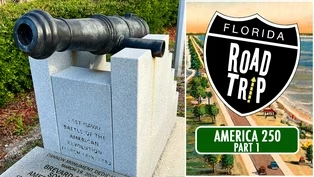 New
America 250 (Part 1) | Preview
Preview: S2026 Ep7 | 30s | Watch a preview of the first part of the Florida Road Trip America 250 Special. (30s)
Providing Support for PBS.org
Learn Moreabout PBS online sponsorship









Support for PBS provided by:
Florida Road Trip is a local public television program presented by WUCF
Watch additional episodes of Florida Road Trip at https://video.wucftv.org/show/central-florida-roadtrip/